Introduction to Fencing 117

Introduction
How to score a touch in fencing? There are several ways a touch can be scored. I am going to break down the steps in one simple example.
- June 2018
The Anatomy of a Touch
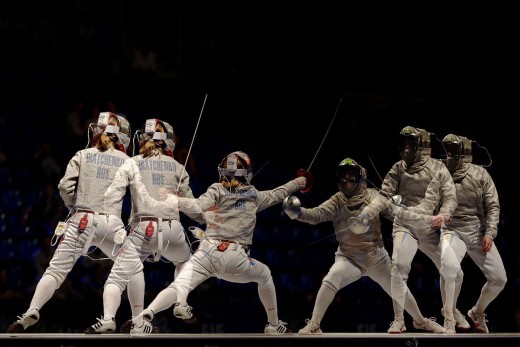
Fencing as in many sports is a series of movements. These movements can be analyzed in a time frame almost like slow motion videography.
Starting with the en garde position as T1, the fencer advances one step T2, he then decide to attack with a simple disengage and a lunge. The T3 is called the preparation step. Then, he extends his blade in a threatening manner T4. The opponent will react by a parry T5, and at the same time the attacker will perform a disengage. He then completes the attack with a lunge and score the touch T6.
This is a typical fencing action. Notice that not all T steps are equal in duration.
From T1 to T2, is a normal step, say .5 seconds.
From T2 to T3 may be only .25 seconds. (Should be as small as possible)
From T3 to T4 should be also a small duration .25 sec. (fraction of a second but convincing)
From T4 to T5 should be approx. .5 seconds to parry and disengage.
From T5 to T6 should be approx. .5 seconds to lunge.
So, a total of approx. 2 seconds to complete the 5 steps from start to finish.
Some Details...
Fencing combines the mind and the body so that they move together in sync. While the mind is plotting and strategizing the next move, the body is in motion. Timing is important to all the moves. Coordination the hand the feet and the body into one graceful motion is not easy. Practicing some common steps in a repetitive manner is desirable. In a typical fencing lesson, the coach provides the practice and the timing so that the student can get a feel of what the particular move is all about. He is made to repeat the same moves several times in order to perfect it and also to imprint it to the student’s memory. The hope is during a real bout, a move would be called for that is very similar to the lesson and the student would be able to recall that move in an instant and execute it to win the point.
Other Considerations...
The other important factor is distance. When a fencer stands across from an opponent, he has to determine what is the “proper distance” to maintain at all times. To reach that conclusion, he uses his many senses to judge. He sees how tall that person is and his reach. He sees how fast he moves. He feels how strong his blade. He senses how agressive is his posture. He then make an initial determination as to the proper stance. He will try and maintain that stance and separation during the bout as they move back and forth on the strip. Occasionally, he will withdraw and provide a safe distance to reassess and possibly to take a breather. Other times, as in during an attack, he will try and close that distance quickly so that he will have a better shot at hitting his opponent. This sense of proper distance canot be taught. It has to be learned on the strip in real situations and against real opponents. It also changes from person to person. That is what makes fencing unique compared to some other sports.
One More point...
In the discussion of the touch, I did not say how one should perform the disengage. There are two choices, clockwise or counterclockwise disengage. Here is a trick that will benefit beginner fencers.
One of the reason I advise people to watch your opponent fence is the knowledge that can be gleamed. In most cases, a fencer will have a preferred move to parry. It could be a parry six or a parry four. Once you determine the preferred defense of your opponent, you can anticipate his reaction and perform the proper disengage. Without any knowledge, your chance is 50/50 in guessing which parry your opponent will use. With this foreknowledge, you may increase your odds to 80/20.
Just to be clear, if your opponent uses a parry six, you should use a counter clockwise disengage and if he uses a parry four, the disengage should be clockwise to avoid his blade.
Summary
The anatomy of a touch is important in analyzing the science behind the sport. Why is it some actions are successful and some are failures?
Knowing when to act is also a gift. This timing is a sixth sense. It is always behind every move and constantly recalibrated until the proper window is opened and an attack is initiated. In some cases, against a beginner, this is an easy determination. As the competition gets harder, the window is smaller and the success or failure of an attack is based on how accurate your distance/timing is.
© 2018 Jack Lee