3 Supposedly Revolutionary Technologies That Actually Make No Sense


Its always pretty cool when you open an article on your favorite tech news journal thing and suddenly you're faced with this new amazing technology that will forever change the way humanity does or deals with something.
Almost always, these news follow a pattern. Big words taken out of technical jargon, amazing new materials or energies with properties never seen or explored before, pictures of men and women smiling, and of course, a conceptual picture or diagram of the device that is responsible for this new breakthrough.
Thing is, you should always keep a critical view when reading ANY sort of news, specially the kind that makes "revolutionary" claims. Here's three examples as to why you should always keep your eyes as open as your mind when reading any article, specially those concerning science and technology in general.
1 Solar Roadways
Concept
Yep, you've probably read something about or watched a weird promotional eske youtube video on how solar roadways are going to save the world lately by providing enormous amounts of solar power and helping the environment and whatnot.
So, the idea is that by replacing pretty much every bit of outdoors currently covered with asphalt and concrete flooring with solar panels.
The craze started with a now infamous indiegogo campaign which has now netted more then 2 million dollars in funding. A promotional video promised that doing such a thing isn't only possible, but somehow a greater alternative then current roof mounted solar panel arrays. The main idea behind that reasoning is that our current plebeian asphalt roadways not only take up a lot of outdoors space, and could thus be of great use in producing solar power.
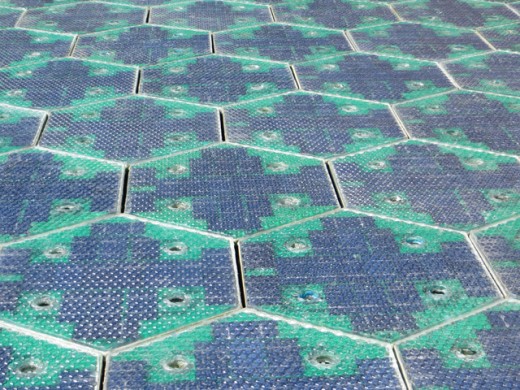
The surface of the roadways would be repaved with tons of hexagonal shaped solar panels with led signage, linked together by wiring and monitoring devices allowing the power absorbed from sunlight to be properly distributed through the electric grid. Since the solar array actually needs direct sunlight to generate power, the entire thing would be covered in sheets of 1/2'' thick tempered glass sheets resistant to pressure and impact.
Sounds great so far, right..?
Why It's a Terrible Idea
Welp, as anyone with a meager understanding engineering, electronics and even basic physics has probably already figured out by the time they get to read this part, the whole idea seems like the worst and most costly way possible to use solar panels.
First, here's a thing about solar panels, they are rather costly. At a local hardware store, your consumer level small (around 30 inches) solar 50 watt panel likely costs around 40 USD. At a cost per watt rate, your run of the mill 200 watt solar panel costs around 150 USD minimum. Then you remember these aren't your normal run of the mill solar panels, but specially build exagonal solar panels with led signage.
You have to also consider that, in order to properly install and anchor anything on roadways (so the force of the wells doesn't make the stuff under it get swept away and launched in the air) like, say, solar panels, you'd need a rather large number of screws, about 150.000 for every mile of your average north american 30 foot wide roadway.
You have to also consider the cost of the wiring and other systems that would also have to be installed to properly monitor the energy levels and distribute the generated power.
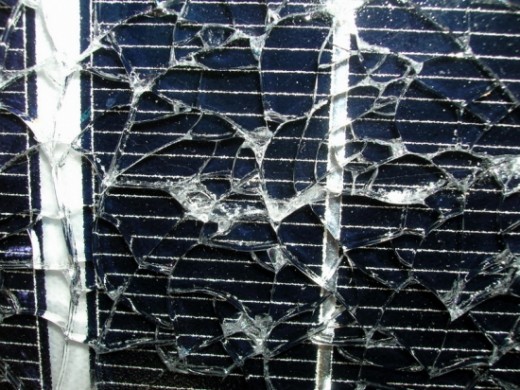
All of this covered by a protective layer consisting of 1/2 inch thick glass sheets which would have to not only resist the constant pressure of car and truck wells, which can put up a pressure of around 100 PSI per wheel (depending on the size and weight of the vehicle), but also has to somehow resist scratching brought by direct contact with hard tire rubber, gravel, weather, etc.
Now, I can't give you the exact numbers on any of this, but it doesn't take a Nikola Tesla to be able to realize this is a terribly expensive way of using solar panels. Not only that, its also hilariously inefficient. You see, in order for solar panels to work at full potential, they need to be pointed directly at the sun, and the sun, as you already know, moves around all day. Ideally, you want your solar panels to be angle in such a way as to catch most sunlight during a good part of the day, like its done with, say, those boring roof mounted solar panels.
So if your solar panel is pointing directly up at all times, it will only be close to 100% efficiency around midday, when the sun is right in the middle of the sky, and that is without accounting for the weather. During every other time, the efficiency will drop significantly.
So yea, sorry, but you won't be walking over solar panels anytime soon, unless of course you feel like throwing money away to break solar panels in a very specifically odd way.
2 Triton Artificial Gills
Concept
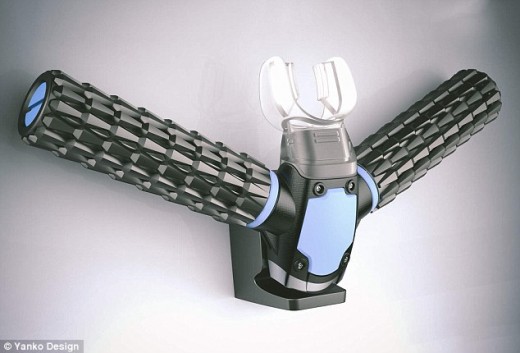
Not too long ago, a South Korea based company called Triton claimed to have come up with a rebreather system that isn't only incredibly light and portable, but allows one to swim underwater by simply (somehow) filtering the molecules of the water, only allowing oxygen to get through, which would provide the user with a supply that would allow him or her to remain underwater for about 45 minutes.
The system has no heavy or clunky tanks or parts to deal with, just a mouth piece that does all the work, which you breathe through.
Sounds amazing, right? I mean, how many of us have wanted to swim underwater without a care, with no worry for heavy water tanks that limit your mobility and other such equipment. It doesn't sound that outlandish at first glance, since rebreathers are a thing that already exist. They're currently used by the military in underwater operations that require a stealthy approach (normal air supply type systems produce bubbles, which isn't very convenient if you're trying to be stealthy underwater), but they consist of a rather cumbersome vest with special chambers filled with chemicals that react with the carbon dioxide exhaled by the diver and then transform part of it back into breathable oxygen, and are rather dangerous if water seeps into the system.

Unsurprisingly, the indiegogo campaign got around 100,000$ right on the first day, After the campaign was over, it had acquired nearly 900,000$ in funding. But even before that, a lot of people were already poking holes at the whole Triton craze and how utterly impractical all of it actualy is.
Why it Doesn't Actualy Work
While something like an artificial gill is possible in theory, there's no way a system as small as Triton's would be able to pull it off.
First, in order to actually provide the diver with enough air supply for him/her to not, say, suffocate, not only the device have to be incredibly efficient at extracting oxygen from water, it also has to be able to process around 5 liters of water every 15 seconds in order to extract that much oxygen, which would at least require a pump of some sort, since human lungs alone are not capable of generating enough pressure to move that much water at such rate, and said pump would be significantly bigger then the entire Triton setup.
Also, you'd need a way to actually store said oxygen, and this would require an air compression system. While Triton claims to have an integrated "micro compressor" in its device, such device would have to be much, much more powerful then any air compressor available in the market today.
Among the many other technical issues with the concept, it didn't help that Triton never actualy provided any sort of real info on the intricacies of how the device works, claiming that this is to "protect their patents". Now, this is all fine and dandy, but Triton didn't even provide a single video that showed their device working for longer then a single minute.
So, without any proof of it all not being a scam, people were justifiably inquisitive of just what was up with Triton. So after a round of questioning, Triton decided to refund all proceedings from the original campaign.
Triton now claims that they weren't very clear on how their device works in their earlier campaign, now saying that the device doesn't actually filter water, but instead uses "liquid oxygen cartridges" that allow the user to remain underwater for a good while, and that they'll also be selling said cartridges along with the triton system. They have since launched a new campaign.
Their new claims aren't nearly as outlandish as the previous, but hey, are you going to trust them with your money after such debacle? Well, I can't judge you, lots of people are still donating money to them anyway.
3 The Thorium Car
If you happen to own a car, then you've probably suffered the swings of fuel prices changing around. Not only that, but refueling is always a kind of "eh" experience. It always feels like you're paying more then you should, and that you're refueling more then you should have to. I don't think anyone actually enjoys spending money on fuel, but hey, if that's your thing, I can't blame you.
However, most people (like me) would love to live to see the day in which spending money almost on a weekly basis to refuel your car becomes a thing of the past.
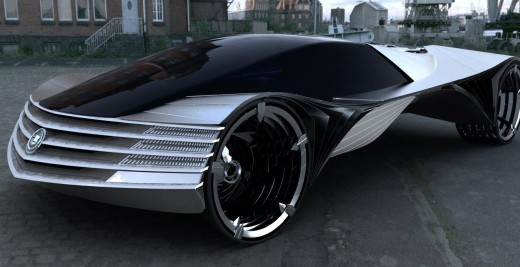
So one day you're browsing the internet or watching TV and you see some news about a research that has come up with a car that can run for over A HUNDRED YEARS without having to be refueled! Amazing right? Sounds like science fiction.
Well, I got news for you, it IS science fiction.
Concept
The basic idea is to somehow use a bit of the element Thorium, a radioactive metal that happens to be the only other know radioactive element that occurs naturally in large quantities, the other being uranium.
By using thorium as an energy source, the proponents of the thorium car claim its possible to use it to produce a laser beam that can then heat water, which then generates energy and causes the car to move.
And... That's it really. No significant explanation for it is given for how this is somehow possible. Its all lasers heating water and the car moving forward and you somehow not having to refuel until a 100 years pass.
Why This Makes No Sense Whatsoever
Well, you see, pointing out everything ridiculous with these claims requires proper knowledge of how nuclear power works, so watch the video for a detailed answer.
Now, if you just want the bullet points, here they are
1-The amount of power it would take to generate a continuous laser need for such a system to work is ludicrously large and, while not impossible to achieve, would be completely unfeasible and extremely expensive to mount on a vehicle of the size of a car. Even if such a laser worked, it would be powerful enough to shoot down airplanes and cruise missiles, IE something that you wouldn't want every car to have;
2-Thorium reactors, like any reactor, can't put out lots of instantaneous power on command. It needs to heat up and get going first. The time between you putting your foot on the accelerator and the car actually moving would be weeks or months long. This essentially means you'd have to have the engine running at all times, dumping all the excess energy into the atmosphere. This mean your car would be pumping radioactive energy all around it at all times, which is a hilariously bad thing;
3-The whole thing (if it worked) just screams of public safety hazard. Not only would it pump radioactivity everywhere it went and carry around a laser that can put most naval military weapons to shame, it would also be an amazing opportunity to any insurgent minded person to use it to make something like a dirty bomb.
There are many other reasons as to all of this is like a really terrible episode of Twilight Zone crossed with Star Trek, but that's too much crazy for one article already!