- HubPages»
- Travel and Places»
- Visiting North America»
- United States
Arizona's Picturesque Antelope Canyon

Located Near the Grand Canyon
Among the many natural attractions that stand out for their raw natural beauty in Arizona is a small canyon in remote northern Arizona known world-wide for its spectacular pictures.
Located about 5 miles east of Page, Arizona and only a tiny fraction in size compared to the nearby Grand Canyon, tiny Antelope Canyon offers visitors stunning rock formations that are both unique and colorful.
If you are planning a road trip to the Grand Canyon National Park or Zion National Park in neighboring Utah, you might want to include Antelope Canyon in your planning. Antelope Canyon is about a two and a half hour drive (134 miles) from the South Rim of the Grand Canyon.
Lower Antelope Canyon
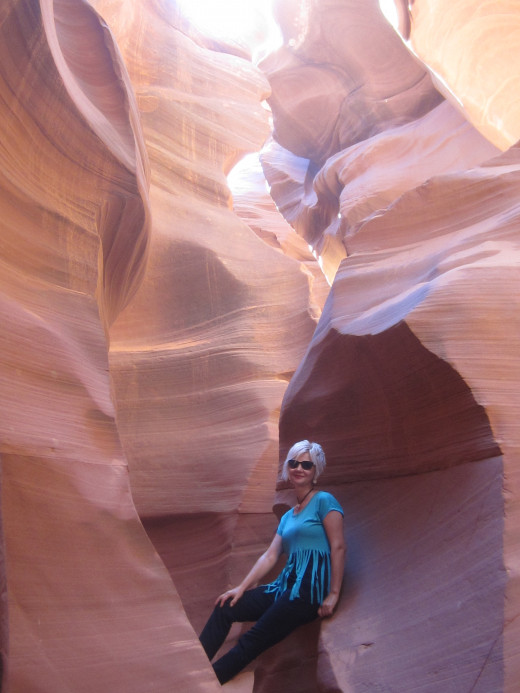
The trip from the South Rim of the Grand Canyon to Antelope Canyon will take you through the famous Painted Desert where you will encounter additional spectacular scenery.
From the less commonly visited North Rim of the Grand Canyon the drive is about three hours (158 miles). And, if you are visiting Zion National Park in southern Utah, the trip is a mere 2 hour drive (108 miles).
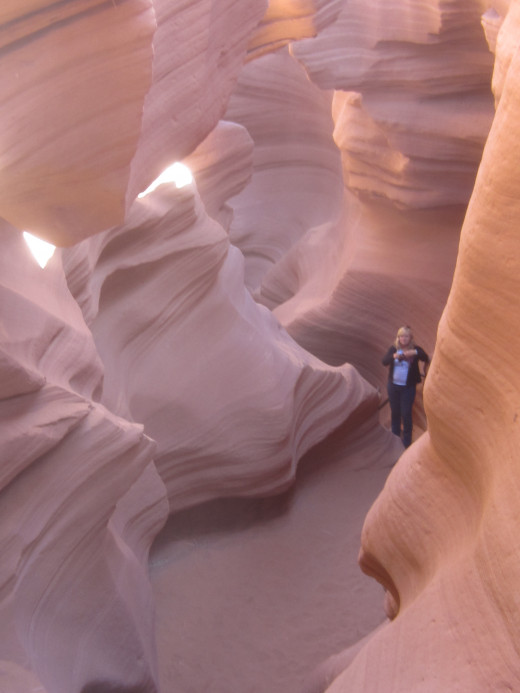
Inside Lower Antelope Canyon
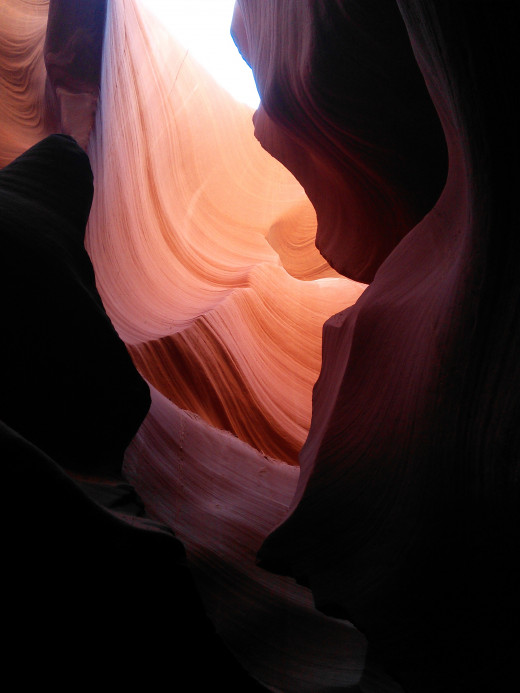
Canyons are Carved Out of Rock By Water
Antelope Canyon has become world famous because of the unique beauty of the rock formations that make up the canyon.
Canyons are deep ravines cut into rock by rivers as they flow through an area. When the source of a river is located at a much higher elevation than the basin of water it empties into (its mouth), the river will erode the rock in its path down to the same level as the mouth. This results in the formation of a deep ravine where the river itself is much lower than the surrounding land.
The Grand Canyon is a classic example of this process. Over the course of millions of years the Colorado River has carved its way into the surrounding sandstone rock it flows through to the point where the river itself is about a mile below the rim.
Grand Canyon & Zion National Parks are Located Nearby

Antelope Canyon is a Special Type of Canyon Known as a Slot Canyon
Like other canyons, Antelope Canyon and other slot canyons are formed by water as it travels over the surface of the land.
Slot canyons tend to be narrow and deeper than they are wide. They are usually found in dry areas that are prone to periodic massive flooding.
Southwestern Natural Wonders
Have you visited any of the Natural Wonders in Northern Arizona and Southern Utah?
Unlike regular canyons which have a river flowing through them continuously, slot canyons are usually found in rocky areas and located along natural depressions, called washes, that are usually dry except when it rains.
Rocky terrain does not absorb water very well which results in rainwater flowing over the land to a wash which channels and usually carries it a nearby river or other basin.
Occasionally, the wall of water rushing through a wash will start to dig down into a section of the wash forming a narrow ravine. Over time the ravine becomes deeper with succeeding rains and a slot canyon is formed.
Group at Entrance to Antelope Canyon
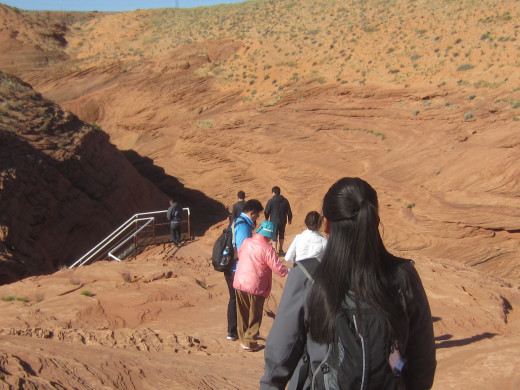
Flash Flood in 1997 Killed Eleven Tourists in the Canyon
During our recent tour of Lower Antelope Canyon, our tour guide told us that during the summer monsoon season the canyon will often be completely filled with rushing water (at some points the distance between the floor and top of the canyon is 30 feet or more).
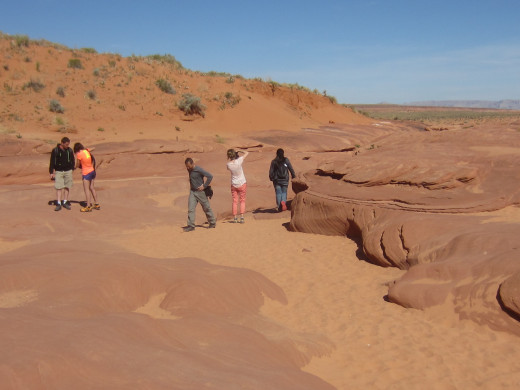
These periodic and short lived flash floods continue the process, which has been going on for millions of years, of carving Lower Antelope Canyon within the wash.
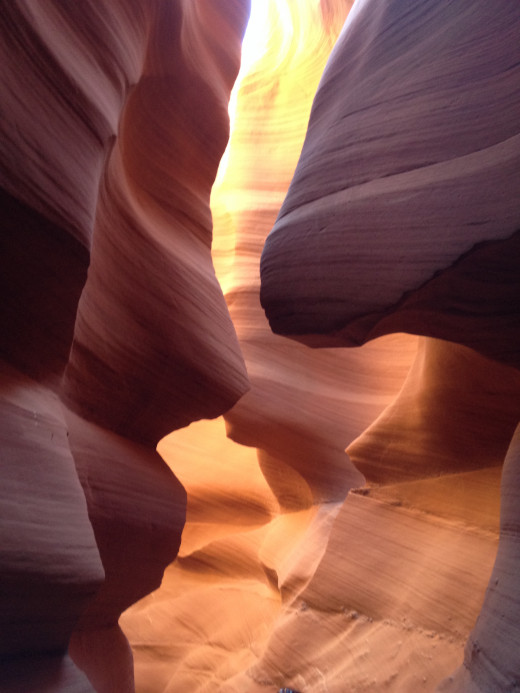
The spectacular swirling walls for which the canyon is famous are the result of this periodic massive rush of water that floods the wash during heavy rainstorms in the area.
In 1997 a flash flood resulted in the death of eleven people (a twelfth one survived) who were touring the canyon at the time. There was no rain in the area of the canyon and the water that flooded the canyon was from a storm a few miles away.
Stairs at Lower Antelope Canyon Entrance
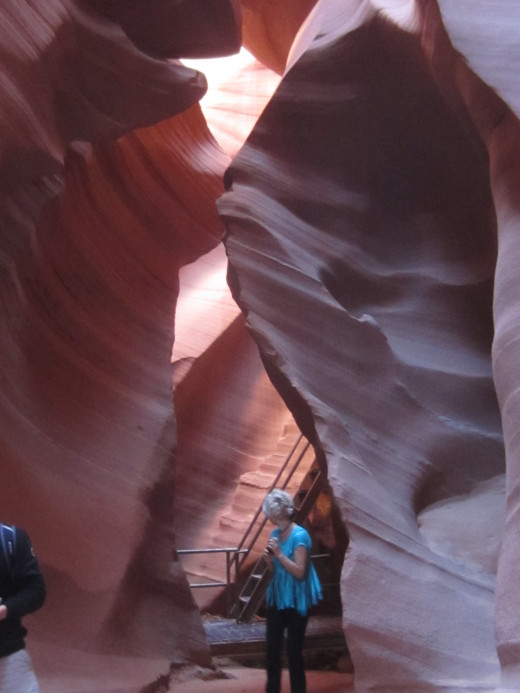
Discovery of the Canyon
While Lower Antelope Canyon has been millions of years in the making, it was not discovered until the last century.
The discovery was made by a young Navajo girl who was herding sheep in the area stumbled upon the canyon one day in 1931. Even today, visitors would be hard pressed to find the canyon were it not for signs directing them to what, even up close, looks like a mere hold in the ground.
Antelope Canyon is located on the Navajo Indian Reservation. At the time of the canyon’s discovery the area was very remote and difficult to travel to.
Sandstone Rock in Lower Antelope Canyon
The nearby city of Page did not exist until 1957 when it was built as a place to house the families of the workers building the Glen Canyon Dam.
Arizona state highway 98, next to which the canyon is located, was not built until the 1970s although there appears to have been a dirt road, built earlier by the Navajo Nation or Bureau of Indian Affairs that followed the same route as highway 98.
Because of its then relatively remote and difficult to reach location, the canyon remained almost unknown to the outside world for the next few decades.
However, word of the canyon’s natural beauty did leak out and, beginning in the 1970s and 1980s, a few professional photographers began to learn about it and began making their way to the canyon to photograph it.
Publication of these early pictures began to increase attention about the canyon. This, along with improved access to the area, resulted in the canyon becoming more accessible to tourists.
The family that owned the land began working with newly formed tour companies to open the canyon to tourists. By the mid-1990s Lower Antelope Canyon and its neighbor Upper Antelope Canyon were joining Lake Powell as another popular tourist destination in the area around Page, Arizona.
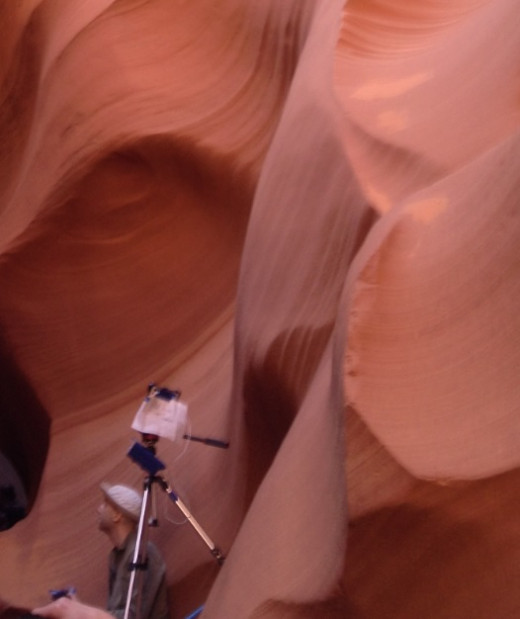
Professional Photographer Taking Time Lapse Photo
Planning Your Visit to Antelope Canyon
Antelope Canyon consists of two separate sections - Lower Antelope Canyon and Upper Antelope Canyon. Both are located a short fifteen minute or so drive from downtown Page, Arizona at the intersection of Highway 98 and Indian Route 222.
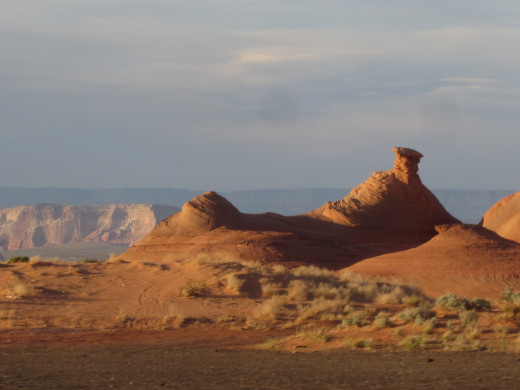
Entering Monument Valley
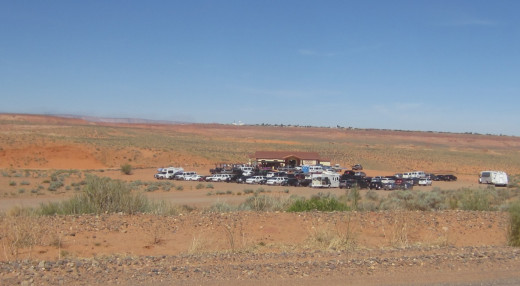
Lower Antelope Canyon located off of Indian Route 222 about a half mile north of the intersection of Indian Route 222 and Highway 98. While the parking lot for Upper Antelope Canyon is just south of the intersection of Indian Route 222 and Highway 98.
My wife and I recently visited Lower Antelope Canyon which appears to be accessible only by private vehicles while nearby Upper Antelope Canyon is apparently accessible by both private vehicle and organized tours with shuttle service from nearby Page, AZ.
Page Arizona sits at the start of Monument Valley and traveling the short distance from Page to Antelope Canyon you will pass some of the spectacular buttes that have attracted photographers and Hollywood movie makers for almost a century.
Lower Antelope Canyon 2014 Fees at a Glance
Navajo Tribal Park Fee: $8 (applies to all adults 13 years and older)
Canyon Tour Fee: $20 (applies to everyone 7 years and older)
Tip for Tour Guide: Optional but appreciated
Children 6 years and under: Admission is free
Payment: Cash and Travelers Checks only (Credit Cards, Debit Cards and personal checks are NOT accepted for payment)
Pets: Not allowed
Fees and Regulations
Regardless of the means of transportation used, both canyons require the use of authorized tour guides to enter either canyon. This means that visitors are guided through in a group.
In the case of Lower Antelope Canyon people are taken through in groups of about a dozen people. The tours start every thirty minutes during open hours and last a little over an hour.
An outfit called Ken’s Tours, which is located both at the canyon as well having an office in Page, appears to have the tour concession for Lower Antelope Canyon.
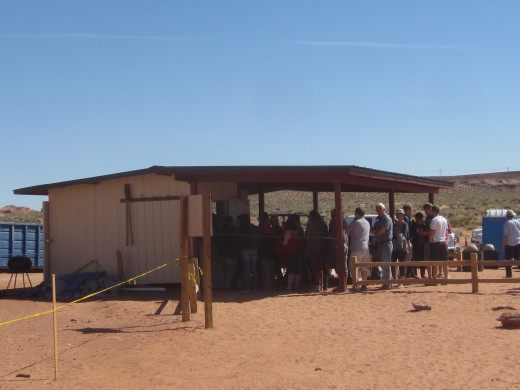
The Ken's Tours site at the canyon collects both the tribal park and guide fees described below. Guides employed by Ken’s Tours conduct the tours and, if company's other guides are as good as our guide, a young Navajo lady named Hope, your tour will be both very enjoyable and well worth the price and any tip you may feel like offering.
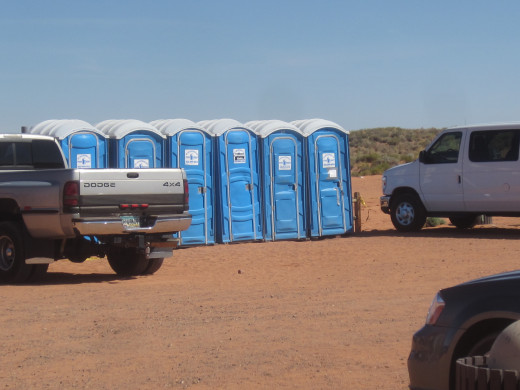
Fee Station at Lower Antelope Canyon
Both canyons are located on the sprawling Navajo Nation located in northern Arizona and both are maintained by the Navajo Nation as tribal parks.
There is an $8 per person tribal park entrance fee (fee price as of 2014) for adults 13 years and older (this tribal park fee doesn’t apply to children under age 13). The $8 tribal park fee appears to be good for entrance to more than one tribal park so long as you show your receipt.
In addition to the $8 park fee, there is also a $20 per person guide fee for the Lower Antelope Canyon tour.
While children under 13 are exempt from the $8 tribal park fee, the $20 guide fee applies to children age 7 years and older. Children 6 years and younger are exempt from both fees. Tips for the guide are optional.
Lower Antelope Canyon
Guide Fees are Different at Upper Antelope Canyon
While the park fee of $8 for Upper Antelope Canyon is the same as the one for Lower Antelope Canyon, guide fees for Upper Antelope Canyon are more than likely different and will vary depending upon which tour operator one chooses (a number of different operators serve Upper Antelope Canyon) and tour package purchased.
Payment of fees at Lower Antelope Canyon is by cash or travelers checks only. Credit and debit cards are not accepted and neither are personal checks. ATMs are available at many locations in nearby Page but are not available at Lower Antelope Canyon itself, so be sure to have sufficient cash before leaving Page.
Both canyons have additional photography fees. In addition to the $8 tribal park fee, photographers have to pay, as of this writing, a $42 rather than $20 guide fee at Lower Antelope Canyon.
Photographer Fee Only Applies to Professional Photographers
While researching prior to our visit I found the published fees and discussions of them on the Internet to be very confusing.
This was not just for Lower Antelope Canyon but for Upper Antelope Canyon and other sites within the surrounding Monument Valley all of which are located on the Navajo reservation.
However, the photographer fees only apply to professional photographers who want both more time as well as the opportunity for special poses and the right to park themselves in a location for time lapse photos.
Tourists with cameras are only required to pay the standard tour guide fee ($20 in the case of Lower Antelope Canyon). However, see my discussion below on picture taking on the regular tour.
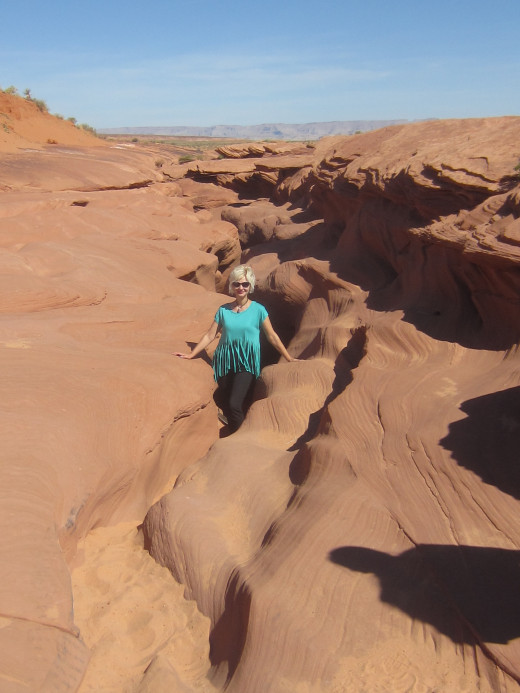
Curved Trail in Lower Antelope Canyon
Tips for Photographs During Your Tour
We visited Lower Antelope Canyon on a Friday morning in early May. We arrived a little before eight in the morning and were on that day’s first scheduled tour which began at 8:30.
I had my Canon PowerShot digital camera, my Apple iPhone and Google Nexus tablet with me for picture taking.
While we weren't rushed and did have some opportunities for stopping and posing for pictures, we had to stay together as a group and generally keep moving.
Despite these constraints I was able to take about 400 pictures inside the canyon. Two hundred and sixty of these were taken using my cell phone. The majority of these required that I frame and shoot while moving with the group as we wound our way through the canyon.
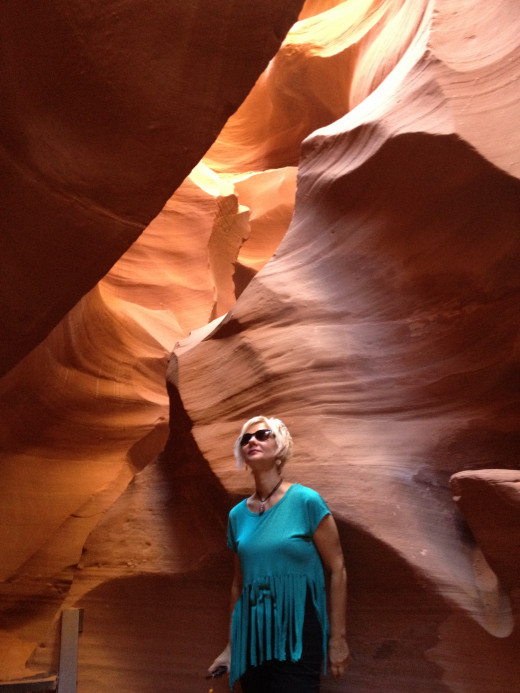
Since, during most of our tour, the top of the canyon was thirty feet or more above us, I was able to shoot over the heads of those in the group ahead of me, with the picture giving the impression that I was alone taking pictures in the canyon.
While keeping us moving at a pace that kept us separated from the group that started a half hour after us, Hope, our guide, did not rush us and everyone in the group was accommodating and would stand aside for a few seconds while someone posed for a picture.
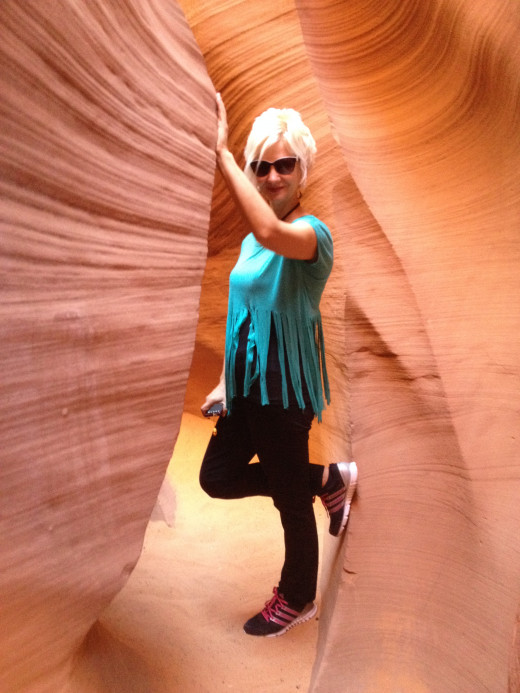
While the trail was basically narrow, it was easy for some others and I to step aside and let the crowd continue past so we could periodically stop and take a particular picture without people in the way. There was also usually enough room to work our way back up to rejoin our travel companions.
I was able to get pictures with all three cameras but found my cell phone the easiest one to use because I could aim and shoot with it quickly.
Also, when my wife, who did some semi-professional modeling years ago and is very particular about pictures of herself, wanted to pose I could shoot a dozen shots with the phone within a few seconds which usually resulted in getting at least one shot in the series that she liked..
Looking up towards the sky
Changing the Angle of Camera to Get More Color
In fact, because of my extensive picture taking with the cell phone, the screen was on for long periods of time and toward the end of the tour the phone started getting hot in my hand - the battery was also almost dead by the end of the tour.
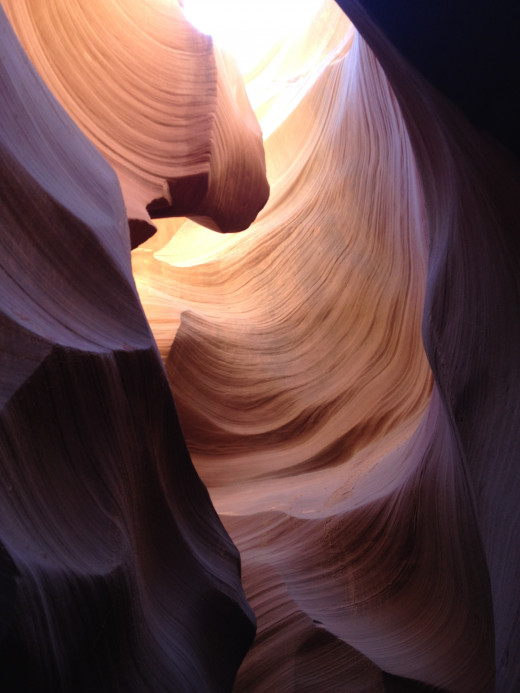
While the rock formations in the canyon were spectacular, the colors, as seen by the naked eye, of the sandstone rock was basically a dull greyish brown.
I was momentarily disappointed and thought we had picked the wrong time of day.
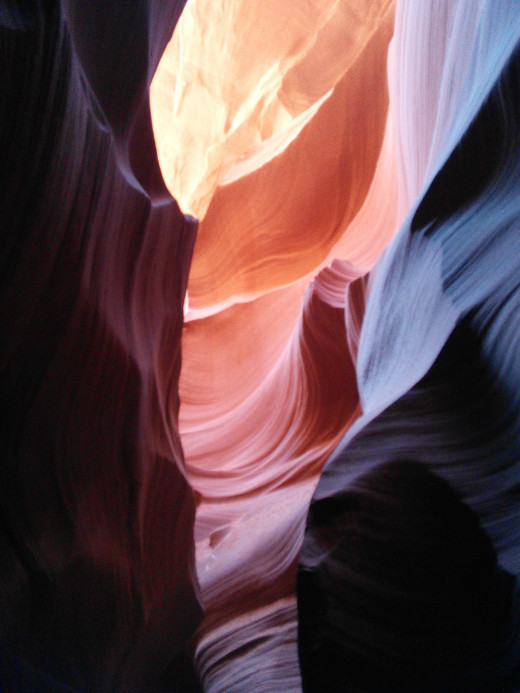
However, when I tried tilting the camera/phone/tablet ever so slightly to change the angle of the light (a trick that works great with sunsets) I was able more the colorful pictures that I was seeking.
This effect could also be accomplished with more sophisticated equipment or, I suspect, by sitting in the canyon for a few hours and letting the changing angles of the sun’s rays produce the same colorful results.
Looking Toward the Sky
Some Final Things to Consider When You Visit
Talking with other people, I have been told that Upper Antelope Canyon has more amazing photo opportunities than Lower Antelope Canyon.
On this trip we choose Lower Antelope Canyon because we were able to get more specific information about access and prices. On our next trip we will choose a tour and visit Upper Antelope Canyon.
In the mean time we have no regrets about our decision to visit Lower Antelope Canyon and thoroughly enjoyed our visit to that canyon.
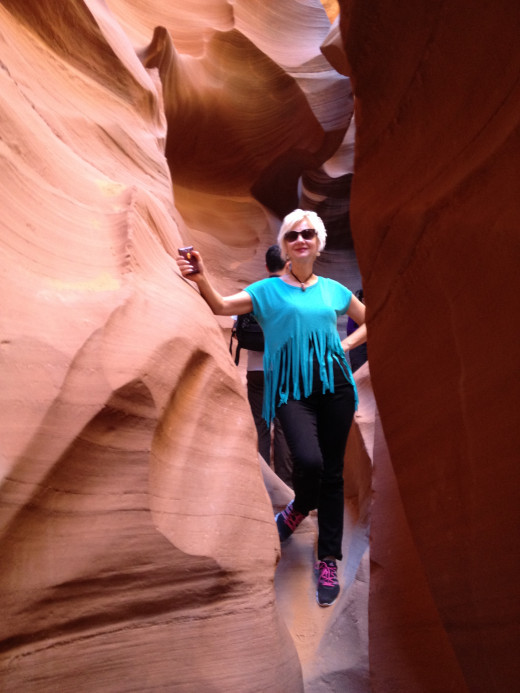
Narrow Passage in Lower Antelope Canyon
As noted above, eleven people died in 1997 when a flash flood hit Lower Antelope Canyon while they were inside. If you are visiting during the summer monsoon season be prepared to have your tour cancelled or the canyon closed even when the weather in the area is perfect.
Storms can hit miles away and most of the water from the storm will end up in the wash resulting in a rushing wall of water charging toward the canyon. During the monsoon season it is not uncommon for Lower Antelope Canyon to be completely filled with fast moving water for a few minutes. You don’t want to be in the canyon during these times.
Lower Antelope Canyon is underground. Unlike a cave, the top is open so it is well lighted by the sun. However, visitors have to climb down ladders to enter. There are also a couple of spots that are even lower which requires more ladders. To exit, visitor's have to climb up ladders.
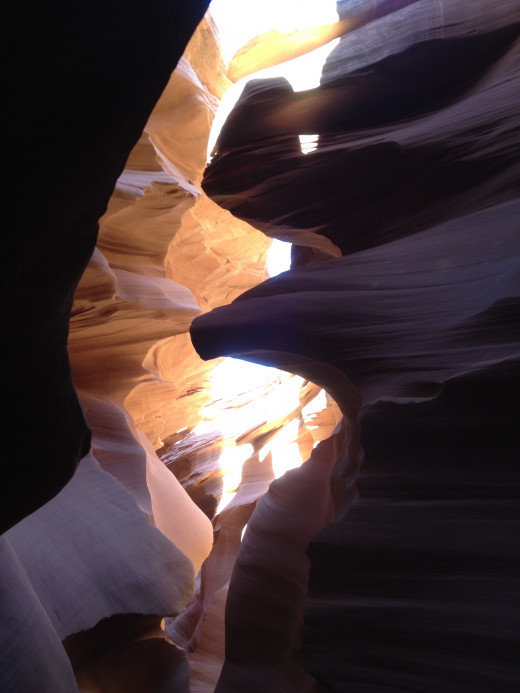
Eagle's Head Rock Formation
Lower Antelope Canyon is not accessible to people who are unable to walk or climb unaided. In addition to the ladders required to enter and exit the canyon, the path through the canyon is narrow and somewhat rocky in places.
While not as narrow as the passages described in my Hub about exploring Peppersauce Cave, some parts of the trail could be difficult for people requiring assistance in walking.
Also, the tour might be difficult and pose hazards for very young children. In all of these cases you may want to check Upper Antelope Canyon as it is above ground and may be more easily accessible.
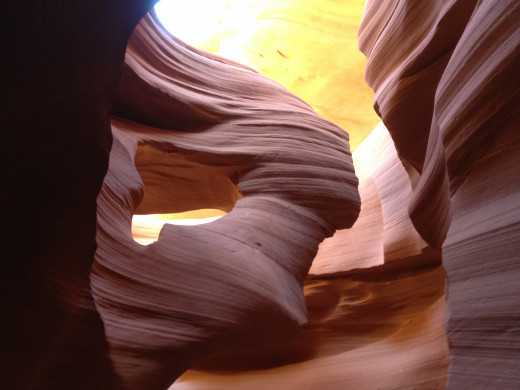
Lady's Head Rock Formation
A Note On Daylight Savings Time
Finally, summer travelers should be warned that Arizona does not observe daylight savings time so during the summer when the other states in the Mountain Time Zone switch to daylight savings time, Arizona does not change which makes Arizona time in the summer the same as Pacific Daylight Savings time.
This is normally not a problem (and cell phones usually reflect the correct local time) except that the Navajo Nation in northern Arizona DOES observe daylight savings time as does nearby Utah. Page and the Grand Canyon are outside of the Navajo Nation and don’t observe daylight savings time.
Because of the close proximity of Antelope Canyon (both Upper and Lower), which are located within the Navajo Nation, to Page, hours of operation and tour times are the same as the Mountain Standard Time used by Arizona year round.
However, if you continue heading east beyond Antelope Canyon through the beautiful Monument Valley area posted times for other places within the Navajo Nation will be based upon Mountain Daylight Time.
Wash Containing Lower Antelope Canyon
© 2014 Chuck Nugent