- HubPages»
- Travel and Places»
- Visiting Europe»
- United Kingdom
Hadrian's Wall, Northumberland

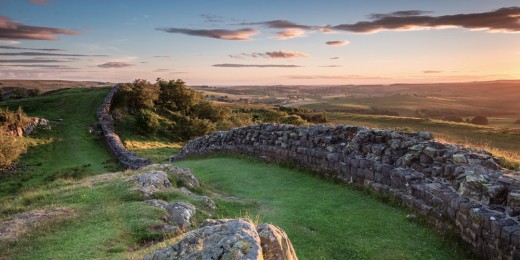
Hadrian's Wall is something any visitor to England must see if they are heading north towards Scotland. The wall, which was declared a UNESCO World Heritage Site in 1987, is a remarkable feat of Roman engineering that dates back to AD122. The stone construction spans the entire width of England at its narrowest point, spanning a distance of some 73 miles and going through the cities of Newcastle in the east and Carlisle in the west. It was the first construction of its kind in Europe.
Some 40 years earlier the Roman governor Agricola had lead an army all the way up to the most northern regions of Scotland, but when one of his legions was needed on the Danube and the remaining force was judged insufficient to occupy Scotland, the decision was taken to withdraw to the position easiest to defend between the Tyne and the Solway.
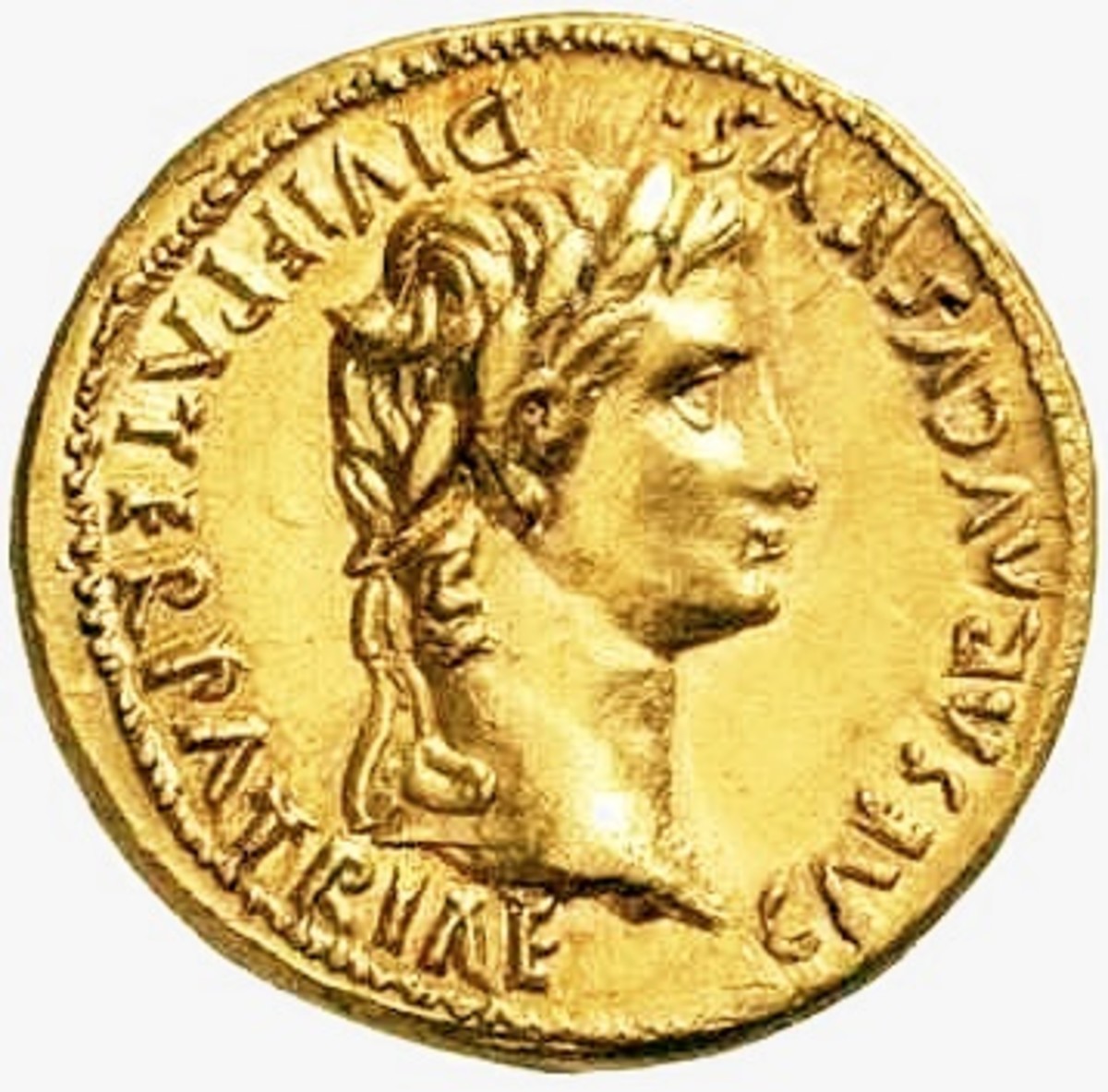
Hadrian became the fourteenth emperor of Rome in 117 AD. Although earlier Roman rulers, such as Nero, had been profligate and conceited, Hadrian is reported to have been a brilliant and conscientious administrator, whose devotion to the army was such that he would sleep and eat among the common soldiers, and he is commonly depicted in military attire even though his regime was marked by relative peace. The historian Gibbon summed up Hadrian’s rule by calling it “the period in the history of the world during which the condition of the human race was most happy and prosperous…when the vast extent of the Roman Empire was governed by absolute power under the guidance of virtue and wisdom”. Although no emperor could avoid creating enemies, Hadrian's reign is generally considered in keeping with Gibbon’s estimation.
In contrast to the expansionist ambitions of his predecessors, he adopted a policy of consolidation. When he ordered the wall to be built, in all likelihood the reasons had less to do with defense and more to do with the symbolism of it. An older turf wall was replaced with a technically impressive construction made of stone, with all the permanence that that symbolised. There are also reports that the wall - nearly ten foot high across its entire length - was plastered and painted bright white to make an even stronger impression. The empire would be as permanent and as impressive as its wall. The ambitious nature of the engineering doubtless made up for the expanionist ambitions that had been given up, and most historians would agree that Hadrian's building projects are his most enduring legacy (including not only the wall - his most famous construction - but also the Arch of Hadrian in Athens and the Pantheon in Rome, rebuilt by Hadrian after the earlier building was destroyed by fire).
The wall was probably completed shortly before Hadrian's death in 138 AD. Immediately afterwards, his successor abandoned the idea of consolidation and advanced again into Scotland, attempting to establish a new border between the Firth of Forth and the River Clyde, where another wall would be built, named after the Emperor Antonious Pius. But after the death of Emperor Severus in 211 AD, the border returned to Hadrian's Wall, where it remained right up to the end of Roman Britain. During the break up of the Roman Empire in the second half of the fourth century troops began to leave, and in 410 AD Emperor Honorius withdrew completely from Britain, sending letters to British cities that henceforth they were to fend for themselves.
A Hadrian's Wall Holiday
The most dramatic sections of Hadrian's Wall and the sites most worth visiting (Chesters Roman Fort, Vindolanda, Brocolitia, The Roman Army Museum at Housesteads - the latter being the most complete Roman fort in Britain) are all close to Hexham, meaning that if you want a base for a Hadrian's Wall holiday, Hexham would be ideal. For those wanting self-catering holiday accommodation, there are many Hexham cottages close to Hadrian's Wall.
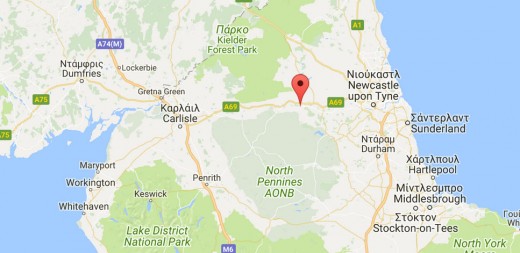
Hexham is situated almost halfway between Newcastle in the east and Carlisle in the west in the picturesque Tyne Valley in Northumberland, and this lively market town retains a lot of its historic architecture and medieval character. It has a very good variety of shops, restaurants, cafes and pubs, and has largely resisted the influx of the kinds of brands that have eroded the local character of many other towns and cities in England.
Hadrian's Wall
Hexham location near Hadrian's Wall