- HubPages»
- Travel and Places»
- Visiting Asia»
- Southern Asia
Nandadulal Jiu temple of Gurap

Introduction
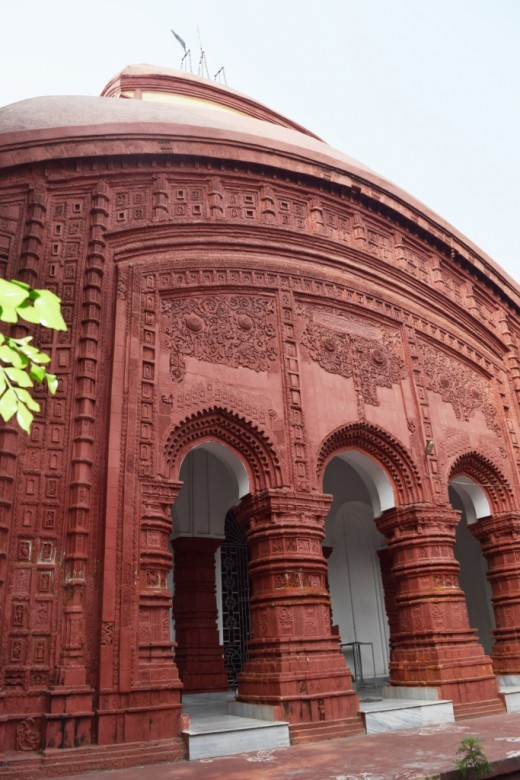
Nandadulal Jiu temple of Gurap, district Hooghly of West Bengal is one of the innumerable temples of West Bengal with excellent terracotta work which was the hallmark of 17-18th century Bengal temples. Founded in 1751 AD by Ramdev Nag, the local landlord and dedicated to Lord Krishna (Nandadulal is a name of Lord Krishna), this temple, though now devoid of a large portion of its excellent terracotta work due to damage by the elements, is still a gem of a temple to the temple enthusiasts.
Gurap : where it is situated
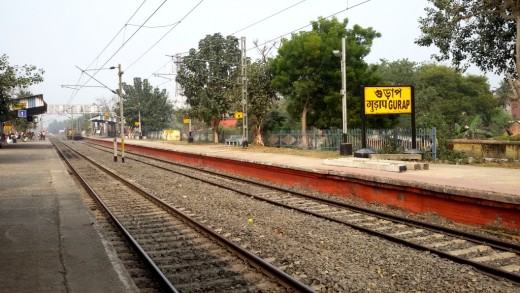
Gurap (latitude 23.034164 N, longitude 88.111468 E) is a village situated about 60 km from Kolkata on the Howrah – Bardhaman Cord line of the Eastern Railways. It is also close to the Durgapur Expressway, an excellent highway which is a part of NH- 2.
Nandadulal Jiu temple : Type
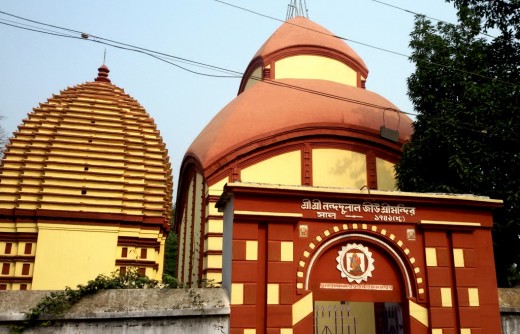
It is a big ‘Aatchala’ type of temple. ‘Chala’ means roof, & ‘Chala’ type of temples are characterized by slanting roofs, the number of which may vary from one (‘Ek Chala’) to sixteen (‘Sholo Chala’). Temples with eight roofs (‘Aat Chala’) are the commonest, where the roofs are arranged in two storeys in 4+4 pattern.
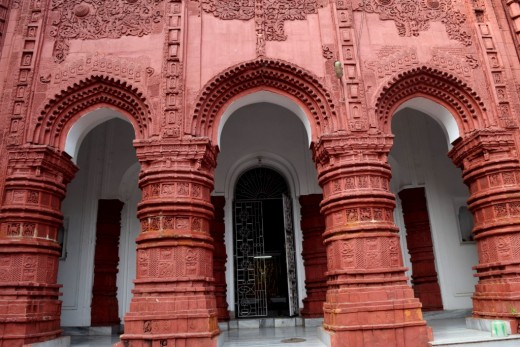
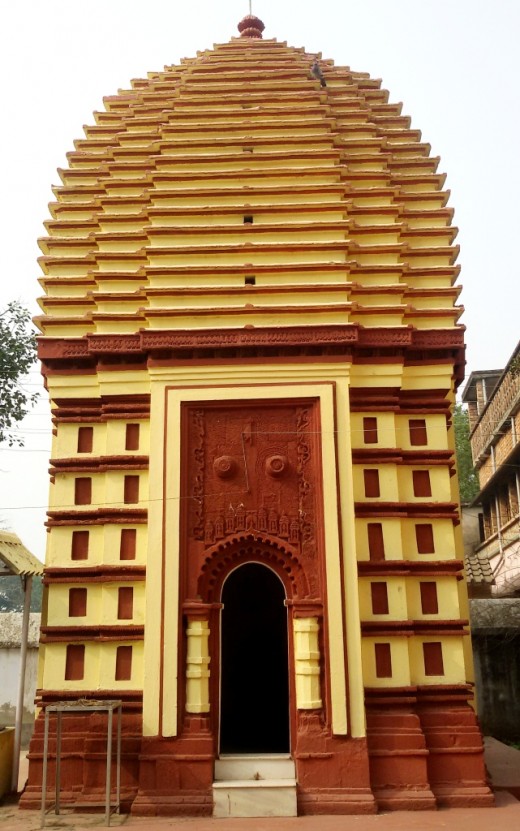
Nandadulal Jiu temple is an ‘Aatchala’ temple with the same 4+4 arrangement of the eight roofs. It has a triple arched entrance porch and the sanctum can be entered through a single door.
Nandadulal Jiu temple : Terracotta decorations
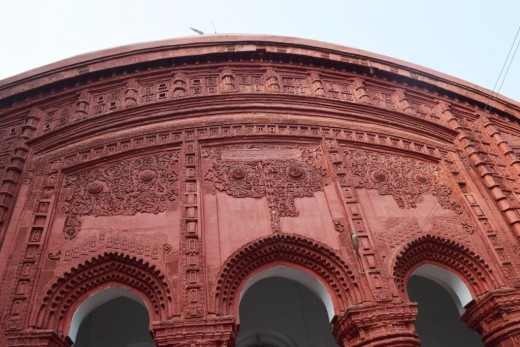
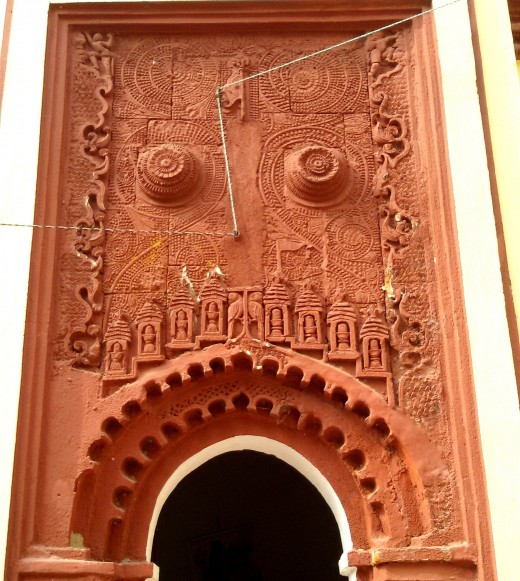
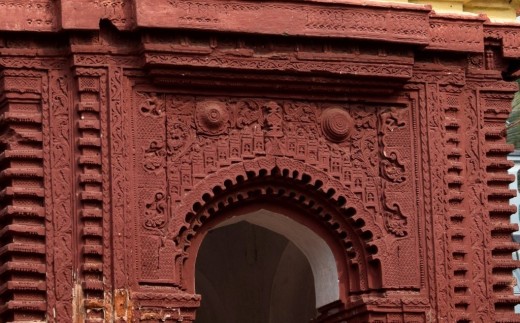
Unfortunately, the original extensive terracotta decorations are no more. Damage by elements in association with neglect in maintenance resulted in a depleted decoration. Now only the front façade and the triple arches with the pillars bear extensive terracotta decorations. Some decorations are still intact on the front walls on either side.
Nandadulal Jiu temple : Terracotta decorations -- Base panels
Right base panel :-
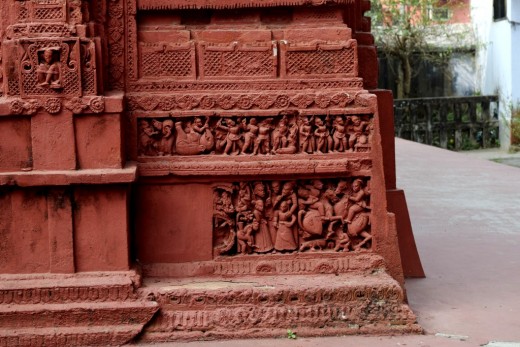
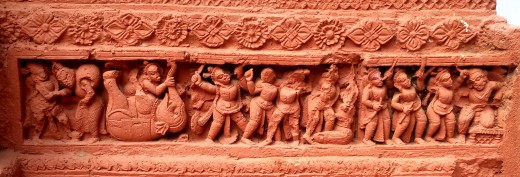
The right base panel shows ‘Kangsha Badh’ (Slaying of Kangsha the evil king by Lord Krishna) in a detailed manner. From left, this beautiful panel serially shows the meeting of Krishna with Kubja, the old hunchback lady; slaying of Kangsha’s elephant Kuvalyapida; fighting with the wrestlers and guards of Kangsha and finally slaying of Kangsha by Krishna and His elder brother Balarama.
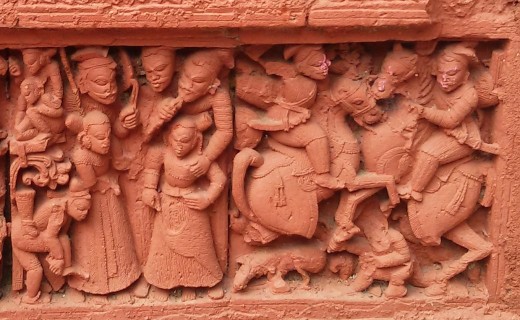
Below this ‘Kangsha Badh’ panel is an incomplete panel depicting some social & hunting or fighting scene. The hunters/fighters on horse-back are vividly depicted.
Nandadulal Jiu temple : terracotta decorations -- Base panels 2
Left base panels
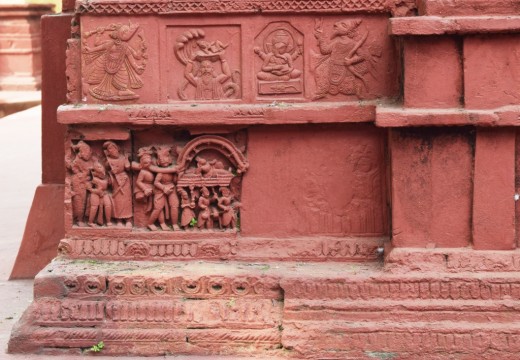
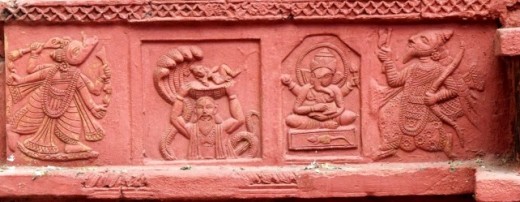
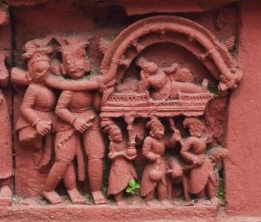
The left base panel is damaged and shows in the upper part from left the Varahavatar ( one of the incarnations of Lord Vishnu, the Boar), the scene of Basudev (Krishna’s father) carrying baby Krishna on his head in a basket en route to Gokul across the Yamuna river, Lord Ganesha and another figure with bow and arrow, possibly of Lord Parashurama. Below it, there is a panel showing a landlord traveling in a palanquin.
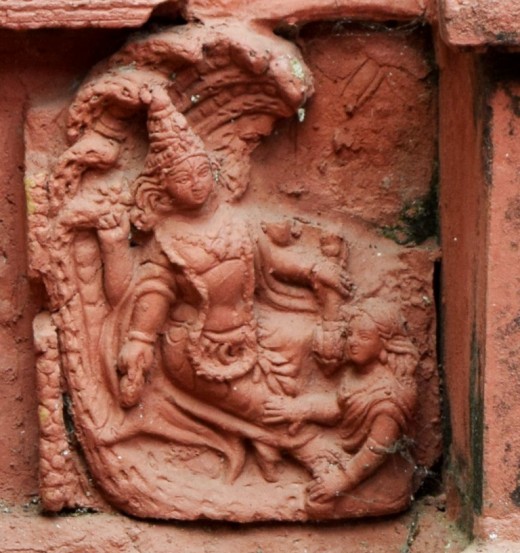
In the damaged lower part, a beautiful panel shows Lord Narayana in a sitting posture with goddess Lakshmi at his feet and the serpent Ananta Naga spreading its multiple hood over Lord’s head. This is perhaps the most beautiful panel of this temple.
Nandadulal Jiu temple : Pillar panels
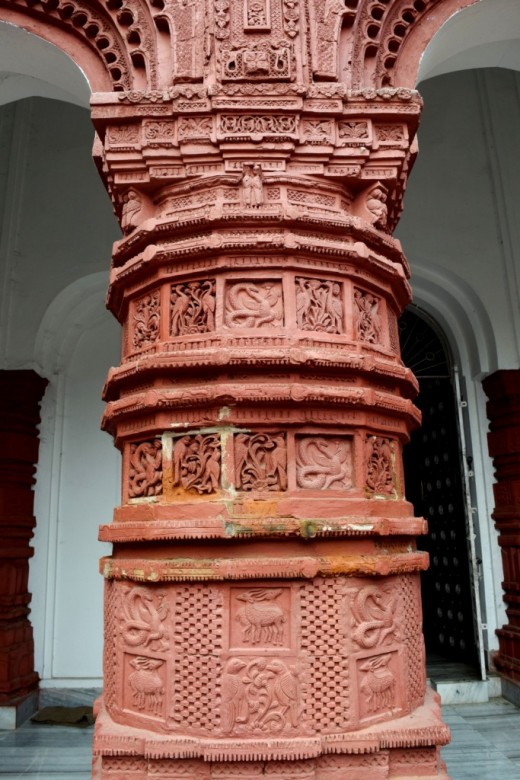
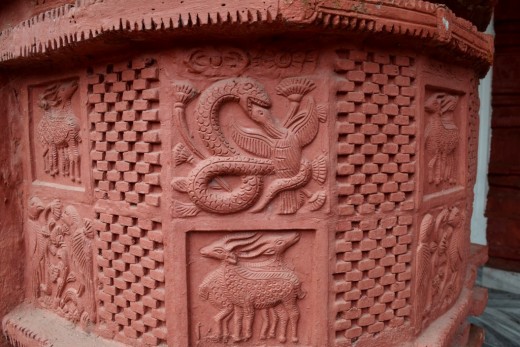
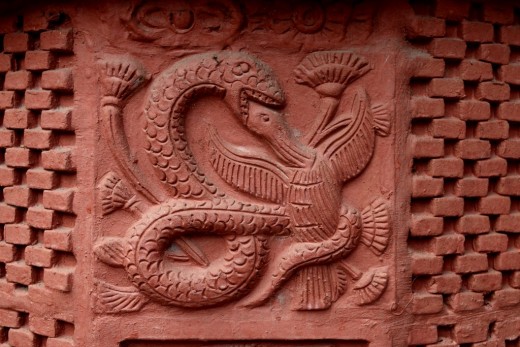
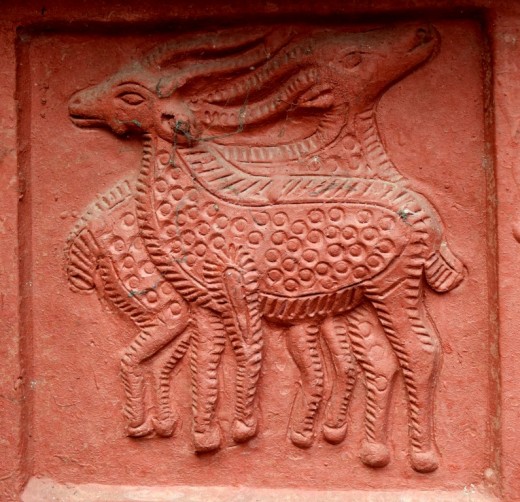
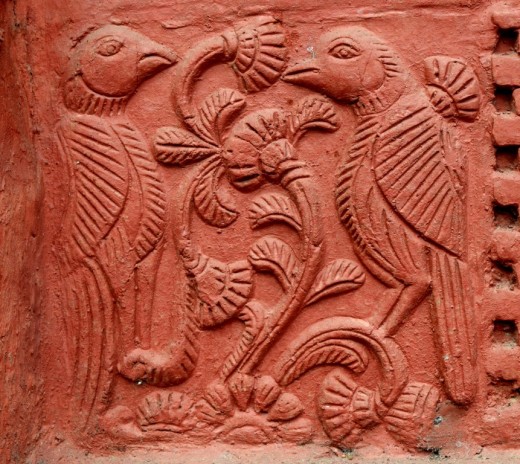
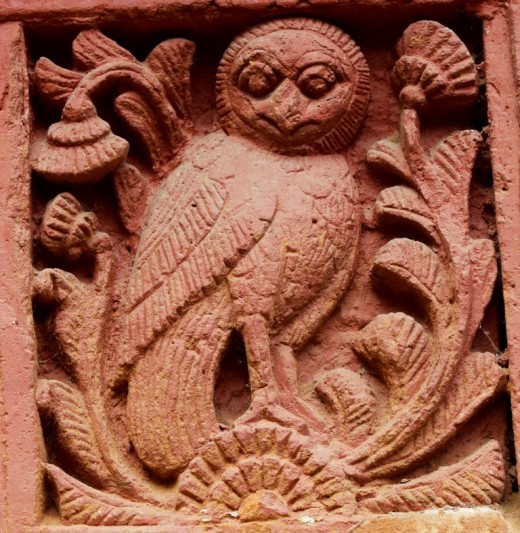
The panels on the pillars show beautiful depictions of birds and animals like deer and snake. Two panels are worth mentioning here. One shows a snake devouring a bird and the other depicting a beautiful owl.
Nandadulal Jiu temple : Wall panels
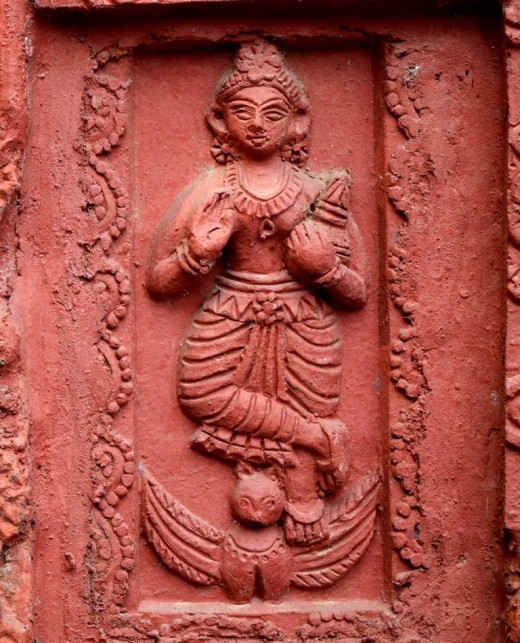
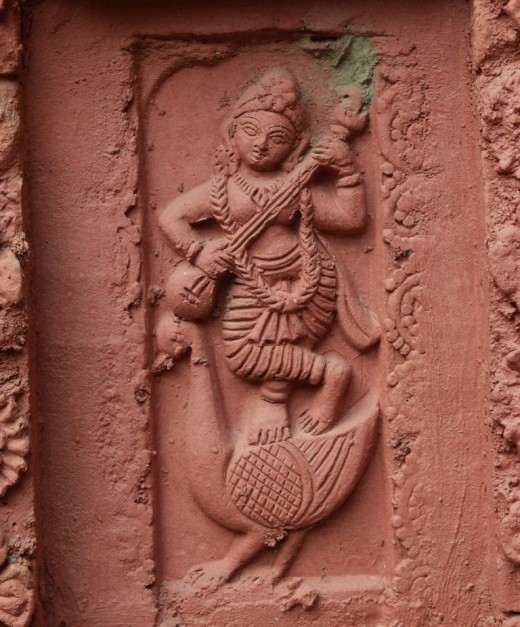
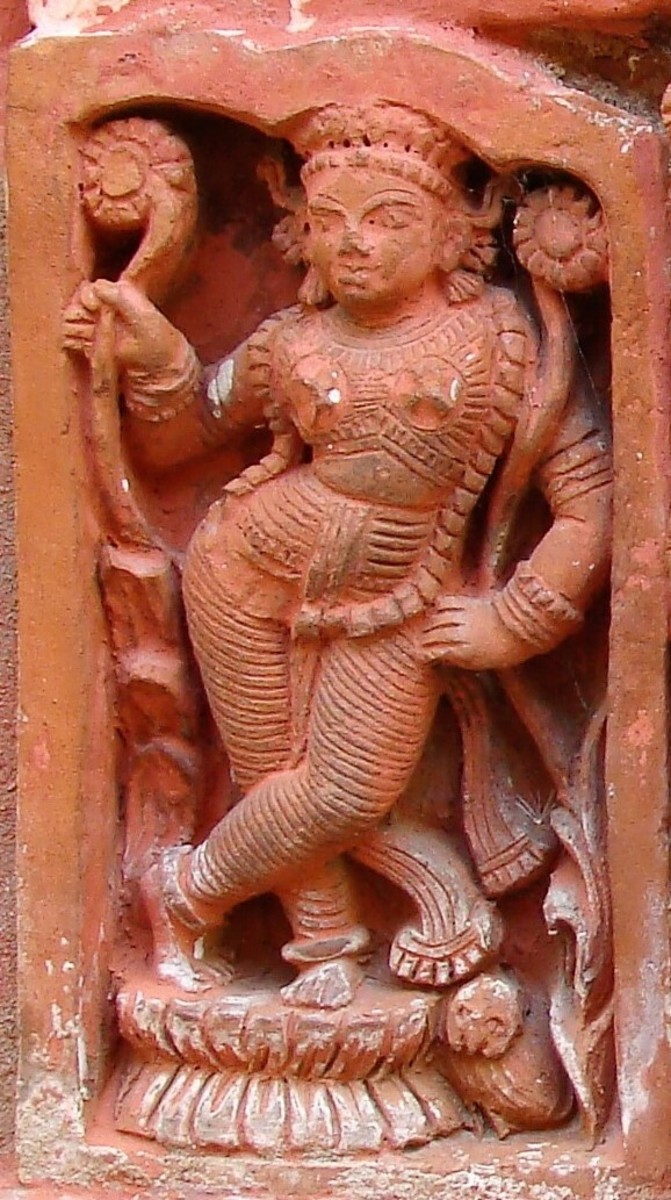
The front walls carry some good terracotta work. Two of the best panels show the goddesses Lakshmi and Saraswati, the goddess of Wealth and Learning respectively.
Nandadulal Jiu temple : Corner panel
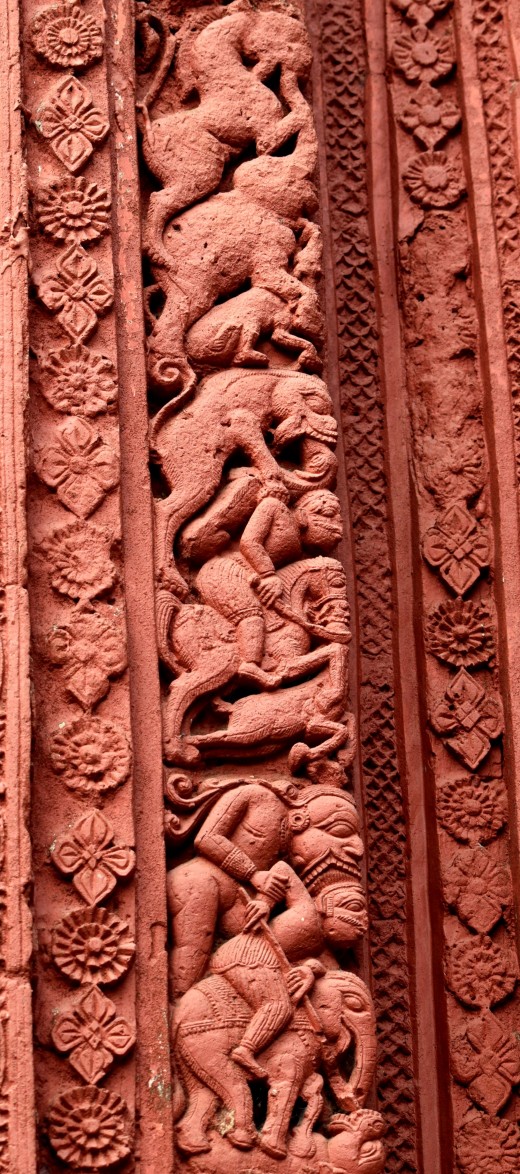
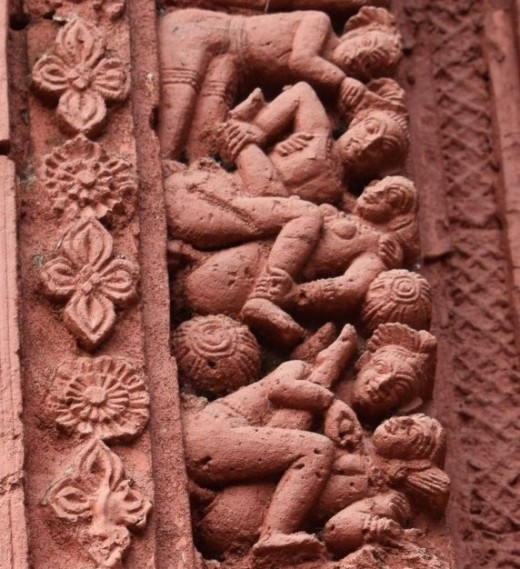
The corner panel is seen on the right side only, the left side is devoid of any corner panel now. The corner panel is a special one, often called ‘Mrityulata’(The Creeper of Death) or ‘Barshaa’(The Lance) panel. This type of terracotta panel typically shows a vertical row of figures of men, animals, gods and demons, each trying to attack, devour or kill the figure immediately below it (hence often called ‘Mrityulata’ - the Creeper of Death). This sort of panel can be seen in some medieval temples of Bengal. But interestingly, the corner panel of this temple shows, in addition to the traditional violent figures, some copulating human figures in its upper part. This is definitely a very rare depiction, and this raises the question whether the name ‘Mrityulata’ is apt or not. Probably, the name ‘Barshaa’ is more suitable.
Nandadulal Jiu temple : The deity
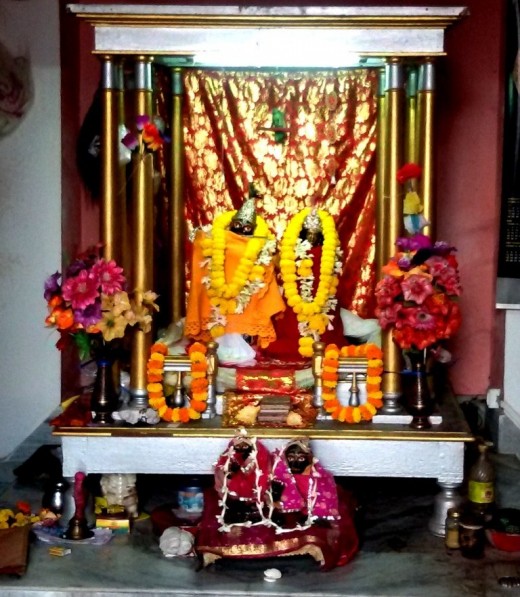
Inside the sanctum, there are the standard deities of Lord Krishna & Radha, His divine consort.
The ‘Naat Mandir’
In front of the temple there is a flat-roofed open hall type structure with multiple supporting pillars. This is the ‘Naat Mandir’ used for devotional singing and similar activities.
‘Dol Mancha’
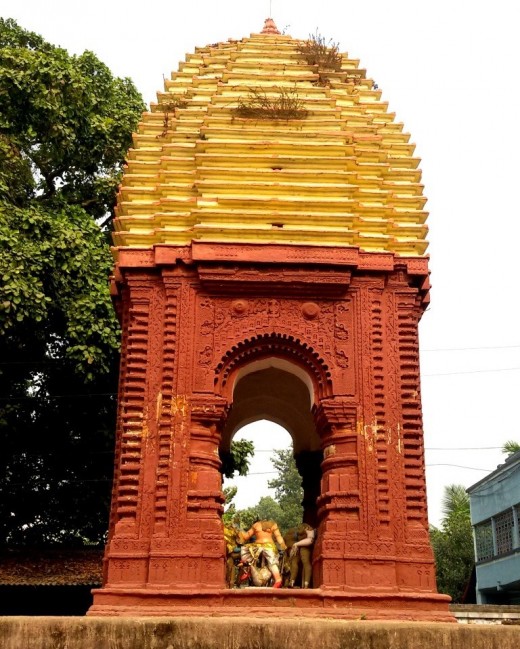
‘Dol Mancha’ is a temple-like structure where the deities are placed during the festival of ‘Dol’. Here, it is a small ‘Rekh Deul’ type temple with single arched entrance, situated on the left of the main temple. It has minimal terracotta work on the front façade.
‘Raas Mancha’ : Nandadulal Jiu temple
The ‘Raas Mancha’ is a temporary temple-like structure where deities are brought for worshiping on certain auspicious dates. Here, the ‘Raas Mancha’ is situated outside the walled premises of the main temple. It is on a raised square platform, and the top is ridged like a ‘Rekh Deul’. The front façade of this structure has minimal terracotta decorations.
How Gurap can be reached
Gurap is a station on the Howrah-Bardhaman cord line of the Eastern Railways. All the cord line locals stop here. From Gurap railway station, rickshaws are available. Gurap can be reached easily by road also, as it is connected to NH-2.
Conclusion
With its exquisite terracotta work and particularly the unique ‘Barshaa’ panel with erotic depictions, this beautiful temple is definitely worth visiting.
Related
Goddess Kali in the decorations of temples of West Bengal
Inexpensive Power With DIY Solar Panel Kits
Shri Chaitanya Mahaprabhu in Bengal temple decorations

Raghunath temple - a special temple of Lord Rama in a remote village in West Bardhaman district, West Bengal
Lakshmi, the Goddess of Wealth and Fortune in Bengal temple decorations