- HubPages»
- Travel and Places»
- Visiting Asia»
- Southern Asia
Welcome to India

An irreverent and different view of India and Indians that you will not find in guide books.
India can be bewildering. Not only for visitors, but also for Indians. Here are a few observations which may help you understand some of the cross-cultural differences and idiosyncrasies that make India what it is--charming, loveable, different, frustrating, beautiful, intense, overwhelming and diverse.
Walking Cheek by Jowl
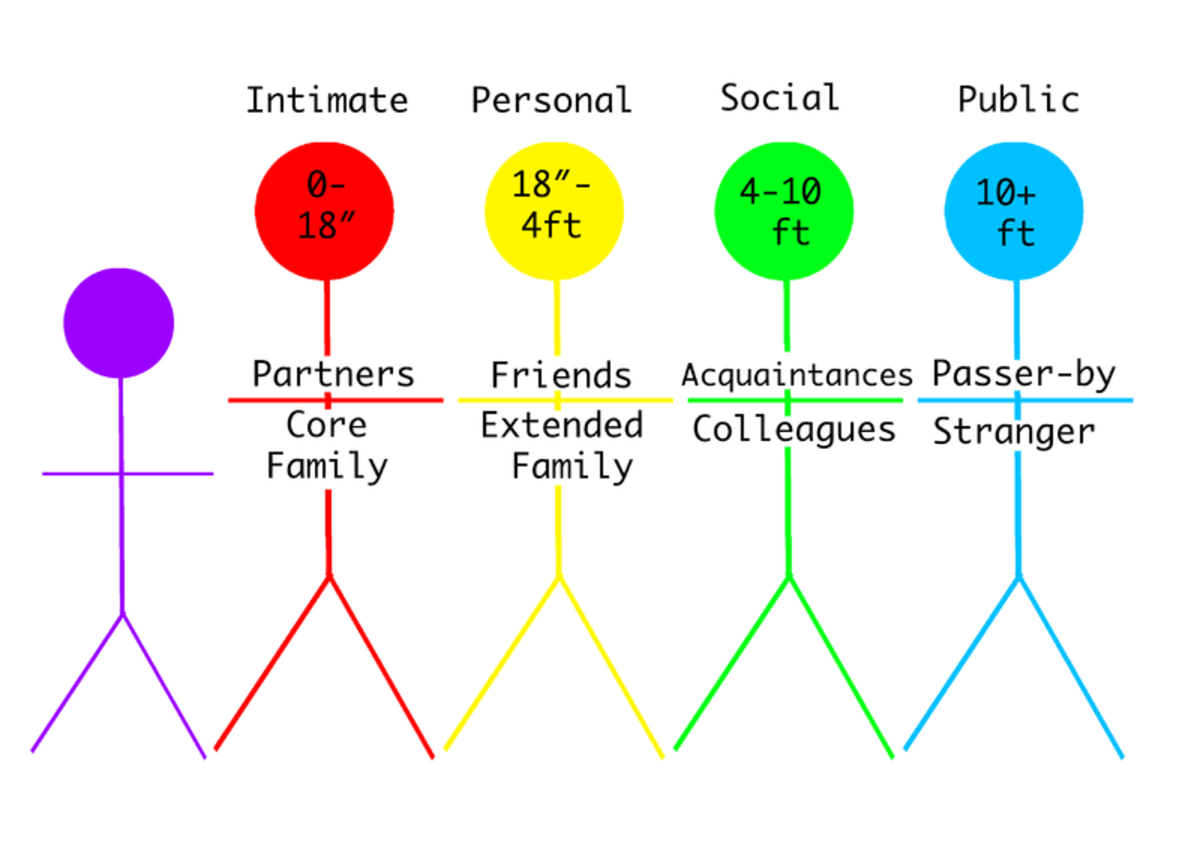
The Concept of Personal Space
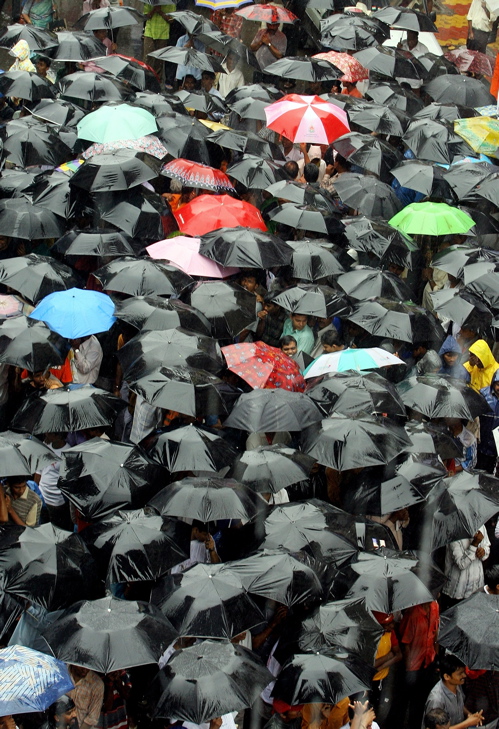
To the Westerner, personal space is inviolable. An unknown person is not permitted close physical proximity. To an Indian, this concept does not exist. There is so much physical closeness involved in everyday life in India. We jostle one another in market places, on buses and trains and aeroplanes, at cricket matches and religious ceremonies, everywhere. A poke in the ribs, an elbow nudge, a smelly armpit right in front of your nose are all accepted with equanimity.
I am sure that even if there were just two Indians on an open ground, they would find a way to brush against each other, if not bang into one another. If they were a gang, it could well be called a gang bang.
Living Cheek by Chawl*
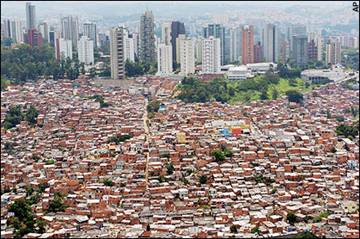
Any Open Space Is My Space
A passageway is designed to allow people to move unhindered. Not so in India. Here, passageways are places, like most open spaces, for people to stand and jabber. And not just stand and jabber. A good Indian will stand as close to the centre as possible with the objective (unprofessed ofcourse) of ensuring that other walkers have to duck and bob and weave their way around. Why would any sane person want to walk in a straight line, for God’s sake?
40 years ago, a friend and I decided to travel from Calcutta to Kathmandu, accompanied by an English couple, Rod and Mary. The first leg to Raxaul was to be undertaken by rail. We were travelling in the cheapest, unreserved cattle class. Rod was assigned the onerous task of holding on to our seats, while the rest of us went looking for drinking water and eatables to take along. I suppose it was difficult enough for Rod to hold on to one seat, forget about four. By the time we returned, one intrepid fellow traveller had perched himself on the inch of space beyond the reach of Rod’s widespread legs. On seeing this intrusion into her space, Mary shouted at the hapless Rod, “Why couldn’t you stretch your a*** a little wider to keep this fellow off our seats?"
Driving a Car in India
"In India, you need three things to drive. A horn, a brake and courage" – a driver to Bob Hoekstra, CEO of Philips Software Centre, Bangalore, after a near-accident.
I have not met many foreigners willing to risk driving in India’s chaotic traffic. The concept of “any open space is my space” applies to driving as well. Simply put, it means that if you see any open space on the road, occupy it before someone else does. The other drivers then have to find their way over, under, behind or ahead, or to the left or right of you. If you understand this principle, driving in India will be a pleasure. Well, it may not be a pleasure, but it will be an essential first step to understanding Indian road traffic.
Watch This Carefully and Don't Get Dizzy
Another feature of driving in India, as a wise observer put it, is that this is probably the only country in the world where the decision to stop at a red traffic light is optional and left to the driver. Well almost. Chances are about even as to how a driver will handle the irresistible pull of breaking a red light. Go-no go. You can almost see the driver debating the pros and cons furiously. So stay alert even when the traffic light is green.
The Car Horn
Ah, are you one of those who honk only to express unhappiness with someone else’s driving skills? Obviously then, the inventor of the horn would not be very happy with you. The horn was made for the express purpose of making a sound to alert other traffic or pedestrians. In India, the raison d'être of the horn is well-accepted and horn-blowing has been raised to a fine art. We have musical horns, plain loud horns, and horns designed by audiologists just to improve their own business prospects. Believe me when I say that standing at a busy street corner in India can do unimaginable things to your eardrums.
Indians are also astute enough to realize that respectful silence will not get them far when confronted with a herd of cattle on the road or a sleeping dog for that matter. If you let sleeping dogs lie, you aren’t going anywhere.
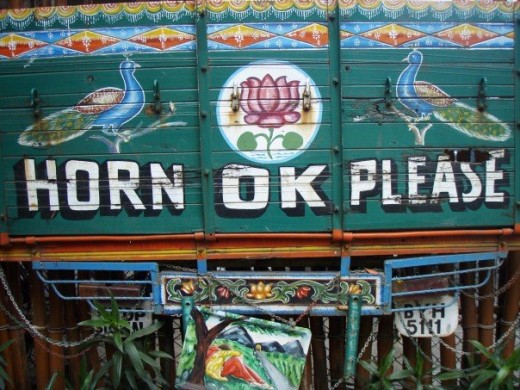
Take a look at the rear of any truck you pass. In bold letters will appear the words “HORN PLEASE”. A newbie will ask."What is that supposed to mean?" Just what it says, mon ami. Please blow your horn so the truck driver knows you are behind him and wish to overtake. Now isn’t that easy?
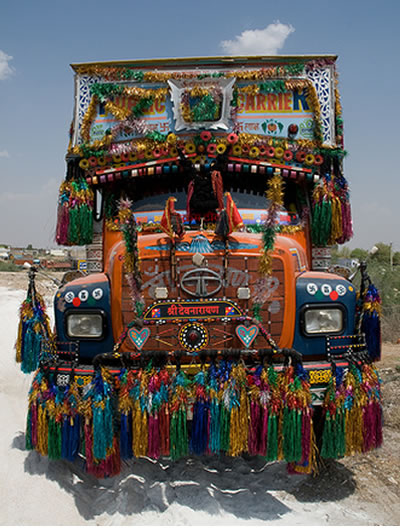
The Front of an Indian Truck
And the Rear
Horsing Around
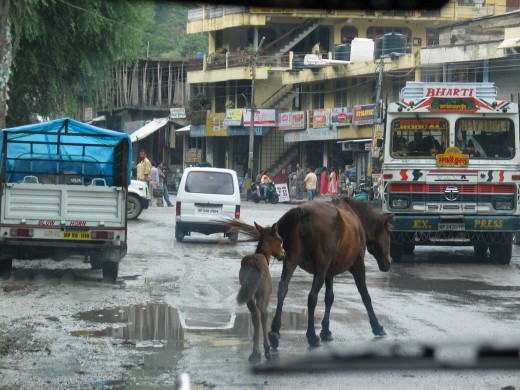
An Indian Road
The British with their motorways, the Germans with their autobahns and the Americans with their highways have got it all wrong, I am sorry to say. Their understanding of a road is that it is a means of getting from Point A to Point B. Period. Gross underutilization if you ask us Indians. Take a look at the innovative Indian brain. Roads are made for the following uses:
- Putting up small shops, eateries and weekly marketplaces.
- Allowing cattle, stray dogs and assorted animals (including camels and the stray elephant) to walk on and sleep, should the need arise.
- Crushing agricultural produce under vehicle tyres.
- Parking vehicles and handcarts.
- Only incidentally for enabling movement from Point A to B.
Queuing up and the Yellow Line
Although the zero may have been conceptualised in India, straight lines and geometry do not interest Indians. Observe queues anywhere. They will always snake around, even at the most modern airports.
The yellow line one sees at service counters is another superfluous Western concept. Research in India shows that the multi-tasking ability and the powers of concentration and hearing of the service-provider improve if eight or ten flailing arms and loud voices engage his or her attention simultaneously. Imagine how boring it can be handling just one customer at a time. Do we want our people to be good multi-taskers or not?
Starers Galore
You won’t see many Indian world champions in sport. The reason is the world has not yet adopted the sports at which we are most adept. Indians would make worthy world champions at staring. We must be the biggest starers of them all. Part of it is curiosity, part plain lewdness. But very few actually mean any harm.
So be prepared to be openly and aggressively stared at, especially if you are of comely mien. And if you wish to react, do so by staring back and then winking. This is bound to make the other person look away sheepishly most of the time.
Spitting Out the Red Stuff
Another sport at which Indians would be undisputed world champions is spitting. I would challenge any other nation to send their most qualified spitters to face us in open competition. It is the birthright of every Indian to chew betel nut and then spit the red juice in seemingly endless streams from buses, trains, bicycles, while walking, while singing and any which way they like wherever they wish.
Staircase corners are a national favourite. Ingenious solutions have been found too. One brilliant idea was to put pictures of any of the thousands of Gods from the Hindu pantheon at frequently used corners. So there is a real chance that red corners may become history.
Even Cobras Do It

We Are Going
We are going,
Heaven knows where we are going
We will know we’re there
We will get there
Heaven knows how we will get there
We know we will–Osibisa in the music album Woyaya
In any Indian town or city, you will see hordes of people rushing around throughout the day and most of the night. This will make you wonder, “Hey, where are these people going? Shouldn’t they be in offices or homes or wherever?” But rest assured, most of them are not just wandering around aimlessly. It may amaze you, but they do have specific places to get to–and they overturn the odds and get there.
Cleanliness and Godliness
India defies the conventional saying of Cleanliness being next to Godliness. Indians score high on personal hygiene, but collectively we are a disaster. Godliness you will find aplenty wherever you look. Cleanliness? Aha, a little more difficult to find. Individual homes are clean but our public areas are a mess. We just dump our muck outside and pray to God for someone to remove it.
If public cleanliness is absent, can unique smells be far behind? Our champion city in this respect is definitely Mumbai. Every kilometer offers a different smell depending on the wind direction. This will surely keep your nose twitching busily.
So What Should You Do before Visiting?
These little bits may help you prepare for the culture shock. And remember, what they say about Romans applies as well to Indians. Perhaps you could consider learning the following arts:
- How to spit accurately to get your own back in case some spit hits you.
- How to blow a horn to create maximum effect to disperse a herd of cattle.
- How to stare back and wink at men who stare at you.
- How to stand in the middle of a passageway and converse loudly while gesticulating wildly.
- How to maneouvre your body so it squeezes tightly into a mass of other bodies.
But don’t let all this scare you. India is still glorious and Indians are warm, friendly and hospitable. Once you’ve learned that you can actually keep your eyes open without fear while sitting in a car, half the battle is won and India is yours to enjoy. Just let the adventurer in you stand up and be counted.
* Chawl-a type of building with single-room tenements, generally in crowded localities.
My thanks to Sally's Trove for her masterly finishing touches to this Hub.