BLS CPR Training Guide
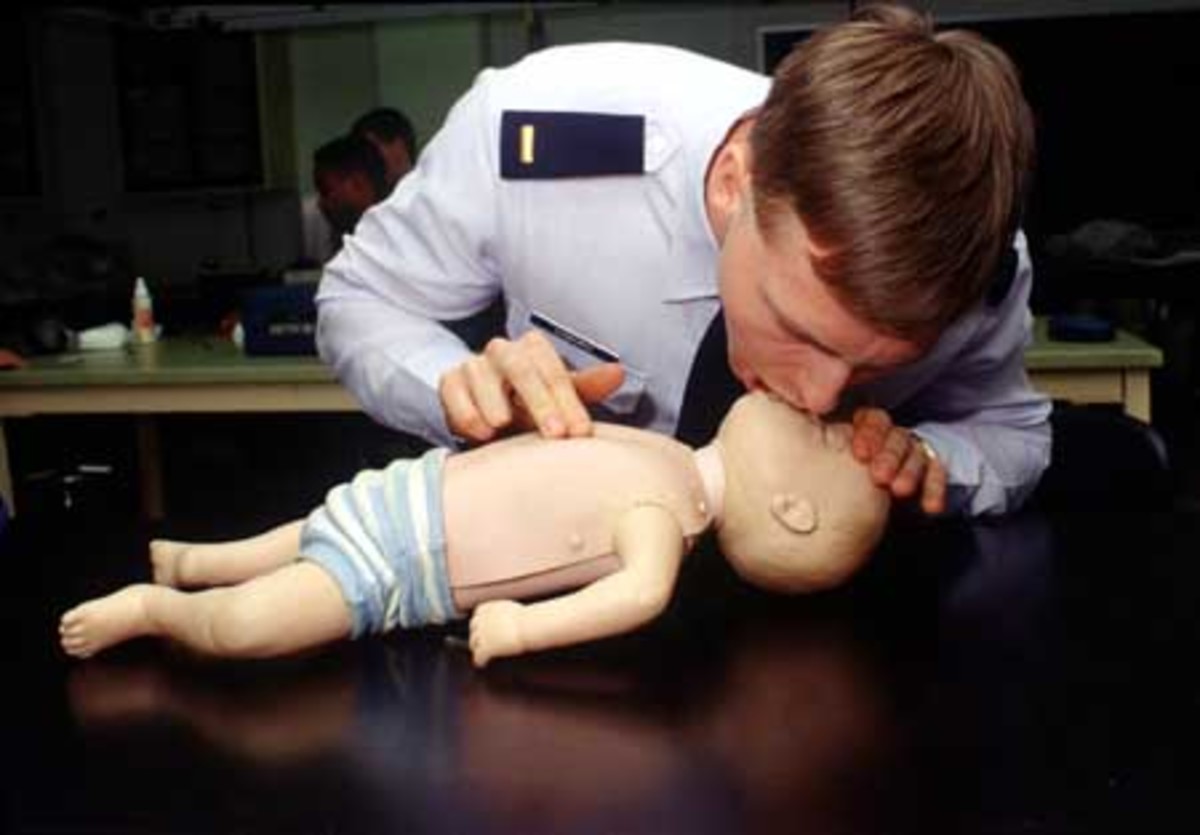
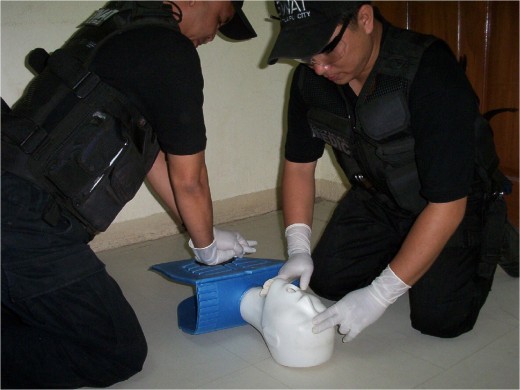
CPR demonstration on a dummy
CPR stands for Cardio Pulmonary Resuscitation. This involves the giving if life giving breaths and a series of external chest compression to person who has no breathing and no pulse.
Often, CPR is associated with medical emergencies such as heart attack, drowning, choking. It should be noted however that CPR is applicable to any situation wherein the victim or patient has no breathing and no signs of life.
CPR training involves the use of mannequin or CPR dummies where the student can apply breaths and compressions to the chest. The courses are often offered by accredited instructors from different institute and are usually updated from time to time.This guideline is based on Pro CPR setting and some aspects of the guideline are not done by Lay Person responders.
CPR saves life! 911 episode, a true story
The Chain of Survival
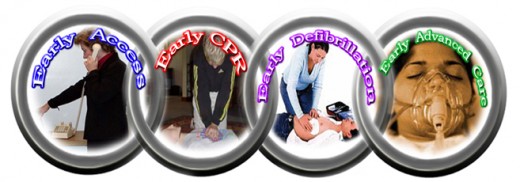
The chain if survival involves a series of procedures that a first aider or responder should do to increase the chances of the victim's survival. The four links of the chain are as follows:
Early Access - immediately call for an ambulance or the EMS to insure that equipments such as the AED and lifesaving medications will be brought to the scene.
Early CPR - providing life saving breaths and external chest compression helps prevent brain damage.
Early Defibrillation - it has been noted that for every minute that defibrillation is not given there is a 10% decrease on the patients survival. So and so that and Automated External Defibrillator has been introduced to the public.
Early Advance Care - providing advance cardiac life support procedures as well as cardiac medications to the victim
Related links for more information
- Basic Lifesaving Solutions Training Center
Visit our website for First Aid and CPR International Course Completion Cards and Certificate - Training Center Journal
View the the training center Instructors and Participants in Action - BLS Simulation Videos
First aid videos during simulation training of Basic Lifesaving Solutions Training Center - AED USE
Automated External Defibrillators (AED) are becoming more and more prevalent in schools, airports, and public buildings all over the country. These fantastic devices have saved many lives that would have... - Earn Money Online
Disease Prevention
Bear in mind that providing CPR may expose you to certain diseases. It is important that you should have sufficient protection against bloodborne and airborne diseases.
For a complete guideline on protective equipments as well as first aid guides on common medical emergencies visit my first aid and lifesaving hub.
When to start CPR
When person stops breathing and the heart stops pumping, brain damage will occur in about 4 minutes. Thus, CPR should be started immediately when the following conditions are observe on the victim:
- The victim is unconscious
- The victim has no breathing
- The victim has no signs of life (no pulse)
Assessment should be done in a systematic manner to insure that CPR can be given in the most reasonable time to increase the chances of survival.
For people with medical background, checking of pulse is necesarry. The pulse can be checked on the carotid area. However, for layperson, checking for signs of life such as coughing, movement, eye opening is enough.
When not to do CPR
Although we have mentioned that CPR is done when the above situation exists, there are also situations that CPR should not be applied anymore. Herewith are the following:
Rigor Mortis - this is a condition where the body is stiff already. This condition occurs when the person died and several hours has elapsed already.
Livor Mortis - commonly known as lividity. When the heart stops pumping due to cardiac arrest, the blood does not circulate anymore and blood is pulled by gravity. This condition can be observed by looking at the body of the victim. Half of the patients body which is near the ground will be somewhat bluish, this indicates that blood has been pulled by gravity to the ground. The upper half will be pale.
Crushed head or skull - if the victims head or skull is crushed by 50% or more, CPR is not necessarily applied.
Decapitated head or body - if the head has been has been separated or the body is cut in half, clearly the victim is beyond recovery
Decomposition - when the body is decomposing already, this is a sign of certain death and CPR is no longer necessary.
DNR - this are actually legal orders from a physician. This means, Do Not Resuscitate. In some cases, the patient has requested for a do not resuscitate order. Basically this is a lawful and binding order.
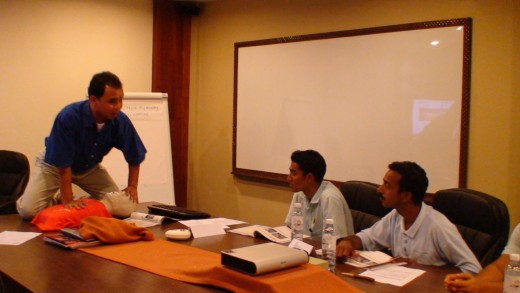
What are the steps in CPR
CPR involves the giving of breaths and chest compression when the person has ceased breathing and when the heart stops pumping. Exhaled air still contains enough oxygen that can sustain life to a person on respiratory arrest. External chest compression will enable the heart to pump and circulate blood which carries the oxygen to the body tissues and organs which are essential for survival. Giving breath alone to a cardiac arrest victim does not deliver oxygen to the brain.
In doing CPR proper assessment and should be conducted and certain step should be followed to make it effective. Bear in mind that it should be done early as stated under the chain of survival metaphor for a greater chance of success.
Check the scene for safety
Before doing anything, make sure that the scene is safe. It is very important to survey the scene for any hazards that could be dangerous to you or the victim. Assuming that the scene is unsafe, make it safe if it can be done without harming yourself. If not, then call for assistance. Only when the scene is safe that you can start your assessment and aide.
Hazards may include fire, possible explosion, electrocution, falling, and many other things. You may perform emergency transportation such as dragging the victim or rolling the victim to safer place if the scene safety cannot be guaranteed.
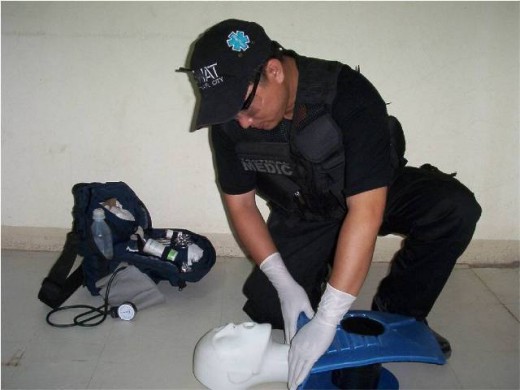
Determine Unresponsiveness
After checking the scene for safety and scene is safe, you may proceed to check the victim for responsiveness. You may do this by tapping the victim's shoulder or chin. Ask if the victim is alright. If there is no response, then it would be best to call for emergency medical services if you have not called for assistance yet.
Open the airway
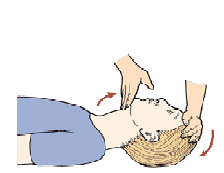
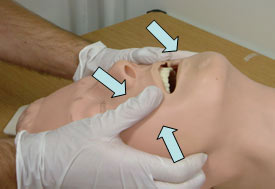
There are two methods of opening the airway. The head tilt chin lift method and the jaw thrust maneuver.
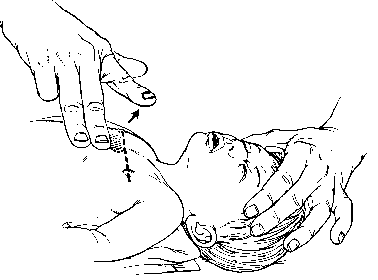
If no cervical injury is suspected, you may use the head tilt chin lift maneuver. One hand is placed on the forehead while the two fingers of the other hand is placed on the chin. By tilting the head backward, this will open the airway. Most often, more than two fingers are place on the chin, this will often cause a choking effect on the neck. Make sure that you only place two fingers on the chin as you open the airway.
If cervical injury is suspected, use the jaw thrust maneuver. This is done by lifting the lower jaw upwards without moving the neck to insure that no additional injury will occur.
Bear in mind that most cases of obstruction during CPR is the tongue. So it is imperative that either of the methods should be applied to insure the opening of the airway and allowing the air that you blow to enter the lungs.
CLICK HERE TO FOR A DETAILED INSTRUCTION ON HOW TO OPEN THE AIRWAY
Check for breathing
The next step is to check the breathing. If you can recall the ABC's after opening the airway, you now proceed to B for Breathing.
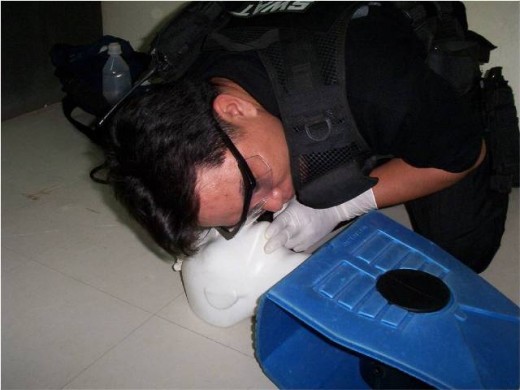
You can check the breathing by placing your ears near the patients mouth and nose and listen or feel for air coming out. Look also for the rise and fall of the chest, this will indicate that the patient is breathing.
Check the breathing for 5 but no more than 10 seconds.
(In most cases the common thing to remember here is LLF. Look Listen and Feel. That is to look for the rise and fall and listen and feel for air.)
Give two initial breaths
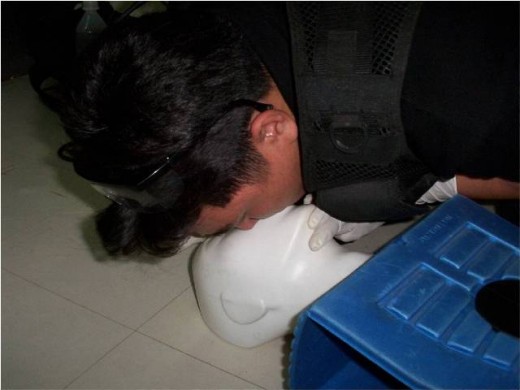
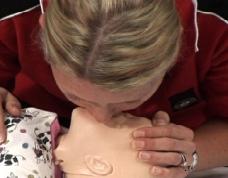
If the patient is not breathing, simply give two blows. This can be done by sealing the patient's mouth with your mouth and blowing air into the mouth. This is commonly called mouth to mouth resuscitation. At least two blows should be given at 1 second each. Remember that the head should be tilted upon blowing or the airway opening should be maintained while giving your blow. Otherwise, effective ventilation is not achieved.
Pinch the nose as you blow on the mouth. This will insure that the air will go directly to the lungs instead of going out to the knows. Release the knows as you release the mouth after each blow.
For infants, seal the mouth and nose with your mouth as you blow. There is no need to pinch the nose. Do not put to much pressure as you blow on an infant. Only use the air from your mouth.
Providing rescue breaths can be done in the following:
Mouth to Barrier - this is with the use of mout to barrier devices such as pocket mask, face shield. This devices are very useful and are very effective in providing the rescuer personal protection.
Mouth to mouth - providing blows towards the mouth of the victim
Mouth to nose - in some cases where mouth to mouth cannot be given effectively, mouth to mouth is the other alternative.
Mouth to Stoma - this is the blowing of air towards the patient's stoma.
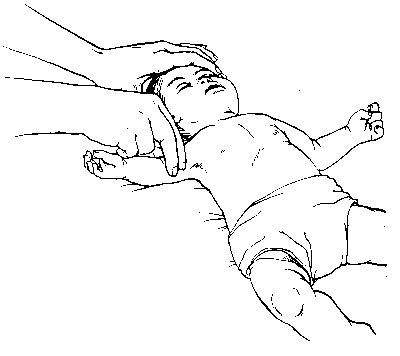
Check for pulse
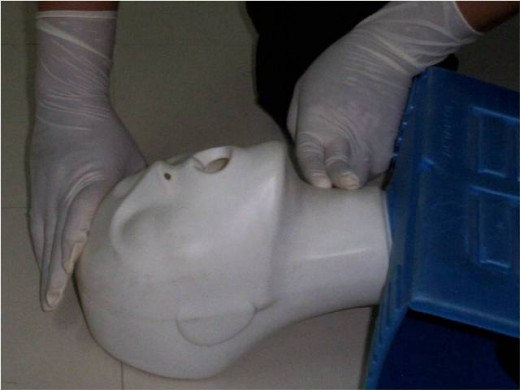
After providing two blows, you may now proceed to check the pulse. For adult and children check the pulse on the carotid artery. You simply place your finger on carotid artery and feel for a pulse. ( for people with no medical background, simply check for signs of life that is - movement, coughihg, eye opening, breathing). If the pulse is not felt and the vicitm has no signs of life begin CPR.
For infants check the pulse on the brachial artery. Your fingers cannot be accomodated in the neck of an infant thus it is imperatvie that you check on the brachial artery instead of the carotid.
Pulse check is only necesarry for healthcare providers. For those who have no medical background (layperson) checking of pulse is not mandatory. (Most often brain damage occurs for failure to provide cpr immediately and most layperson are not familiar on how to check the pulse properly taking to much time to check and often deliver late cpr.
FOR LAYRESPONDERS, PULSE CHECK IS NO LONGER NECESARRY. RATHER, CHECK FOR SIGNS OF LIFE INSTEAD.
Give external chest compression
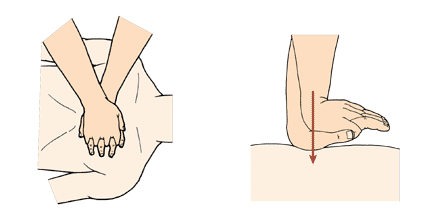
If the pulse is absent, then perform chest compression. This is accomplished by placing both hands on the chest and compressing the chest. This will actually make the heart contract and eventually pump blood to the body most especially to the brain.
What is important is proper placement of the hand and proper positioning of the body to insure good and effective compression without getting tired right away.
Place the middle finger of one hand in line with the nipple line of the victim. Bring the heel of your hand to the patients sternum until the heel of the hand is directly on top of the sternum while keeping the middle finger aligned with the nipple. Place the other hand on top of the other hand. The fingers can be interlocked or not. What is important is that only the heel of your hand should making the compression with the assistance of your upper body. This can be accomplished by moving your upper body forward until your shoulders are parallel with your hands.
Give 30 compressions, at a rare of 100 compressions per minute. The depthness of compression should be at least 1 1/2" to 2 inches for adults.
For Children, you may use one or both hands during compression. Compress the chest 1/3 to 1/2 the depth of chest.
For infants compress using 2 fingers. Compress the chest 1/3 to 1/2 the depth of chest.
Provide Cycles of CPR and Rescue Breaths
Perform 5 cycle of 30 compressions and 2 ventilations. This should be accomplished in two minutes time. The compression as mentioned should be given at a rate of 100 compressions per minute and blows should be given at 1 second each blow.
Regardless if the victim is an adult, child or infant, the ratio for compression and ventilation is 30:2 for single rescuer CPR
When To Stop CPR
The CPR provider can stop CPR in any of the following conditions
Help arrives - EMS personnel, first aider who can take over
Exhausted - you may stop CPR to rest but never leave the victim until help arrives since this may constitute abandonment
Life Appears - when patient is revive or pulse and breathing have returned
Pronounce dead - when a Medical Doctor arrives at the scene and pronounce the victim dead.