A Painter Teaches
Lessons from Spring Art Week at the Western Colorado Center for the Arts
- Western Colorado Center for the Arts
A dynamic community art center, the Western Colorado Center for the Arts offers exhibitions, classes, and support for arts education.
A Creative Field Trip
This April, the Western Colorado Center for the Arts in Grand Junction held its annual Spring Art Week. More than 3000 students from District 51 schools attended.
Presenters, all local artists, included
- a stone sculptor
- blacksmiths
- potters
- a glass artist
- a musician
- a batik artist
- a cartoonist
The lessons offered here were presented by a Remodernist painter working in acrylic on canvas.
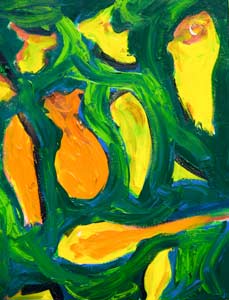
Fish in a Pond
Primary children attending a fifteen-minute session took turns painting simple fish shapes on a blank canvas. By adding the green "water" between the fish, the painter showed them the importance of negative space in a composition.
Ways to teach negative space in the classroom:
- Place an apple or other simple object on a sheet of white paper. Invite students to draw the white space instead of the object.
- Show students examples of great paintings and photographs. Point out that the "background" shapes are just as important as the subject.
- Invite students to create their own paintings of fish in a pond.
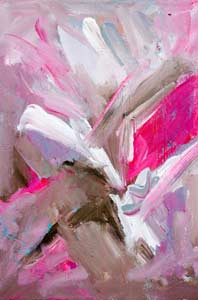
Love
Before starting this painting, the painter discussed two-dimensional and three-dimensional works of art.
- Students were invited to consider the difference between a hand, a three-dimensional object, and a photograph of a hand, a two-dimensional object.
- Paricipants identified works by the potter, the sculptor, and the blacksmiths as three-dimensional.
- Students named length and width as the dimensions of a painting or photograph.
Next, the painter pointed out the importance of a painting's two dimensional personality. She used the fish, deftly-placed by first-graders, to demonstrate the importance of every mark on the picture plane.
Ways to teach two and three dimensions in the classroom
- Show examples of sculptures and two-dimensional art.
- Encourage students to shoot digital pictures of each other and print the results. Discuss the differences between the model and the picture.
- Invite students to make a drawing and a clay sculpture representing the same subject.
- Use the program "Poly" to make three-dimensional geometric forms. Invite students to name the two-dimensional shape on each face.
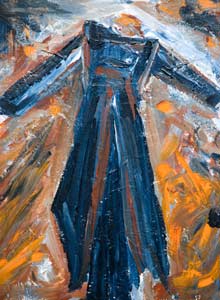
The Conductor
As part of a lesson with older students, the painter discussed the role of reference materials in the creation of a work of art.
- She asked students what kinds of references they used when they wrote reports.
- She encouraged them to name such sources as encyclopedias, library books, online historic information, and interviews.
- They agreed that they would never use just one source to write a report and that they would not simply copy from a book and call the work their own.
- The painter discussed the references she used to create her own work.
- As an example, she showed some sketches she made at a local symphony concert.
- She showed the painting she did using the sketch as a reference.
- She explained that painters use many different kinds of reference when they create their works.
- She showed examples of watercolor sketches and photographs.
- She pointed out that an actual scene, still life setup, or posing model is a kind of visual reference.
Teaching Children to Use Reference Materials in the Classroom
- Assign a history or science report. Help students choose a workable topic. Use Inspiration (software popular in many schools) or other brainstorming tools to gather initial ideas.
- Demonstrate how to use encyclopedias, the library's online card catalog, online periodicals, and primary sources to find out more about the ideas listed in the brainstorming session.
- Show how to organize the gathered information into an informal outline.
- Review paragraph structure, emphasizing topic sentences.
- Encourage children to write a rough draft.
- Hold Writer's Workshop groups allowing children to read their rough drafts aloud and encouraging group members to make suggestions.
- Instruct students to write the final report.
In art, allow time for students to use various types of visual reference, or, if there is no time in class, assign drawing projects as homework. These projects may include:
- Copying a Master drawing upside down. See Wikipedia Commons for Public Domain works.
- Drawing a simple object from real life.
- Making a landscape drawing that combines elements of two different photographs.
- Drawing a portrait of a friend or family member from life.
- Sketching a favorite object, such as a stuffed animal, and then using the sketch as the basis for a painting.
Discuss the similarities between visual art references and print references.
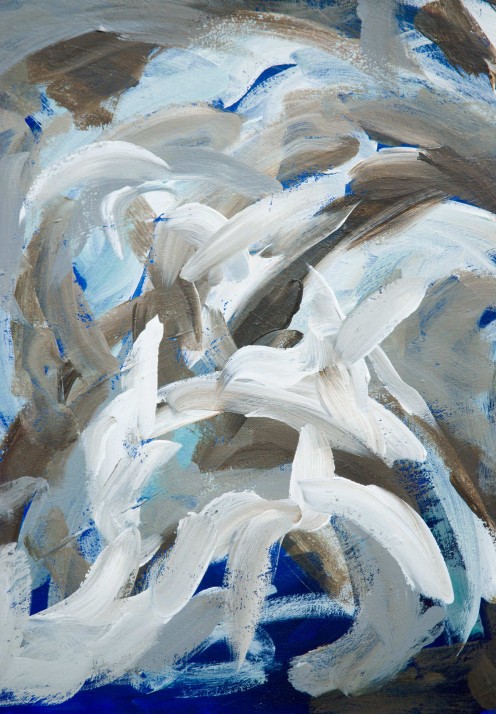
Explosion of Birds
The demonstrator started this exercise with a canvas covered with blue paint.
- She showed students previous paintings made with oranges, reds, and yellows.
- Through discussion, she established that those were warm colors.
- She pointed out that blue was not a warm color and asked for a word that meant the opposite of "warm".
- She asked the children to name other colors that were "cool". (For the first-graders, this was a vocabulary review and a review of the important concept of opposites.)
- She demonstrated how to hold a brush.
- She showed them how to step back from the picture.
- She emphasized the importance of using large arm movements when painting.
- She pointed out that it is important to take time to look at the "whole picture. " This concept is of great value in every field.
- She encouraged students, one at a time, to come up and make a brush stroke on the canvas in brown.
- As they watched, she developed the painting.
- She explained that, as an artist, she often does not know what the painting will become when she begins.
Many artists, including poets and writers of fiction, consider this kind of uncertainty and discovery to be one of the greatest rewards of the calling. It is hard to explain, but easy to see.
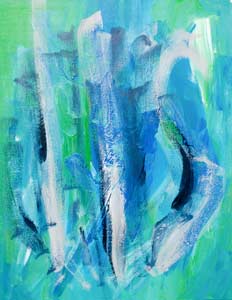
Three Lines
With another group, the artist featured lines.
During a quick discussion, children named different kinds of lines. These included
- diagonal lines,
- vertical lines
- horizontal lines
- straight lines
- curved lines
- thick lines
- thin lines
Children took turns coming up to paint lines on the canvas. Later, the artist developed their marks into this painting.
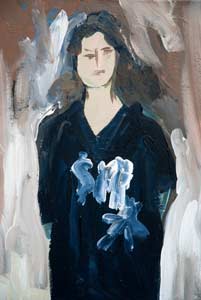
Girl in a Black Shirt
Girl in a Black Shirt
The artist did this quick study of one of the students to demonstrate the importance of establishing large shapes before concentrating on details.
- She used Fish in a Pond to show the importance of negative space.
- She discussed different types of paintings including landscapes, still lifes, and abstracts.
- She showed examples of each.
- She selected a volunteer to pose.
- As students watched, she blocked in the shape of the model in dulled pink and Payne's gray.
- She explained that rendering the text on the girl's shirt literally would be distracting.
- She pointed out the relationship of the bold shape to the edges of the canvas.
- She worked on the piece until the end of the 15 minute period.
- She encouraged students to take turns modeling for each other when they returned to class.
Support Music and Art Education
Visit these Elementary Education Hubs
- Cardinal Elementary School
Cardinal Elementary School, 5415 Highway #16, Eldon, Iowa 52554 Cardinal Elementary is part of the Cardinal Community School District which is a 1 to 1 Apple Technology School. We educate grades PK-5 serving... - Teaching: The True Art of Patience
Teaching can be a rewarding experience. It is a way to inspire young minds, and encourage thinking. However, a teacher's main asset is patience. A good teacher must remain patient with his or her students at... - Insights of Becoming an Elementary Grades Teacher
Once you choose to become a teacher prepare yourself to be a knowlegeable person teaching a variety of subject matter covered in the daily lesson plan but as long as you enjoy working with children there... - Arts & Crafts Idea for Kids
If you're a camp counselor, elementary school teacher, or homeschool mom or dad, you're probably on the lookout for new arts and crafts ideas for the coming school year. Even senior center directors are always... - Teaching Art In the Elementary Classroom: A Lesson I...
Last year I was given the awesome opportunity to teach art in my daughter's 5th grade classroom. I eagerly accepted this new challenge and looked forward to sharing my love of art with the children. It was my... - Elementary Help Web Sites For Kids
- Keep Music Education in Our Schools
- Insights of Becoming an Elementary Grades Teacher
For Skeptics: Careers in the Arts
- Careers in the Arts
Does art education still seem like a waste of valuable time? Check out this fascinating and extensive list of high-paying and interesting careers in the arts.