The Wonderful Camera Obscura

A Victorian Motion Picture
The camera obscura - Latin for "dark room" - was a sort of giant camera that Victorians could enjoy along with the other delights of the seaside, for they were usually found on popular beaches or in parks - anywhere that tourists and passers-by could enjoy them.
Briefly, the camera obscura works on the optical principle that when a pinhole of light is admitted to a dark room, the rays of light order themselves into an upside-down image of what is outside. The camera obscuras of the Victoria era were fitted with a lens (to sharpen the image that was created by the thin ray of light) and with a mirror to cast the image onto a horizontal viewing surface.
The camera obscura was first developed by the Islamic scholar Al-hazen in the 10th century, and was mentioned by Da Vinci in his notebooks. However, it was not until the 18th century that the portable, box version (the pinhole camera) was developed as an artist's tool, as well as the room-sized version. The 19th century was the real heyday of the walk-in camera obscura. They were popular all over the US and Europe.
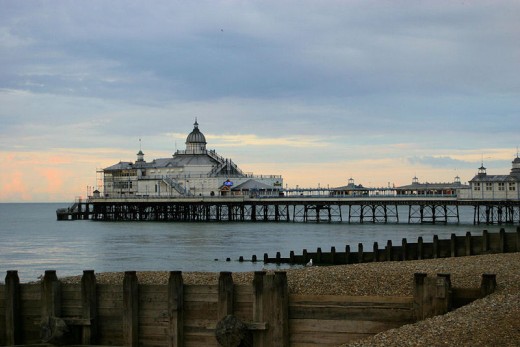
The Eastbourne camera obscura dates from 1901 (some sources say 1888, however) and is the only one still in operation in the world that is located on a pier. It is well worth visiting if you go there, as long as you don't mind heights! I do, but I was so excited at the prospect of seeing one that I braved the sensation of being so far up, so far out from the land!
The Eastbourne camera obscura is in a VIctorian white onion dome of a building, located at the far end of the pier. It is placed high above several flights of stairs so that one can get a good view of the pier, the beach and the ocean - and this is really effective!
Inside, the camera obscura looks like a round room, very ordinary, with a large shallow white dish in the center, sort of like the 1960s home-movie projector screens, only round and horizontal. The curator made sure that the room was completely dark and began to turn a crank so that the panoramic image would turn and give us a 360 degree view of the outside world. It was really clear and sharp - the ocean, the pier below us with people moving around, and in the distance, the beachfront and beautiful white hotel buildings like wedding cakes. It was more like a home movie - not a still picture, which is what you think of with a camera - it is like a giant live-action photograph. I loved it and was so glad we had been able to visit.
Now there are only a handful of operatng camera obscuras, mostly in the US and the UK, as well as a few elsewhere in Europe and one in Cuba. Here's the current list - and if you ever do get a chance to go inside one, please do! I promise that you will not be disappointed!
US CAMERA OBSCURAS
Santa Monica, CA - Pacific Palisades Park
Los Angeles, CA - Griffith Observatory
San Francisco, CA - Cliff House
St. Paul, MN - Science Museum of Minnesota
Raleigh, North Carolina - North Carolina Museum of Art
UK CAMERA OBSCURAS
Bristol Observatory
Eastbourne Pier, Sussex
Portslade, Sussex
Long Melford, Sussex (Kentwell Hall)
Greenwich, London - Royal Observatory
Edinburgh, Scotland
Kirriemuir, Scotland
Dumfries, Scotland
Douglas, Isle of Man
Aberystwyth, Wales
Llandudno, Wales
Portmeirion, Wales
SOUTH AFRICA CAMERA OBSCURAS
Grahamstown
Johannesburg
Pretoria
Capetown
EUROPEAN CAMERA OBSCURAS
Turin, Italy - Cinema Museum
Lisbon, Portugal
Tavira, Portugal
Cadiz, Spain
Perdika, Aegina Island, Greece
Marburg, Germany
CAMERA OBSCURAS ELSEWHERE
Havana, Cuba
Images from Wikipedia and the New York Public Library Digital Gallery.
- Eastbourne Pier
Description and photos of Eastbourne, Sussex pier including information about its beautiful 1901 camera obscura. - The Magic Mirror of Life: An Appreciation of the Camera Obscura
A site devoted to the history and appreciation of the camera obscura. - Lost Camera Obscuras
A list of lost camera obscuras in the UK, somewhat out of date as it includes the restored Eastbourne camera obscura, but still a good list with historical info as well. - A Travelling Camera Obscura
Willett and Patteson travel around the UK with a portable camera obscura - this is the official website.