Politics: Presidential Transition Process: Party Time

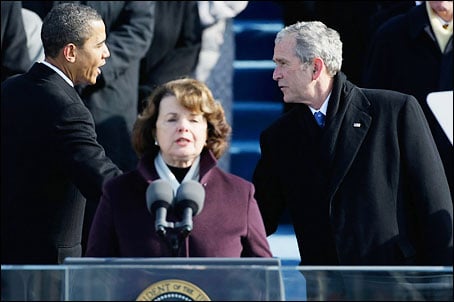
President Obama's First Term Inauguration in January 2009
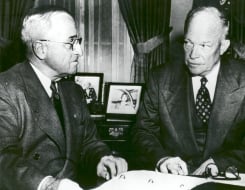
Truman, Eisenhower Transition
Clinton, George W. Bush Attend First Obama Inauguration
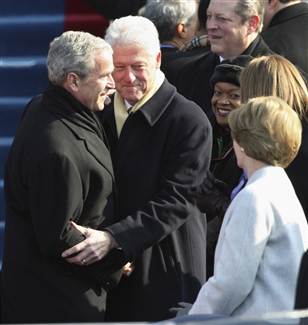
Reporting on the presidential transition on Jan. 20 some television commentators called attention to the remarkable process which has become our legacy in this country, a legacy that contrasts sharply with some other nations where violence and anarchy often characterize an exchange of power.
In the United States the process has become so mundane that the emphasis has shifted to the fringes: What is the First Lady wearing; who's entertaining or appearing at inaugural balls.
It is true that over the years the process has encountered a variety of minor problems, such as personality conflicts between incoming and outgoing chief executives, but the process has endured, even flourished, without disruption and without bloodshed -- no small accomplishment.
Peaceful Exchange
The peaceful exchange of power between men (Sorry, ladies) representing competing political parties was all the more striking this year because so many of the world's nations are in political turmoil; so many nations, including some of those reconstituted from the breakdown of the Union of Soviet Socialist Republics, are seeking transition of power not through peaceful means but rather by the muzzle of a gun.
One might wonder why the United States has been able to pull this off so smoothly while some other nations fail so miserably.
United States Not Exempt
One major reason is, of course, the incredibly well-written U.S. Constitution which provides the necessary foundation -- which is not to say that this country could not fall under some real transition problems some day under another set of circumstances.
Our history of peaceful transition mitigates toward future exchanges of power being accomplished in a peaceful and, for some, even a boring manner.
While the Constitution plays an important role, the temperament of our outgoing presidents also can be important.
Political Party Restraint
No doubt that temperament is a factor of the individual's personality, but it also may be tempered somewhat by his obligation to represent his political party; how he performs from the beginning to the end of his term reflects on everyone in the party. Should a future outgoing president balk at giving up his power merely because of an election, he would likely find little support among his fellow party members who have to look to future elections to regain power.
Two-Party System Helpful
For this reason, and others, the two-party system has not only helped make the United States a strong world power, but also has made an important contribution to the quadrennial transition of power from one party to another; some intermittent third parties have been no real threat to this process.
Independent candidacies, such as those of Ross Perot, George Wallace and John Anderson, serve the temporary purpose of sending a message to the major parties that many electors are not happy with the way the country has been run.
The Role of Party Loyalty
But any sustained effort to do an end run around the two-party system will not only diffuse opinion within the United States so much that no president could muster support for the often critical actions that must be taken, but also could endanger the presidential transition process by removing the aspect of party loyalty.
Political parties keep reins on those who would abuse their trust.
Pick one.
This piece was written as a "My View" column for The Hour newspaper of Norwalk, Conn., on Jan. 30, 1993. The subject is relevant to the transition of power after the 2008 presidential elections.