The Two-Party Political System

Gov. Lowell P. Weicker, Jr.


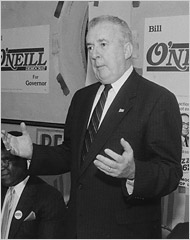
Governor William A. O'Neill
The two-party system in America is not a one-party idea, contrary to popular belief.
The conventional wisdom is that Democrats favor the system because the Republicans, urged on by U.S. Sen. Lowell P. Weicker, have departed from it by embracing the independent voters (called nonaffiliated in Norwalk because a local party has adopted the Independent moniker) in its primaries; and because Gov. William A. O'Neill fought unsuccessfully in court to block independents from participating in Republican primaries.
While it is clear that Sen. Weicker would greatly benefit from giving independents a role in selecting Republican candidates here in Norwalk former GOP Chairman Enrico DiPasquale battled hard, and often, in behalf of the two-party system -- not necessarily the most popular thing to do in a four-party city.
Weicker attracts Independents
Sen. Weicker's maverick antics over the years have attracted many independents to his corner, as well as a goodly number of Democrats while simultaneously enraging many of his own Republican Party members. The recalcitrance of many in the GOP each time Sen. Weicker throws his hat in the ring appears to be what gave birth to the concept of independents voting in Republican primaries.
Sure, it makes sense for a political party that is badly outnumbered in registered voters -- whether it be in a ward, precinct, city, state or federal district -- to seek a coalition with others in an effort to gain power. But the practice is fraught with danger.
Coalitions Lead to Inaction
One does not have to go to France or Italy, or to myriad South American countries that have multiple factions, or parties, to find an example of how coalitions can lead to inaction and disaster.
In Norwalk, where Democrats, Conservatives, Republicans and Independents have been jockeying for power for years (with several other, smaller parties trying their hands at times), the two-party system has been dealt a damaging blow. It is the Democrats that have most often benefited from the division among the other three parties, enabling the election of their slates on several occasions.
However, in those times when the three other parties cross-endorsed candidates, creating a political coalition, the Democrats suffered -- but it was not all rejoicing for the coalition. By definition, coalitions bring together varied elements requiring compromise -- often fueling bitter battles with political opponents.
If we must compromise -- and we must -- why not do it within the two-party system?
I wrote this column as an "Editor's Notebook" for The Hour newspaper of Norwalk, Conn., on Aug. 17, 1987.