Time Travel on a Budget

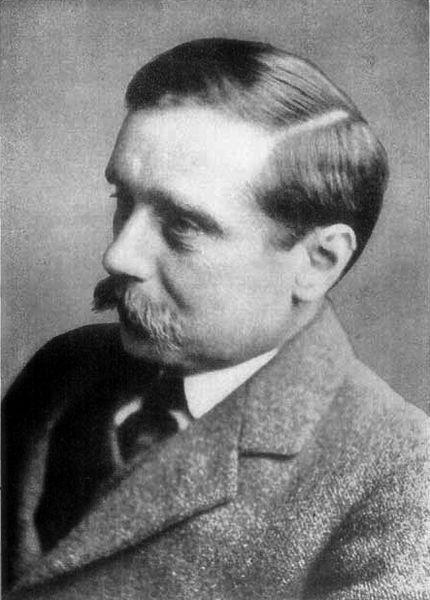
H.G. Wells - The Father of Science Fiction
A Wormhole is All You Need
The literature of time travel is based on one idea: it is theoretically possible to travel in time. When Einstein postulated his General Theory of Relativity he turned physics on its head. E=MC² is the familiar equation that says energy equals mass times the speed of light squared. The formula opened the gates of scientific inquiry as no other formula ever had. It also spawned some fascination theoretical possibilities, one of them being the ability to travel in the dimension of time.
The theoretical formulation known as the Einstein-Rosen Bridge is also known as a wormhole. The term wormhole was first used in 1957 by a theoretical physicist named John Archibald Wheeler. Find one and you can go back or forward in time, with or without the flux capacitor that Michael J;. Fox used in Back to the Future. Physicists use the language of mathematics to communicate with one another. When a physicist tries to translate a mathematical formula into readily understandable language, trouble ensues. That's because theoretical physics is really explainable only in numbers. But nevertheless they try.
The Einstein-Rosen Bridge is a case in point. It's difficult to understand using standard English rather than mathematics. Try to picture a two dimensional surface and then try to fold it along a third dimension, creating a sort of bridge between the two dimensions. Now if you picture a circle or mouth in the two dimensional plane, the mouth would be spherical in three dimensions. See what I mean? It's not easy to picture, but physicists theorize that this bridge or wormhole can actually be an entrance to a different time.
The Literature of Time Travel
Even without an explanation from the theoretical physics folks, time travel would still be a hit as a sub genre of science fiction. H.G. Wells, often referred to as the father of science fiction, wrote The Time Machine in 1895, before Einstein's General Theory of Relativity, and well before the idea of a wormhole. Mark Twain wrote A Connecticut Yankee in King Arthur's Court in 1889, even before Wells' time machine.
One of the most recent popular novels involving time travel was Stephen King's 11/22/1963. The book is about a man who finds a wormhole and steps through it intentionally to go back from 2011 to the early 1960s. His goal is to kill Lee Harvey Oswald before he assassinates John F. Kennedy. He travels back and forth in time, letting us in on a fascinating look at life in America in the early 1960s, with all of the plot twists, scenes and character development we've learned to expect from Stephen King. I won't spoil your fun by telling you the end, but the book is a wonderful read so you should find out for yourself.
The Butterfly Effect
The Butterfly Effect is a scientific theory hatched by an American mathematician and meteorologist named Edward Lorenz. He was an expert on chaos theory. The idea behind the Butterfly Effect is that the tiny atmospheric disturbance created when a butterfly flaps its wings can set in motion a string of events that may lead to a gigantic hurricane a continent away. The Butterfly Effect is also a staple of time travel literature. The idea, in books on time travel, is that if you go back in time and change anything, your action can have an enormous effect on the future, just as the flapping wings of a butterfly can create climactic chaos. Stephen King has a lot of fun with the Butterfly Effect in 11/22/63. In the great 1985 time travel comedy, Back to the Future, Marty McFly, played by Michael J. Fox, struggles valiantly to make sure that his mother falls for his father, otherwise Marty wouldn't exist.
Alternate History Novels
An alternate history novel is one that weaves a story based on a different history than the one that actually occurred. Fatherland, by Robert Harris is one of the best in the genre. The book starts in Berlin in April 1964, Hitler's 75th birthday. The Third Reich is still around, because Harris came up with an alternate history: Hitler and the Third Reich were not defeated in World War II. This book did not involve time travel, but alternate history stories work perfectly with the time travel genre.
Alternate history novels are popular because it's a fascinating task to speculate on what the present would look like if certain changes occurred in the past. Any serious novelist knows that the evolution of a story from an idea to a concept and finally to the story itself, begins with a string of "what if" questions. This is true for any kind of novel, not just alternate history or time travel. What if the hero was injured before he could save the damsel? What if he saves the damsel and she turns out to be an evil person? What if the hero is killed before the end of the book?
In time travel books, especially ones involving alternate history, what if questions are what makes the story. What if the cloud cover didn't break up near Midway Island in 1942? The American bombers wouldn't have seen the Japanese fleet and wouldn't have attacked it, and the war in the Pacific could have drawn on for years. What if Dewey had defeated Truman? What if the atomic bomb that was dropped on Hiroshima was a dud? You can ask these questions over and over and suddenly you may notice something: you have a story to tell.
Time travel and alternate history novels are such a rich source of literature and film because the "what if" questions, in the hands of a good novelist or screen writer, can give us a great story.
The writer of this article is the author of three time travel novels, The Gray Ship, The Thanksgiving Gang, and A Time of Fear
Copyright © 2013 by Russell F. Moran