The Law of Moore - What's in a Name?

Do You Know Moore's Law?
About Moore's Law
Intel co-founder Gordon Moore predicted in 1965, based upon the former developments of microchips and underlying logical patterns (that comes with chips), Moore's Law. This law should not be considered as a natural law. See it more as an observation of a development.
Moore's Law predicts how many more transistors fit on a microchip each year. The last 50 years this law appeared to be precise. Are there similarities with Moore's Law and developments in society?
It formally says that the amount of transistors on a microchip doubles each 1½ to 2 years. Growth is possible by reducing the size of components (transistors) on the chip. That this law won't continue eternally is something that almost everyone will understand. At the time transistors arrive at atomic level Moore's Law simply stops to work.
But this will take a while though. Instead of packing components side by side, the newest generation chips already have piled components. Moore's Law just keeps on going.
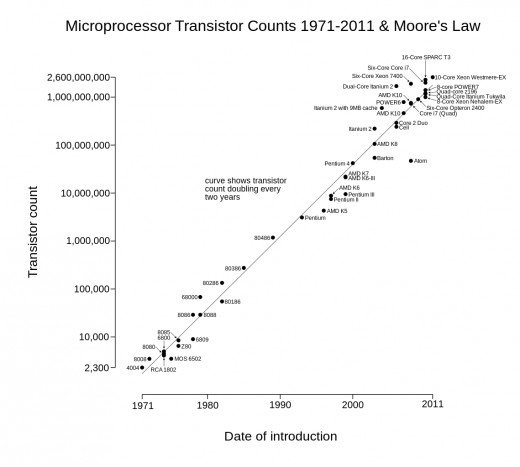
Up to this day Moore's Law appeared to be very consistent. Every new chip generation applied almost to this law, as you see in the graph below.
At the time transistor technology reaches its borders there will be other techniques, like optical chips, that will apply to a new generation of Moore's Law (not to confuse with Moore's second Law).
What is Interesting About Moore's Law?
The interesting thing about Moore's Law is that it allows to 'measure' parallels between the development of semiconductor technology and developments in our society. These parallels make future predictions more reliable than it otherwise would be, since our society depends now for almost 100% on ICT. Everyone is hooked on to the machine these days.
The often considered question is that Moore's Law wouldn't be an actual law, but more a kind of wishful thinking of an Intel engineer. Intel dictates 80% of the microprocessor market, and the question is therefore legitimate: does Intel comply to its own made laws? Why not? It became more or less a goal to focus on.
Nevertheless is the effect the same. We have a measurable development, and that's the scope of this Hub.
So, how is our future looking if it's up to Moore's Law?
*Moore's Law and computing power (flops) have a linear relationship. This makes it easy to step over to computing power whenever you want.
When is Moore's Law Dead?
With an internal circuitry of 14nm wide, the molecular level is getting in sight. Another increasing challenge is the frequency of light, that is used to etch the conducting lines on the chips, which is larger than the width of the tracks. For this reason chip producers won't be able to push the limits for another two decades.
Piling component looks a nice solution, but the heat generation (and cooling) becomes an increasing problem with this technique. For the first time since Moore's Law started, the costs per component are beginning to increase. Will Moore's Law die soon?
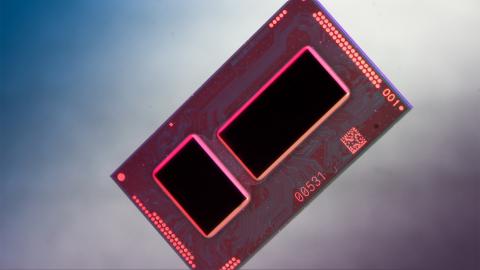
The newest 5th generation 14 nm Intel Core M is again more powerful than its predecessors. It makes devices thinner, smaller, more energy saving, and fanless. But for the first time since 50 years the price per transistor stopped to drop, which means, that the economical end is in sight for this technique - 100% sure.
The question, will Moore's Law soon be dead? The answer is yes. But there will rise a second version of Moore's Law for a w-h-o-l-e new generation of chips - the optical chip.
History of Intel Chips
Year
| Intel processor
| Average Frequency (MHz)
| MIPS (millions instr. per second)
|
|---|---|---|---|
1974
| 8080
| 2
| 0.3
|
1978
| 8086
| 8
| 0.7
|
1982
| 80286
| 10
| 2.5
|
1985
| 80386
| 25
| 8
|
1989
| 80486
| 50
| 30
|
1993
| Pentium
| 60
| 100
|
1997
| Pentium II
| 350
| 450
|
1999
| Pentium III
| 1,000
| 1,850
|
2000
| Pentium 4
| 2,500
| 3,400
|
2003
| Pentium M (mobile)
| 1,200
| 2,650
|
2006
| Core 2 Duo
| 2,400
| 7,000
|
2008
| Core I7
| 3,000
| 9,800
|
2013
| Core I7 4th gen
| 3,000
| 80,000
|
2015
| Core M (mobile)
| 800
| unknown
|
Sources: roylongbottom.org.uk / Wikipedia
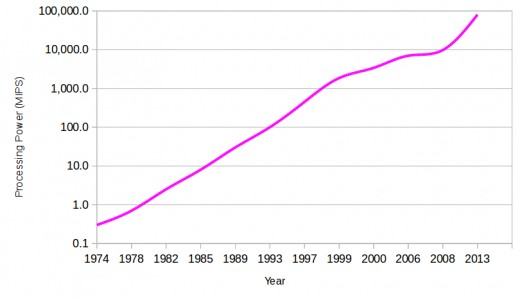
Processing Power of Intel's Chip Over the Last Decades
MIPS and FLOPS
MIPS stands for Millions Instructions per Second, and is used to measure performance of processors of the same architecture.
FLOPS stands for Floating Point Operations per Second, and is used to express performance between two different totally different processors. It stands for the amount of calculations a computer can make per second.
A New Kid in Town - The Optical Chip
There's recently a new kid in town - the optical chip technology. There are a few developments going on simultaneously. The two most promising solutions are:
- The graphene technology (IBM)
- The liquid crystal grid technology (Optalysys)
The graphene technology of IBM will take many more years of development until commercial devices will be available.
The liquid crystal grid technology is currently the most promising optical chip, which is capable to process large data portions parallel by using an advanced mathematical technique - the Fourier transform. The technique is totally different as we know today, and offers insane possibilities in boosting processor speed.
The Optalysys Chip
When millions of these tiny light switches are packed together on a chip, it's in fact the same concept as the traditional chip, but much faster and less energy consuming, with promising applications.
The liquid crystal optical chip is built by the company Optalysys. This first prototype (2017) is approximately 3 times as fast as the fastest Intel I7 processor. The prognosis is that the future chips will crush Moore's Law, and heads very fast to a new limit, somewhere around 2030.
The new chip technology will focus on miniaturisation and on processing power. This hybrid mix ensures that huge processing power comes available in one tiny chip, which makes it able to integrate these chips inside sheet materials like plastics, glass or even metals.
The processing power of this chip for a desktop sized computer in 2020 is claimed to be remarkable. It is expected to reach 17 exaflops, which is 150 million times faster as the fastest Intel I7 chip! That is beyond comprehension, isn't it?
This technology enables the possibility to stuff the processing power of at least 10 Iphone-6's on a human hair! Grandpa, who was Gordon Moore?
When you're looking for a long term investment goal, this technologies will be a good pick!
Moore's Law Extrapolated Into the Extreme
Inventor and Futurist Ray Kurzweil
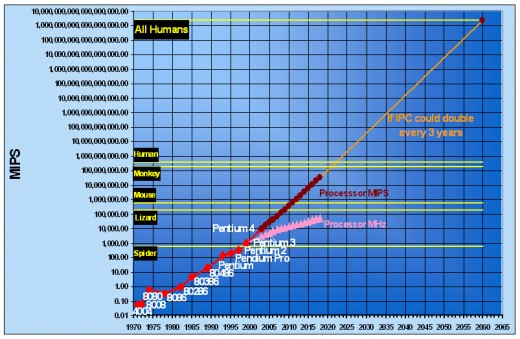
This graph above is based on the book called "The Singularity" of Ray Kurzweil. Everyone knows (or feels) intuitively that one single chip will never be able to beat all human brains together. Every intuitive sane person knows that's simply impossible.
But it seems hard to prove that he is wrong, since he bases his conclusions on past events and extrapolates them to Walhalla.
The author exceeded in his approach the limits of quantum mechanics - the Planck constant. This ultimate border cannot be passed, while you have to pass this to enter the singularity. Nothing material can pass the borders of the Planck constant. Kurzweil's ideas are impossible. It is sad that so many people actually believe this bullocks.
The territory between the Planck constant and 0 (the singularity) is only reserved for the Monad (the Soul).
This book contains nice ideas to read, but I would advice to take this not too serious, since they are based on fairytales.
What About the Parallels With Society?
There are clear parallels between advancements in chip power and how our society changed. The current chip technology has reached a turning point in two ways:
- the costs per transistor is increasing for the first time in 50 years
- the physical barrier of the current technology has been reached
There's a gap between the introduction of a new chip and the actual introduction of affordable devices. The coming 3 to 5 years you won't notice much of the limits that has been reached in the traditional chip industry. But after this period the current technology will become second-rate. The new technology will revolutionize society again at the same rate the semiconductor did the last 50 years.
The new optical chip technology will overtake the conventional technology at an amazing speed after 2020.
How Moore's Law Will Continue
And What About This One?
The Future is About Integration of Technology
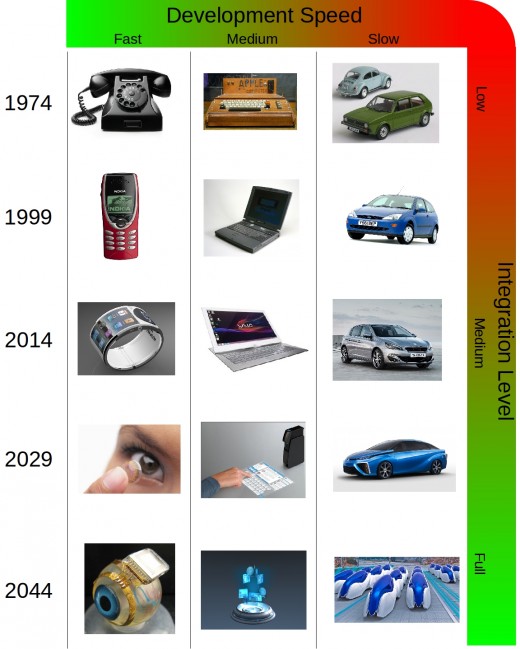
When you look to the scheme, you'll probably notice that in 1974 the Apple had nothing to do with the (bakelite) telephone, and the telephone had nothing to do with the Volkswagen Golf.
In 1999 the fast changing devices became more personal. The phone contained now your contacts, and the laptop your files. It was possible on a rudimentary level to connect the phone with the laptop and with the car. There was no full integration.
In 2014 the fast changing devices became even more personal and closer to your body, like the iWatch. Laptops became faster, smaller, and thinner. It was possible to connect the iWatch with the laptop, and with the car. There's no connection yet between the laptop and the car. Still no full integration.
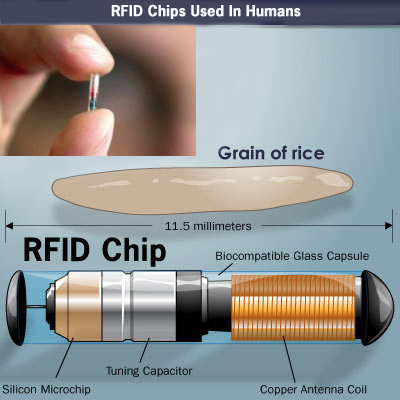
In 2029 the processing power will be boosted on such a scale that all devices will be stored on just a contact lens. Interface will be possible through speech and holographic interface. All devices will be fully integrated with eachother, and able to communicate with eachother, without human interference. Everyone will be obliged to have a RFID-chip implanted. This chip can communicate with surrounding devices without noticing its own host (that's you).
In 2044 integration of devices in the human body has reached a new level. It will be possible to replace an eye for a much better artificial eye. The robot eye is intertwined with our brain. The highly advanced eye has the computing power beyond our current comprehension. The robot eye is able to create holographic images and to manage all other devices in our surrounding. Cars will be fully automatic personal displacement devices for one person. You can take a nap while you are transported! The computer has taken over most of our tasks and thinking.
Well folks, I hope you enjoyed this future watch! Make sure to unplug yourself from the Matrix before the mandatory chip implants will start, otherwise there will be no way out.
© 2015 by Buildreps