The mystery and magic of riding a bicycle

Ride!
When I turned six my parents gave me a two-wheeler to replace the tricycle I had been riding for about three years.
Getting to ride a bicycle was something of a challenge and I was scared at first, but my mother, who was a no-nonsense kind of person, put me on the saddle, gave the bike a push and said, in her most commanding tones, “Ride!”
I rode.
Not without quite a few spills, scraped knees and bumped elbows, to be sure, but I rode, and have been grateful ever since for the mystery and magic of riding a two-wheeled vehicle.
It is said that cycle riding is one skill that, however early or late one learns it, it will always be there for you. You never forget it.
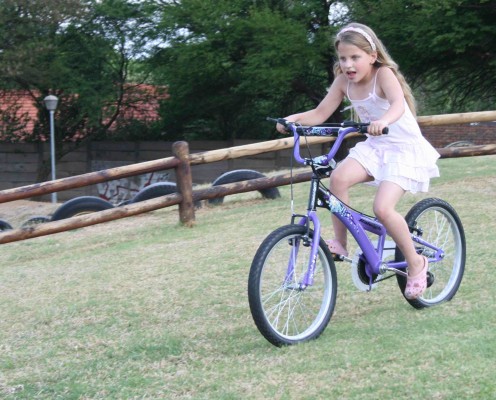
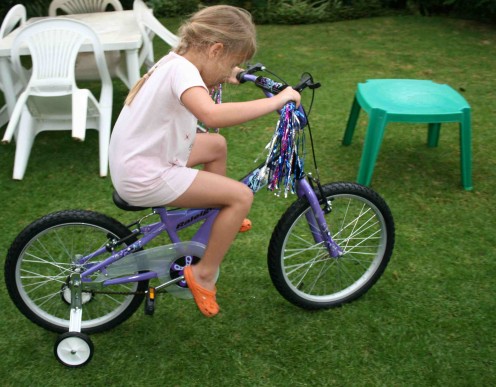
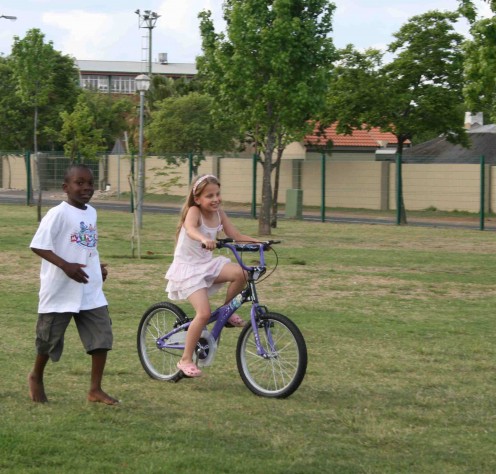
These memories and thoughts have come back to me this year as I bought a bike for our daughter as a seventh birthday present. It had fairy-wheels. She struggled at first and I realised that the fairy-wheels actually were more of a hindrance than a help and so I took them off. She has since begun to ride, if not quite like a pro, at least with a rising sense of confidence and assurance.
I must say that for me seeing Caitlin getting on her bike and riding is a source of tremendous pleasure. It is a significant step towards independence. And if there is one gift I would like to leave her when I shuffle off this mortal coil, it is the gift of independence – independence of thought and behaviour, an independence of mind and will.
That is what my mother did for me when she commanded me to ride – she gave me a sense of being able to do something for myself.
From that day on there was seldom a day
that I did not ride. And from that riding I learned so much – of
cotter pins, and ball bearings, of punctures and tyre pressures, of
how to tighten a nut without stripping the thread, of how to ride in
mud and in the long grass. It was a never-ending adventure made
possible by the fact that we lived in a rural area with forests, dirt
roads, streams, hills and valleys, which I soon learned to conquer at
will, deriving intense pleasure from flat-out speed down precipitous
hills, or the painstaking negotiation of home-made mazes which
required a fine ability to control the bike at dead-slow pace. Cycling became an important part of my life
History of Bicycles
This is a very brief history of the bicycle.
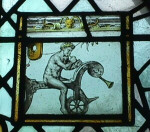
A 16th Century stained glass window in St Gile's Church, Stoke Poges, in Buckinghamshire, England, shows a naked angel sitting on or riding something which looks very like the vehicle invented two centuries later. Was this the first bicycle? Who knows.
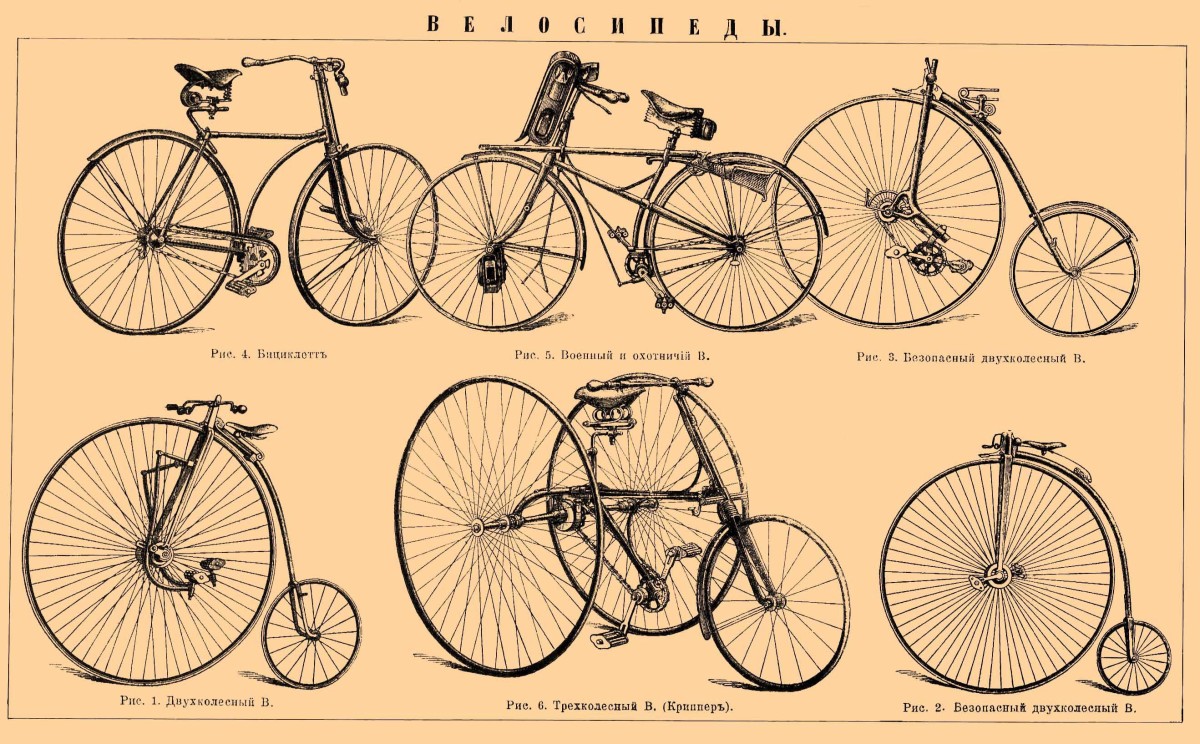
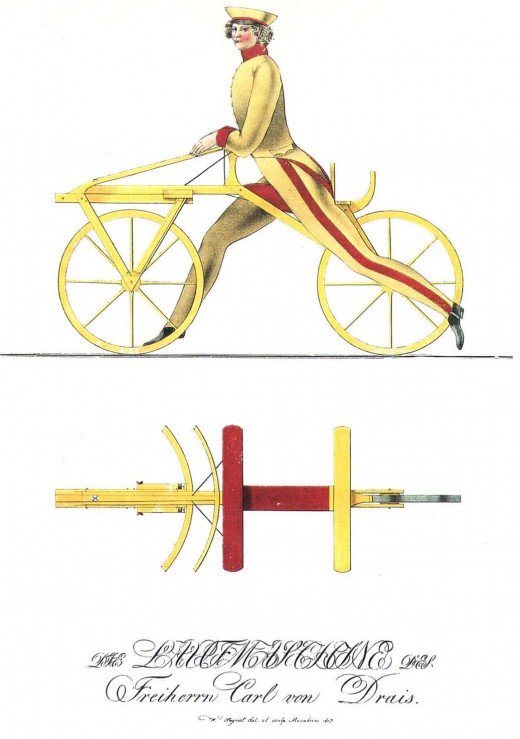
The first two-wheel vehicle seems to have been invented by a German nobleman Karl von Drais in around 1817. He used his wooden Laufmaschine or “running machine” to go around to his tenants and collect the rents from them. This vehicle was a simple frame on which the rider sat astride and pushed it along with his feet. The front wheel had steering.
From then on the bicycle developed in many different countries. In France the velocipede was invented by Pierre Michaux and Pierre Lallemont, who added a crank to the front wheel which could be turned by the rider's feet. In order to get increased speed the front wheel was enlarged, and I guess you can see where this was going!
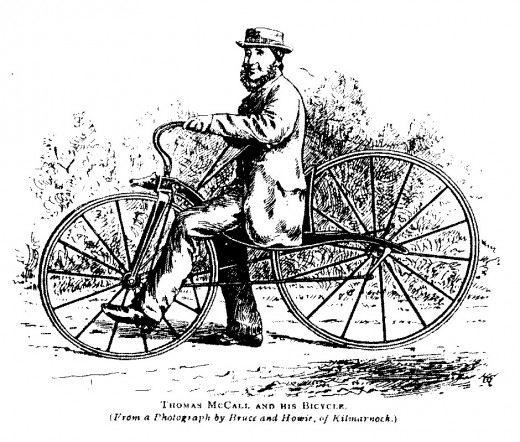
A rear-wheel driven velocipede was invented by Scottish inventor Thomas McCall in 1869. This was rod- not chain-driven. Also the rear wheel was now larger than the front. In the same year a design for a solid rubber tyred two-wheel vehicle was patented with the name “bicycle”, the first use of that term.
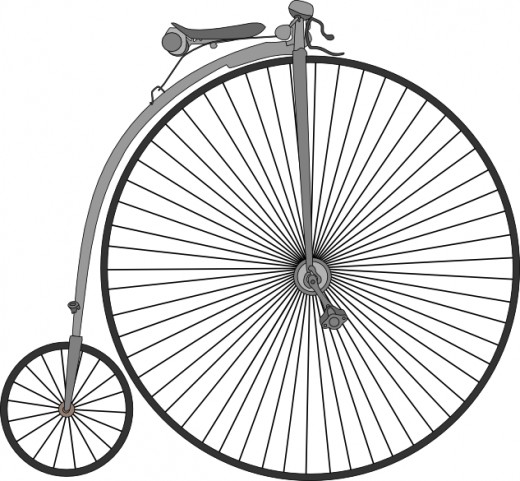
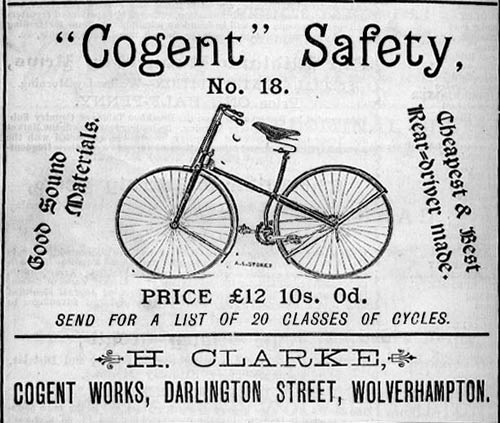
The French version of the velocipede developed into the “penny farthing” which was so-called because of the big difference in size between the front and rear wheels reminding people of the proportions of the two British coins of those names. This bike, also known for some obscure reason as the “ordinary bicycle”, became very popular in spite of the relative dangers of riding such a high machine with its poor weight distribution and high centre of gravity, added to the obvious difficulties of mounting and dismounting, not to mention the high possibility of being thrown forward and having a really nasty fall.
The need to overcome all these difficulties led to the development by a trio of Englishmen of the so-called “dwarf ordinary” which was the first chain driven bicycle. The chain was driven by frame-mounted pedals. One drawback was the rather bumpier ride due to the smaller wheels which had solid rubber tyres. The three Englishmen were J.K Starley, J.H. Lawson, and Shergold. Starley went on to develop the bike most recognisably a modern one, the Rover of 1885.
The next developments were the addition of of the seat tube, which formed the double diamond frame still familiar today, and the addition of pneumatic tyres which had been invented by Scotsman (these Scots keep turning up, don't they!) John Boyd Dunlop in 1888. These tyres were a major step forward in the comfort of the bike.
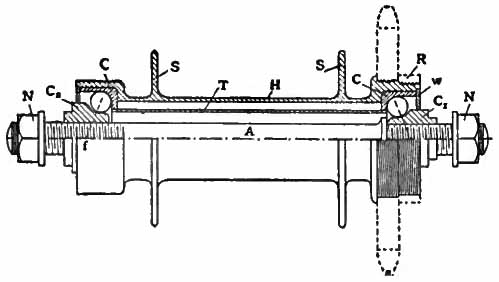
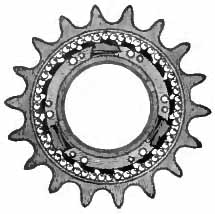
Free wheel hubs, gears and brakes followed soon so that by the turn of the 19th Century the bike was pretty much what we know today, with further development focusing on increasing the efficiency and serviceability of those parts of the bike which were amenable to such development.
The 1911 Encyclopaedia Britannica gives the following description of the bicycle: “The modern bicycle, as developed from the old velocipede, consists essentially of two wheels placed one behind the other and mounted on a frame which carries a saddle for the rider. Between the wheels is a crank-axle which the rider drives by means of the cranks and pedals, and its motion is transmitted to the rear or driving wheel either by a chain which passes over two chain wheels, one fixed on the crank-axle and the other on the hub of the rear wheel, or, in the chainless bicycle, by a tubular shaft and two pairs of bevel-wheels.”
The continued development of the bike has led to the specialised bikes we know today – racing bikes, mountain bikes, BMX bikes, etc.
The fun part
Of course the bike started to gain in popularity once the issues of safety and comfort were satisfactorily dealt with. Clubs formed and races were run and the industry in the United Kingdom became a force to be reckoned with.
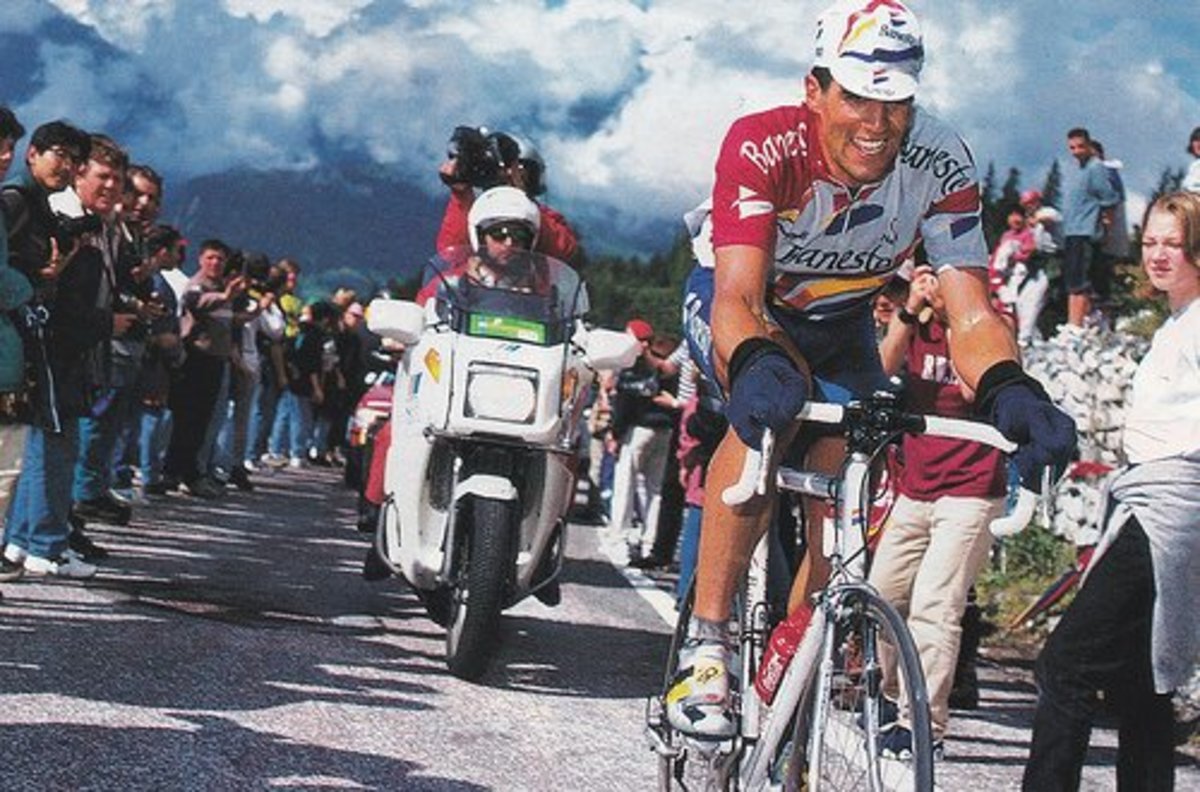
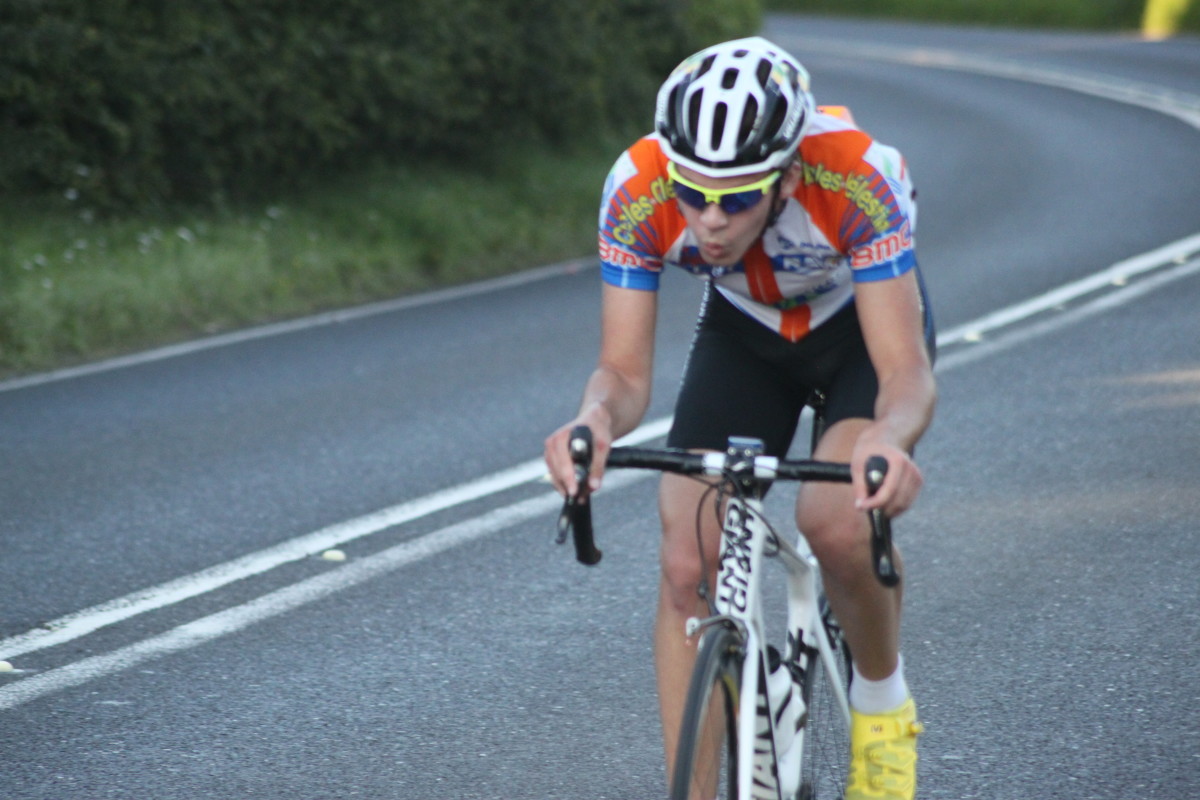
Bicycle tours and races now attract large numbers of people all over the world and it is a recognised fitness tool for people.
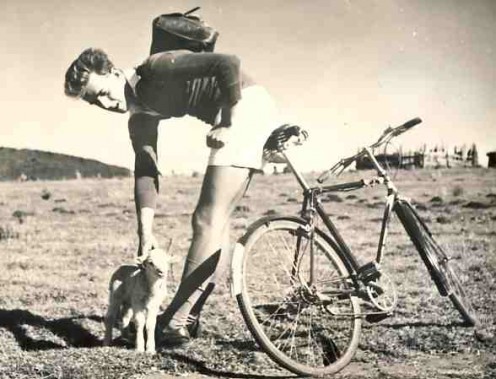
I learnt to ride in 1949 – exactly 60 years ago, can you believe? Well, it was December so maybe 59, but who's counting?
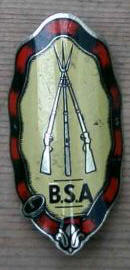
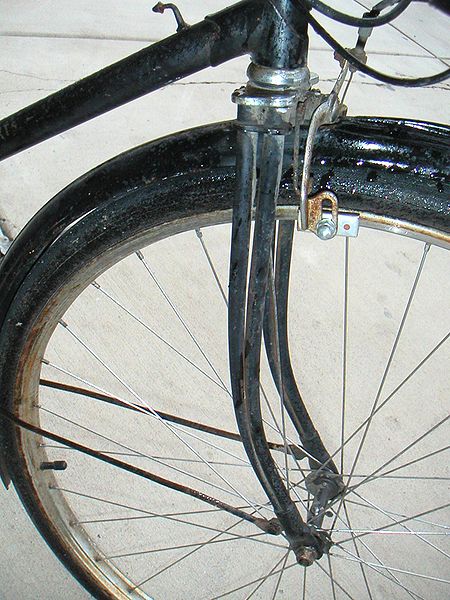
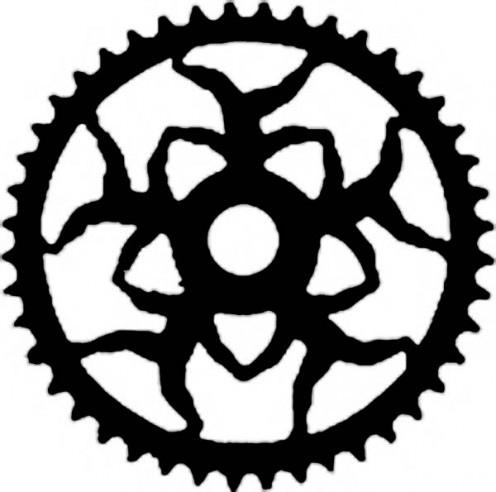
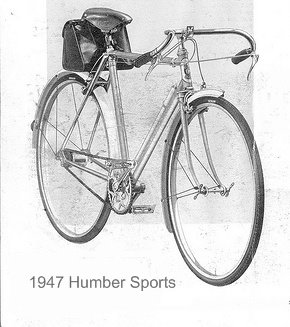
My first bike was, I think, a BSA with 24 inch wheels. The one that I got next, I'm not sure in which year, was a Humber, with its distinctive “Duplex” front fork design and the chainring with spokes forming five people in outline. I thought It was very, very special, as none of my friends had anything like it. It had fancy white mudguards with a shiny chrome thing at the leading edge of the front one. Very impressive!
This brings me to the interesting aspect of all the parts of a bicycle, with which I became increasingly familiar.
Since this is not going to be a fully technical Hub I will just mention a few of these that are perhaps more interesting to the general reader.
The chainring, mentioned above, is part of the crankset of the bike. The crankset is part of the bike's drivetrain, and the drivetrain is what connects the energy from your legs to the back wheel of the bike, giving it forward motion. The legs of the rider push the pedals which, in turn, turn the chainring which then moves the chain which, via the rear sprocket, turns the rear wheel.
The chain and chainring are often encased in a chain guard to protect both the chain and the rider's clothing.
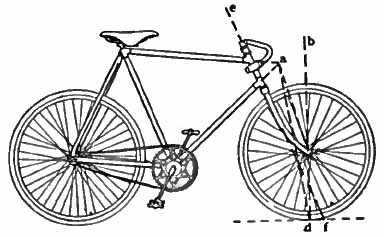
The handlebars are what the rider uses to steer the bike, and to support himself or herself while riding. Handlebars are a great feature of some bikes, especially sports bikes. They are also used to carry bells or hooters, and sometimes fancy decorations.
My Humber had normal handlebars and sported a bell. I also had a lamp which was powered by a generator run off the rear wheel. I thought it really cool! I took the chainguard off quite soon after getting the bike, thinking it not very cool, and for sissies only!
I spent a lot of time cleaning and oiling my bike as well as doing simple maintenance things like shortening the chain when it got stretched, making sure the pedals were working properly, keeping the wheel properly aligned and making sure the spokes were tight.
Punctures were the bane of my riding life, and I had many of them to fix, because I rode in all sorts of places where there were long, hard thorns to puncture the tyres, rocks which caused major problems when hit hard, and I seemed to spend a great deal of time with the bike upside down and getting a wheel off to take the tyre off and find and fix the hole in the tube.
This entailed roughing the tube around the hole with the little file in the repair kit, then putting the compound around the hole, then fixing the patch over the hole, and then dusting it it with the powder that also came in the repair kit, before replacing the tube into the tyres and getting the tyre back onto the wheel and pumping it up again.
I remember often raiding the kitchen for forks to help in the process of getting the tyre off the wheel and getting it back on again! This was not popular with my mother!
- She's Even Faster In The Nude
She rode her bike so well. She loved it as most could tell. But as many men that would find her, She would quickly put behind her. So many beaus she left to grieve. She had many goals to...
The environmental question
Bikes are also being hailed as very environmentally friendly modes of transport.
A very interesting site called “gotoes” has this information about the energy efficiency of bicycles (http://gotoes.org/bikestuff/index.htm):
“The bicycle is the most efficient form of human transport in the world. Energy is often measured in calories, which we are all familiar with. When you look at food labels, the available energy is actually listed in Kilo Calories (that's 1,000 Calories). The available energy in a gallon of gasoline is 31,070 Kilo Calories. The average person consumes between 30 to 50 Kilo Calories per mile traveled on a bicycle (depending on the load and speed). As you might assume, carrying a heavier load or going faster will burn more calories per mile - just like in your car. Anyway, suppose you are cruising to and from work at a 30 KCal / hour pace. At that speed, you could travel 1,035 miles on the energy in a gallon of gasoline. Given that even today's high tech hybrids generally get 55 miles per gallon, you are using 18 times less energy by riding your bike. Moreover, you are saving resources - far fewer materials are needed to make a bicycle.”
Go figure!
Bikes are not just magic and fun, they are also good for you and the environment.
To anyone who has read this Hub I say, as my mother said to me 60 years ago: “Ride!”
Copyright Notice
The text and all images on this page, unless otherwise indicated, are by Tony McGregor who hereby asserts his copyright on the material. Should you wish to use any of the text or images feel free to do so with proper attribution and, if possible, a link back to this page. Thank you.
© Tony McGregor 2009