- HubPages»
- Education and Science»
- Life Sciences»
- Entomology»
- Insects & Bugs
Pictures of Blue Butterflies in the U.K.

Beautiful Blue Butterfly Pictures
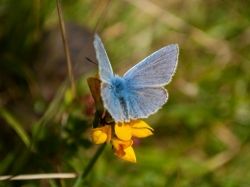
*** An irresistible foreigner added - An Ontario Azure***
All my life I have loved butterflies and they have never ceased to capture my imagination. I never understand why some never settle and fly off at the slightest movement (the whites) while others are so engrossed in a flower you can almost touch their wings (Tortoiseshells).
I have often said that my favourite individual butterfly is the comma. Its wild irregular shape is so unusual and it has a North American cousin which is called the question-mark. Both species are aptly named for the white mark on their under-wings. But as a group, the blue butterflies are my favourite. We are fortunate to have seven species in the UK and with a little bit of research they have sufficient differences to be identifiable by anybody.
I hope you enjoy my introduction to this lovely butterfly group and the blue butterfly pictures I have posted to go along with each description.
Photo credit: Peter Broster (the author)
Blue Butterflies
An Overview of the Blue Butterfly Group
The scientific name for butterflies is Lepidoptera and the family of blues which also includes the coppers and hairstreaks, is called the Lycaenidae. Any reference to the origin of the word leads to connections with fire and wolves. Without any real proof my belief is the referral is to the gossamer on the wings that all these butterflies exhibit although how the wolf fits in escapes me. Most of the species are fairly small with 20 mm wingspans but a few like the Large Blue are quite, ahem large! For whatever reason these butterflies may be small but they are quite territorial, protecting their stretch of grass against all comers. They lie at rest with open wings and are usually quite easy to photograph before flying off. They prefer open grassland, upland chalkland and sea coasts and I have never seen one in a wooded area.
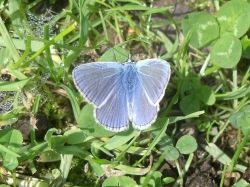
Common Blue Butterfly
Polyommatus Icarus
True to its name, the common blue is the most widespread of all our blue butterflies. On sunny days it can be seen in most patches of meadow and open grassland. My favourite place to see them is on scrubland close to the coast where the land has been left untouched for centuries. Identification of the blues is often tricky and usually resorts to a feature on the wing underside. Common blues are identified by a unique black spot on the underside forewing. But this isn't much use if you can't see it. On the upper wing the common blue is more identifiable by what it has not got. The male is a true blue colour while the female is brown with varying amounts of blue around the wing base. Around the perimeter the white band is not barred and the black edging to the blue does not seep into the wing itself. If you get to see the underwing, it is heavily spotted with orange around the edge and many black spots in the wing along with the all important bespoke black dot. Common Blue's love Birds Foot Trefoil but will go to most members of the pea family. They are seen from April to October and can manage three broods in a year.
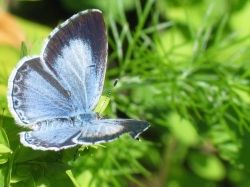
Holly Blue Butterfly
Celastrina Argiolus
Like the Common Blue the Holly Blue is generally widespread through the country but its choice of location tends to be where holly and ivy grow well and so are the species more likely to be seen in a garden. The butterfly flies in two distinct periods, April-May and August-September and for reasons not fully understood, favours holly in the spring and ivy in the summer to lay its eggs. The Holly Blue is similar though slightly larger than the Common Blue and the underwing is quite distinct with a simple pale blue colour and a thin sprinkle of black dots. In the upper wings the black border clearly seeps into the wing itself and this is even more prominent in the female. The black border also runs into the white rim creating a pale chequered appearance.
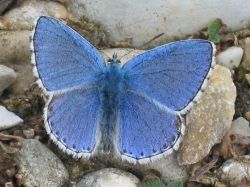
Adonis Blue Butterfly
Polyommatus belargus
This spectacular butterfly is unmistakable with its vivid blue wings and chequered edge seen mainly on open chalkland where it finds its favourite food the horshoe vetch. There are two broods of caterpillars in Spring and Summer and they can be locally quite common although they are suffering from loss of habitat on the English chalk downs.
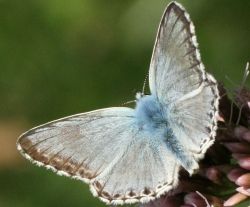
Chalkhill Blue Butterfly
Polyommatus coridon
Unlike other blues this butterfly has a true sky blue colour and is therefore a lot lighter in appearance. The wings are strongly veined and the black border seeps into the forewings substantially. It is also a fairly large member with wingspan up to 4cm across. Horseshoe vetch is also the plant of choice and the butterfly can be quite common in a given location when the conditions are right.
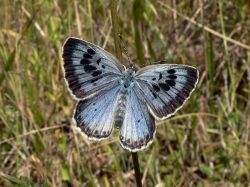
Large Blue Butterfly
Maculinea arion
With a 4cm wingspan the Large Blue is one of the largest members of the blue family. Common in Europe the butterfly became extinct in the UK largely through a misunderstanding of its needs. The pupa needs to be nursed by a specific species of red ant and if they aren't around then the the result is calamitous. The butterfly has now successfully been reintroduced to the downs of Somerset where there is a good supply of wild thyme and marjoram and.....red ants. The large blue is easily recognisable due to its size and the black patches within the forewing. Their flight time is limited to sunny days in July.
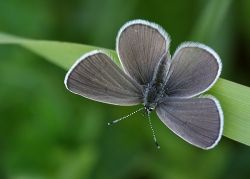
Small Blue Butterfly
Cupido minimus
Also known as the Little Blue this butterfly is only blue at the wingbases. Measuring only 2cm it is the smallest member of the family and has an erratic fast flight which makes it difficult to spot and identify. It can be seen from May to August feeding mainly on kidney vetch. As with most blues it favours sunny chalk or limestone slopes that face south and can sometimes be found buzzing closeby as it is attracted to human sweat.
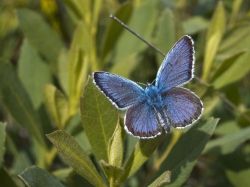
Silver Studded Blue
A beautiful silvery blue butterfly
Positive identification of this butterfly can only be made by the blue green iridescent spots of the edge of the underside hindwing. The silver studded blue is a fast flying silvery blue butterfly that seems to keep going all day which makes seeing the spots very difficult ! The blue colour is purplish and has a diffused black edge that spreads into the strongly veined wings. This silvery blue butterfly is widespread in the south and west of the UK but subject to the same environmental stresses of other butterflies and loss of habitat.
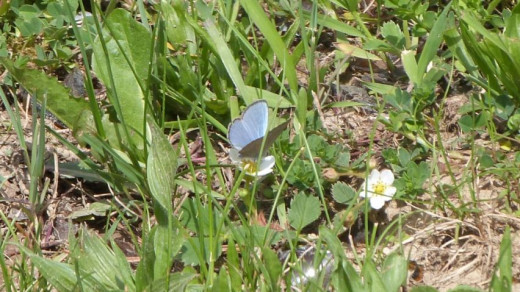
Spring Azure (Celestina Ladon)
North American Cousin
This is not a UK butterfly but I have added for comparison. I have the privilege of being able to go to Ontaio, Canada on a regular basis and of course I go butterfly hunting. A continent has many more species than our small island and it is quite the challenge to identify them, but I think I have finally got this one right. I have always loved blues and this group in Ontario is given the name azure and boy oh boy is that fitting. The blue is iridescent and is spectacular as it rises from the grass. The only way I could capture was this one lucky shot and then a series of shots captured from a video. They are very skittish and rarely open their wings at rest. I hope you will forgive the inclusion of this new world cousin to the Blue collection.
Common Blue in Polaroid
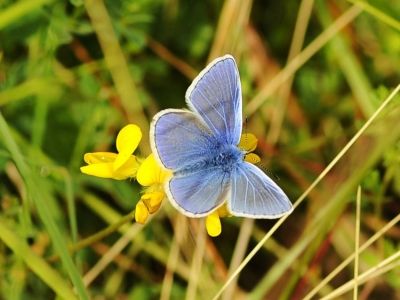
Recent discoveries.
If you can't decide on a butterfly, try thinking about which family you like best. I went hunting butterflies again this summer and I realised that without doubt the biggest thrill for me are the blues. I constantly try to see one of the different blue species but when I see that it is the common blue yet again I am strangely not disappointed. It is a beautiful butterfly and I have included here some of my most recent photos. These are all common blues but you can see variety within the species that is also interesting.
Blue Butterflies Summer 2014
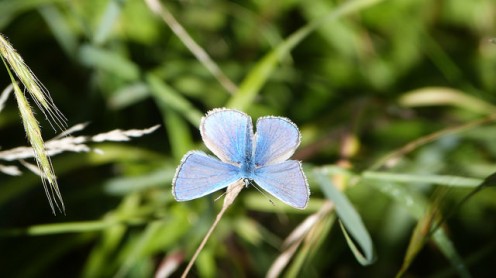
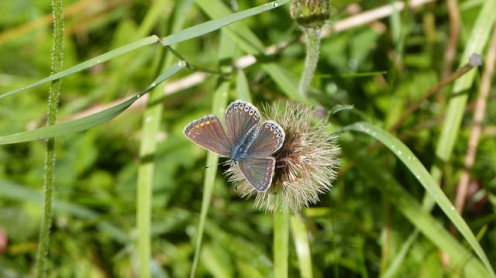
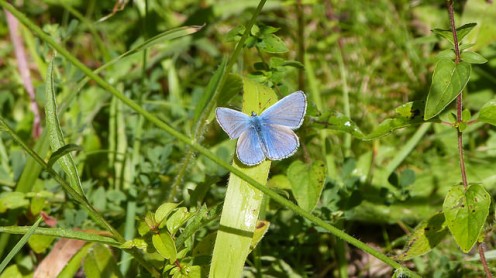
Blue Butterflies
Have I helped you to appreciate Blue Butterflies
My Favourite Blue Location