German Cinema: Nazi Control Reshapes the Industry
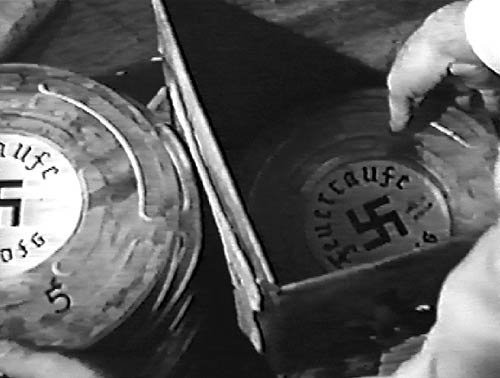
German Cinema: 1930-1945
German cinema during the Nazi regime was bold, innovative and powerful yet constricting, filled with propaganda and ideologically single minded. The time between 1930 and 1945 showed itself to be, cinematically, a stumble backwards with several strides forward. It was an interesting period and one that would show the fighting force of film on levels it had never been before.

The Nazi Regime Loved Movies
It is an odd truth, but both Hitler and Dr. Josef Goebbels (the minister or propaganda) loved movies like fan-girls, so much so they made it a point to develop strong relationships with directors, actors and producers within the industry.
Hitler often screened movies at parties, which was a very expensive activity for that time period. Goebbels was known to watch a movie every day if not more.It is no wonder that the pair would use film and the film industry within the Nazi regime so effectively.
The trailer (shown below) for The Goebbels Experiment (Hachmeister, 2005) shows, briefly, the mind process of the man in charge of Nazi propaganda. The movie goes into detail about his life, but shows how much the media and film play in role of the Nazi regime.
Trailer for The Goebbels Experiment
The Mass Exodus
In 1933, the Nazi party removed all Jews from every aspect Germany’s film industry from the director to the actor all the way to the person picking up the phone in the distribution office. This led to the mass exodus of many great directors such as:
- Max Ophüls (Lola Montès, 1955) Trailer for Lola Montès below
- Billy Wilder (The Seven Year Itch, 1955)
- Robert Siodmak (The Killers, 1946)
Interesting enough, Goebbels wanted Fritz Lang (M, 1931)to take a leading position in the industry. I guess Goebbels didn’t know Lang was part Jewish and opted to leave when it was clear that things were becoming too dangerous in Germany.
Trailer for Lola Montes

Not Everyone Escaped
Just a few of the famous actors that vacated during this period were Peter Lorre (M, 1931), who was Jewish and left for Hollywood only weeks after the release of M.
Conrad Veidt (Cabinet of Dr. Caligari, 1920) also went to Hollywood, but only after putting “Jew” on his paperwork, a requirement for the film industry. He was an Aryan. Ironically, he would find great success in propaganda films for England (The Spy in Black, 1939) and as villainous Nazis in Hollywood (Casablanca, 1942).
Many in the industry saw the writing on the wall, but not all got out. Kurt Gerron, who played the Kiepert, the Magician in The Blue Angel (1930) and directed over twenty films stayed in Germany and succumbed to the same fate as many other Jews in hat time and place: he died in the Auschwitz Concentration Camp at the age of 47.
The Blue Angel starring Marlene Dietrich and Emil Jannings
- Film Review of the Day: M
This is a film review for Fritz Lang's classic "M" Read about the movie, learn some interesting facts about the actor, director and era then watch the original trailer before watching this outstanding movie.
In 1934, Goebbels gained control of censorship and personally reviewed every film, short and newsreel that was shown in Germany during the Nazi regime. Interestingly, although he hated communism, he respected Sergi Eisenstein’s The Battleship Potemkin (1925) for its imagery and use of propaganda. He would direct those in the film industry to take the same approach, using montage to promote the regime's anti-Semitic ideals.
In fact, Goebbels would go so far as to re-screen every film before 1933 and ban any that didn’t live up to the new “Nuremberg laws”, which included any film that could be considered anti-Nazi, pro-diversity and anything questionable. The movie M fell under this rule and was banned in 1934.
Nationalizing Germany's Film Industry
During this period, Germany still depended on importing and exporting films, but found it difficult with their own strict rules and other countries no longer wanting to deal with them. To deal with this, the Nazis turned to nationalizing the film industry by secretly purchasing controlling interesting in all of the major companies including Ufa, Tobis and Bavaria. The take over began in 1937 and was completed by 1942. The end result was Ufi, which combined all the film industries in Germany as well as Austria and Czechoslovakia, which had been seized by this time.
![Inglourious Basterds [Blu-ray]](https://m.media-amazon.com/images/I/51VMfu4L0IL._SL160_.jpg)
Oddly enough, even with control of such a huge film industry, the Nazis were unable to keep up the movie supply since there was such a large demand. Things became even more strained when World War II officially began in 1939 and imports from the extremely popular Hollywood went from a trickle to a halt. The Nazis couldn’t control the world’s film market, but they did control what happened within their own borders.
It is interesting that though Tarantino’s Inglorious Basterds was an over the top, completely fake story, there are moments of honesty and truth there.
Related
Propaganda and Spin: The Manipulation of Mass Actions, Attitudes and Behaviors: Emerging Propaganda Spinternet

Why the Arts are Essential for Society, and Not a Luxury
Baltic Sea Anomaly Is Not a Nazi Secret Weapon
Most Beautiful Hong Kong Actresses from the Peak of Cantonese Cinema! (with Pictures!)

Beautiful South Indian Actresses in Hindi Movies (Part I)