The Mechanics of a Discerning Brain

Introduction
Our brain is an amazing piece of work. It can make complex decisions in a fraction of a second. It is not a computer as we know it. A computer is a fancy calculator. Our brain, on the other hand, can do much more.
- Oct. 2018
Background
Our brain can be thought of as a black box. It has many inputs and it has outputs that can be simplified into a binary tree. Go or no go. For example, when we walk across a busy intersection, our brain is getting all the signals from our eyes and ears and at some point, decides it is safe to walk across the road. How does it do it? What is the mechanism or algorithm that allows our brain to make these decisions and in most cases on the fly.
If you were able to build a computer that simulates this function, it would be quite complex. A computer is nothing more than a fancy calculator that can do simple operstions very fast. In order for a computer to make decisions, it needs to be “programmed” to act a certain way. These programs are complex and have many branches. It boils down to if A then do B else do C. Combining many of these options will produce an algorithm that solves a given problem.
If it was a simple task, then a computer probably can do it better and faster than a human. However, there is one class of problems that a human is better than a super computer. Those are problems that have no easy solutions. The human brain has a shortcut that a computer does not have. This is what allows us to do amazing things that so far a computer cannot do. What is this shortcut?
When you sit in front of a Windows PC computer, and you do some complex task, an hourglass comes on and you can see the computer is crunching away. Eventually, an answer pops up. Or else, it gets stuck and you would have to kill the task. What is going on? Sometimes, a program gets stuck in an endless loop. All computer programs are susceptible to this. In a human brain, we don’t have this. We have something called common sense. When a problem is too complex, we make a decision that is not perfect but as a best guess, this is based on our experience and our instinct. Unfortunately, a computer does not have it.
Details...
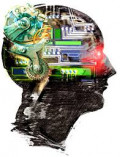
If I was to design a model to simulate what is going on in our brain, it may look something like this. I would call this a filter operation. Our brain has numerous inputs that comes from our senses. That includes our vision, our hearing our touch and our taste and our smell. In addition, we have a database of knowledge that includes the history of our experiences up to this point. The “filter” is our brain creating a logical sorting of all these inputs and deciding which to let through and which to ignore. Afterwards, our brain make a decison. The answer is not a binary tree but a tertiary result. The response may be to take left, or right or stay put. Assuming there were enough information, we decide to go left or right. However, if there were not enough information, we may choose to stay put. Finally, if there were incomplete information, our brain may decide to use our past experience to make an educated guess. With each of these guess, and seeing the results, our brain make adjustments and corrections. That is what give us the gut instinct.
Intelligence
What is intelligence? Or more specific, human intelligence. Is memorizing facts and regurgitating it back a form of intelligence. I say not. A good example is a computer. You can program a computer to respond to questions. When you ask a question about some fact or some math calculation, it gives you the correct answer every time.
Therefore, an intelligent being must have two parts. First, it has to be able to comprehend the question. Second, it needs to use all its memory and experience to produce a best answer. In addition, it needs to recognize that the question may be flawed and that the correct answer may be there is no answer.
Machine Learning and Big Data
In the evolution of the pursuit of artificial intelligence, a new development is to try and simulate this part of our brain. How do we take advantage of a database of knowledge? Assuming we can build a large complex memory system which includes all the data and past experiences...and somehow use that information to guide the computer to make a better solution. This knowledge database is also known as big data. Collecting the data is not the problem. How to make the best use of this information is the key.
In the human brain, some people seems to have a knack for this while others have more difficulty. This has little to do with how educated one is. You can get a PhD and still have very poor skills in this area, while some people with no education can be very good at this. It is also called street smarts.
My Personal Case
This is just based on my own experience. I have no other information except for my own experience. I have always had a good sense of instinct. In my many jobs, I was able to grasp the problem fairly quickly and come up with a solution based on my limited and incomplete knowledge. Invariably, my solutions and conclusions were correct. In the rare cases when I was mistaken, I developed a better skill for the next time around. That is to say, I was able to learn from my mistake.
I think this is the key to advancing artificial intelligence. How we implement such a system escape me. The problem is how do we find the needle in the haystack quickly. The bigger the data, the harder the solution and the longer it takes to get there.
The key may be the filtering that I referred to earlier. Somehow, our brain has a built in filtering system that reduces the problem down to size. No matter how complex, and how many inputs, our brain seems to be able to reduce it down to manageable size.
The solution we come up with may not be the perfect solution or the best solution but in most cases, it is sufficient.
One Example
I was asked to serve on a jury a while ago. A jury or a judge must have good instincts. In a complex case, we are presented with a lot facts or data. Some are relevant and others or not. The two sides, prosecution and defense try to present their best foot forward. In a jury, there are 12 members. A ruling must be unanimous in order to convict. That is a very high bar. A person’s life is at stake.
The trial is to get to the truth of the case. It is up the prosecution to present a case that is solid and no reasonable doubt exist.
The job of the defense attorney is to plant as much doubt into the jury’s mind. It is all about swaying the opinion of even one juror.
In my own mind, after hearing all the testimony and weighing the evidences, I came to the conclusion of a guilty defendant. However, there were several other jurors could not make up their minds. They were caught up in the details that had no bearing on the outcome. The defense attorney were the top in his field. He was persuasive and smooth and passionate in his presentation. The DA on the other hand was young and inexperienced. The judge played the key roll in giving the juror the instructions on how to evaluate all the information. At the end, after a week of deliberations, a guilty verdict was reached. It just took much longer than necessary in my opinion.
Summary
I was forced to come to the conclusion that our brains are not all alIke. Some people are just better at decision making. The process is a mystery. Somehow, given all the data, some people are able to easily sort out the various components and find a solution while others struggle with the details and cannot make up their minds.
Perhaps, our brain is wired differently. This leads me to think perhaps the holy grail of AI is never going to be achieved. Where are they going to come up with new data to populate this database?
The other secret weapon humans have is the ability to “think out of the box”. Humans can come up with totally new answers, that have not been tried before. AI can only draw answers from an exist pool.
© 2018 Jack Lee