Masonry Trowels

Introduction
Is masonry toolery a new field? Learning more about such tools, notably trowels, involves more than how they look to a neophyte. Advice, comfort, history, material, price, quality, suppliers, terminology, and testing (not necessarily in that order) are areas to explore and research. The ultimate goal is finding masonry trowels that perform with ease and efficiency.
London Trowels
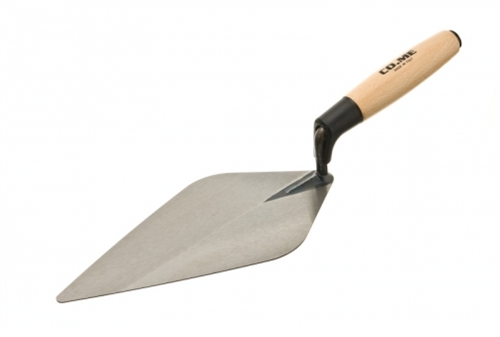
Familiarize the novice
For the newcomer, masonry tools may appear identical to one another. A piece of flat steel is mounted to a handle and that is it. True, masonry finishing tools vary little in overall optical design. The only choice seems to be, "Do I want a rubber handle or a wooden one?" The consequential variable however is quality. Lots of products sold in big box stores tend to have a short life. Many tradespeople declare in earnest that they do not have the privilege to purchase junk. "Buying tools every day will put me out of business. I have to live. My kids need milk on their corn flakes!” states an independent mason.
Invest in good tools
High-end has always been synonymous with expensive. Picture a mogul in a top hat drinking wine and wasting money. But step back for a moment and look at the big picture. The total cost of doing business doesn't necessarily mean cutting corners.
As for masonry trowels, many are on the market. What is sacrificed by investing in a lower priced tool?
Imagine being deep in a trench racing against time. A trowel snaps and pressures mount. Cheap tools cause problems. They break at the worst times. Cutting corners by purchasing sub-par tools will impact interplay with fine tools and sabotage overall workmanship. A second-class job—because of poor tools—precariously dangles a builder’s reputation.
Thus, high-end can also be synonymous with made to last. Beware that some high-priced tools are not high-end. Although a high-end tool may be a larger investment upfront, like masonry, it will last in the long run.
Strive for high quality performance
During the latter part of the 20th Century, the term “high-end” took on a sinister meaning. Through countless marketing strategies to push foreign water-downed junk, the word became a big-ticket evil villain. A true top of the line product is not about price, it’s about performance. Thus, on a price performance chart, a genuine quality article will be in the optimal performance sweet spot of the graph—the “high-end.”
Quality is historic. Picture ancient cities, such as Rome, with vast amounts of masonry structures scattered through their environs. Paver-lined thoroughfares intersected aqueducts and monuments in various building stages. Much is still standing. Further proving that high-end products last. Italian craftsmanship continues to astound.
Test before purchasing
Before buying, test tools of interest. Decide on the top three and take them to task. Trial a bricklayer’s trowel, for instance. A quality model will be made of tempered steel. The drawn out blade has been forged on the shank, fitting into the handle. To see if a trowel is authentically made from tempered steel, preform these tests:
- Tap the trowel blade gently on a hard surface. Do you hear a clear metallic ring? If the sound is minute or dull-sounding, the blade has not been tempered.
- Determine if the blade is evenly balanced. With your index finger, hold the trowel below the base of the handle. Does it quickly hang in a vertical position? If so, it’s balanced. If not, it’s a dud.
- What about the bend of the blade? Typically, it should bend one inch (1”). This flexing motion is crucial as it reduces strain on your wrist. It should easily spring back to its normal shape. An inferior tool will remain bent and interfere with the ease of controlling mortar while flashing.
The above brick trowel tests will prove effective for other types of trowels.
Learn about differences
Distinguishing between hand and power tools
It's necessary to mention that hand and power tools differ. Power tools are basically motorized tools that are driven by energy sources, such as batteries or electricity; whereas, hand tools mechanize by the thrust of human muscle. A hand tool is literally an extension of a human hand. A lot depends on how workers have been trained; however, most apply each on the same job for different purposes.
Getting to know about hand tools and acquiring the skill set of using them can showcase masons' talents and techniques.
Defining fine hand tools
What then are fine hand tools? They are quality high-end implements used for specialty often intricate purposes. Artisans trowel (yes, trowel is also a verb!) layers of colorful plaster on walls and ceilings. This decorative plastering effect is known as viela. Masons butter (another masonry verb) globs of mortar onto brick joints to bind paver layers together for exterior hardscaping structures. Both exemplify the wide range of use that trowels impact. Trowels are further categorized with descriptions about what they do or where they originated, such as brick, London, or Philadelphia, to name a few.
Explaining trowel characteristics
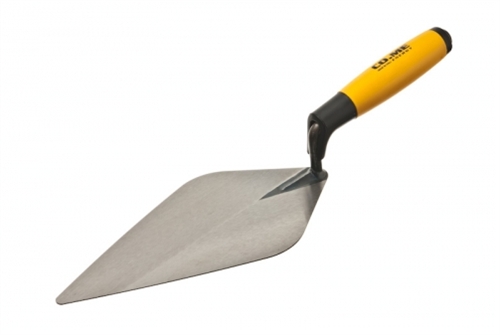
Trowels are delineated by size. A pointer is a smaller trowel for tight intricate work. Pointing (another masonry verb) designates the detail work of buttering bricks, filling joints with mortar, making small repairs, and cleaning up parts to refine the project. A basic trowel is larger, designed for comfort and bigger applications. Brick or bricklayer's trowels have three parts: point, heel, and handle. The London trowel version is narrower in the heel (the metal part forged into the handle). The Philadelphia trowel version is broader and more squared off at the heel. Both are good for moving large amounts of mortar, although some masons prefer using a Philadelphia trowel for buttering block.
A number of companies offer product lines of masonry tools.
Come Masonry Trowels
Co.me Tools
The company is a natural offshoot of the family’s original ironworking production in northeastern Italy. Since 1964, Co.me or Come Masonry Tools has been invigorating its collection of fine quality and specialty purpose masonry tools. Best practice ethics and R & D tactics continue to address customer needs with attention to quality assurance and state of the art ergonomics. Their assorted line of trowels come with either wooden or what they call energy rubber handles. Builders, grasping tools hour after hour, must choose comfortable extensions of themselves. Relatively new to America, everyday masons will soon discover the option of wielding these fine hand tools.
Goldblatt Tools
Goldblatt Tools
A Russian immigrant to the United states named Henry Goldblatt started the business in 1885. This Kansas City company strategically located to meet growing Midwest masonry needs. Reviews for this product line tend to be positive. The tools range from the middle to upper scale and perform well for price performance.
Marshalltown Tool History
Marshalltown Tools
Marshalltown Tools may be the best known brand presently in the masonry field. The name Marshalltown derives from the first use of the tools in 1884 to help build Iowa's Marshall County Courthouse. The company in turn began operations in 1890. These tools can be found in many building supply stores. A lesser quality line called QLT has been sold in mass merchandise home centers. Note that these particular trowels have been made overseas of cheap steel that has not been tempered.
Adhere to fine quality and comfortable fit
Get the genuine article that suits your pocketbook. To satisfy curiosity and improve understanding, also ask a local supplier for advice. Jot down a list of questions to discuss (perhaps by adding to those already started below):
1. What is the quality? That's the defining question.
2. What is the feel? How the handle feels held in your hand exhibits comfort.
3. Which material is preferred? After quality and comfort, the third consideration is one of personal preference between a natural (wood) or a manufactured (synthetic) handle.
Conclusion: Go for the high-end masonry trowels
Bolstered with well-earned product knowledge, a consumer can confidently exercise control twofold by purchasing better quality and more comfortable-fitting implements. Trowels are no exception. When buying new ones, seeking the highest quality is well-advised.