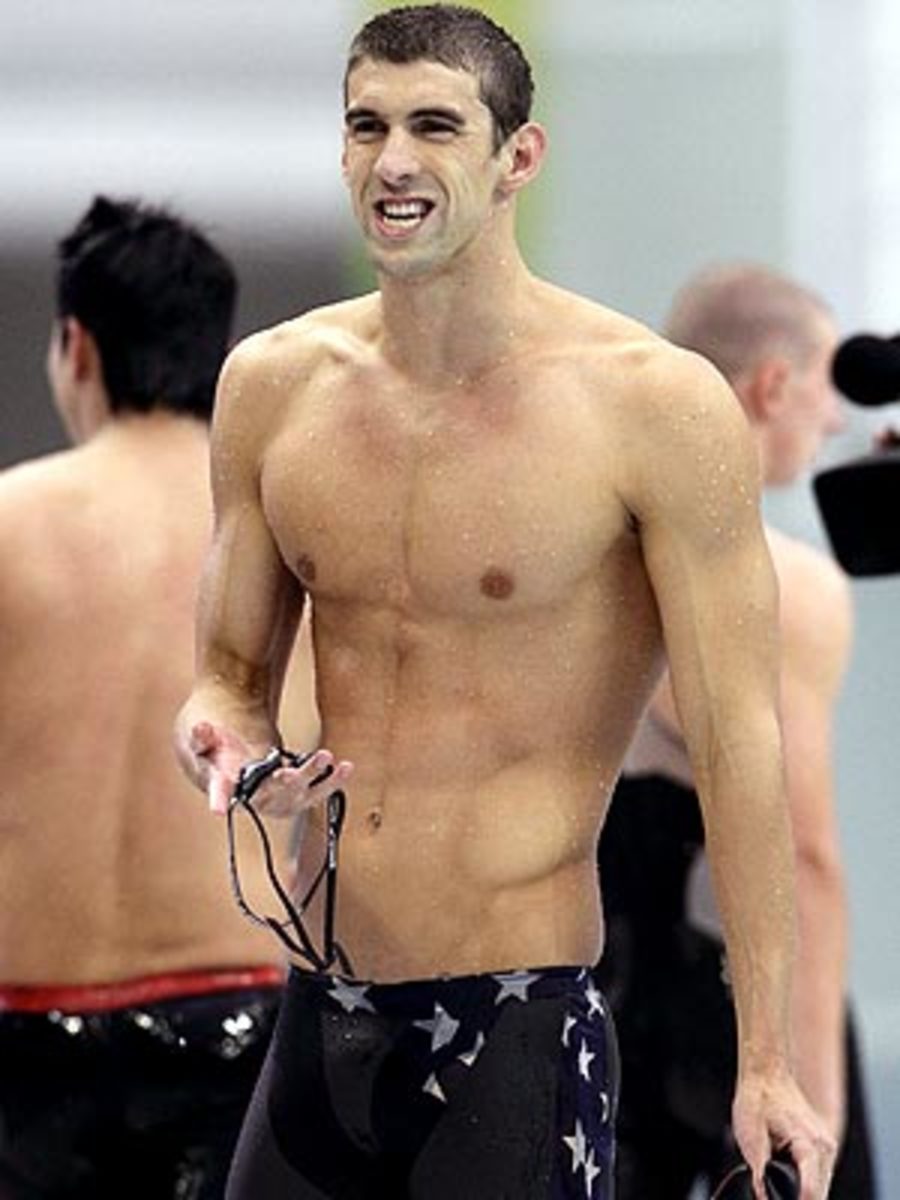
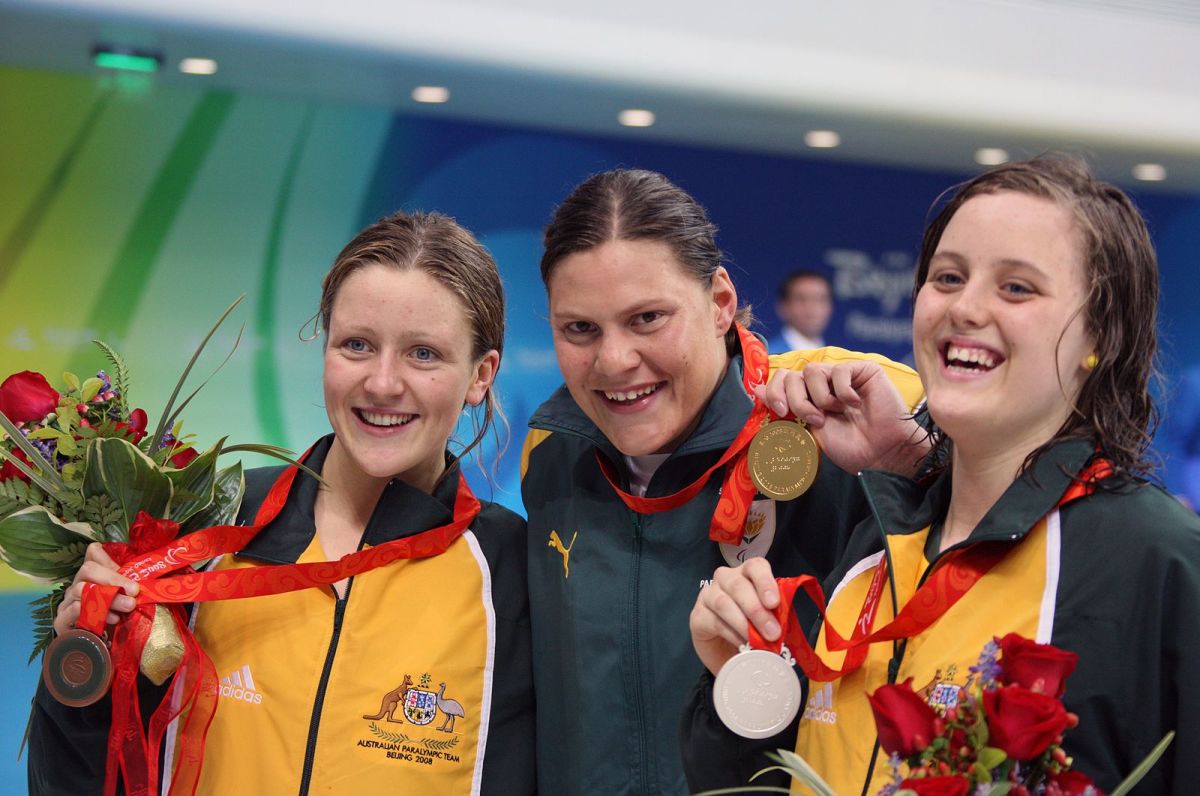
Mayumi Narita, Japanese Paralympic Gold Medalist

ATTENDING MAYUMI NARITA'S LECTURE
In October 2005, the year before I moved to Canada, I attended Mayumi Narita's lecture as part of a two day seminar held in a suburb outside Tokyo. Mayumi Narita is a Japanese Paralympic gold medalist in swimming and has been in a wheelchair since her teens. She has won fifteen gold medals at the Paralympic Games, having competed in six games, Atlanta (1996), Sydney (2000), Athens (2004), Beijing(2008), Rio de Janeiro(2016), and Tokyo (2021).
At the book signing session after her lecture, I purchased her memoir, which she signed. I was deeply moved by her grace and positive attitude. Despite her disability, she did not show even the slightest resentment.
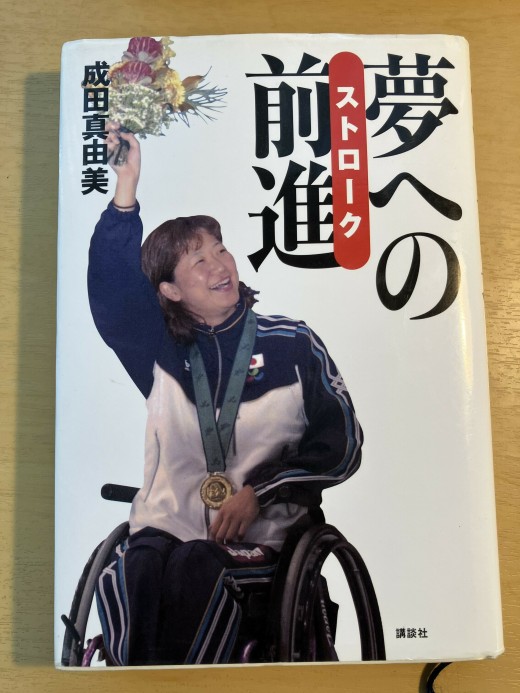

Brief Biography of Mayumi Narita
Mayumi Narita, born in 1970, had been very athletic growing up. In junior high school, she was on the track team and soon started playing basketball. She was about 13 years old at the time. It was not long before she experienced pain in her knees and was hospitalized. She had inflammation in her knees and had surgery on both of her knees to remove the affected area, but the pain would not go away. She commuted to school from the hospital and when the pain finally subsided, she discovered that her legs had become paralyzed. She was later diagnosed of myelitis, an inflammation of the spinal cord which results in the paralysis of the limbs.
When she started using a wheelchair full time, she could not stand people staring at her, as she states in her memoir. At first, she was unwilling to come to terms with her disability. While still hospitalized, she attempted to escape, but very quickly she realized she was immobile without the help of a wheelchair. She then discovered wheelchair basketball and joined the team, which gave her confidence. Until then she had asked herself repeatedly, "when will I ever walk?" but after discovering this sport, she now asked herself "what can I do in a wheelchair?".
She then goes on to try many different kinds of sports, including canoeing. In her early 20s, she discovered swimming and became immediately absorbed. Eventually she finds herself training for the Paralympic Games under a very understanding coach. It also says in her memoir that she finished school by correspondence and got a job, but was involved in a car accident which left three of her left fingers at least partially paralyzed. She had to quit her job and after that, she returned to swimming and was later asked by an official from the Federation of Swimming for Handicapped People if she would like to swim in the Atlanta Paralympic Games.

At the Group Session
Prior to her lecture, I attended her group session in which she spoke to about thirty of us. She was nicely dressed and appeared very healthy. As she spoke, it became clear that despite her disability, she had a very positive attitude. She did not feel sorry for herself, nor was she asking for sympathy.
She confessed in this group session that before she started swimming seriously, she hated swimming and actually could not swim at all. She said she would make up excuses so she could miss swimming during gym at school. She also said "I'm actually 174 cm (almost 5'10") tall". Given that she was in a wheelchair, she could not show us just how tall she was, but she said it with grace, without a hint of resentment.
She then discussed her biggest obstacle, that of mobility. She drives most of the time, but from time to time, she would take transit, including taxis. She described how difficult this option was for someone in a wheelchair. She told us how taxi drivers were sometimes not very helpful, and she had to enlist the help of train station employees to help her get up the stairs to the platform to take the train. On one occasion, she was left to wait for more than half an hour before a station employee was able to enlist the help of other employees. She couldn't wait much longer as she missed at least a few trains. She asked a stranger for help. He was very kind as he helped her get to the platform. Afterwards, the employees came back and one of them berated her for not waiting for their help.
Although driving helped her to get around more easily than taking transit, there were problems here as well. Sometimes, handicapped parking spaces would have a pole right in the middle of it, presumably to prevent non-handicapped people from parking. When she saw this pole as she was about to park, she had to get out of her car and into her wheelchair, remove the pole, then get back in her car and park. It required much effort and it was time-consuming. When she complained, she was met with a heartless response "why didn't you tell us beforehand that you were coming?"
In Atlanta
When she first arrived in Atlanta to compete in the Paralympic Games, she was impressed that every entrance to a store had a slope and there was a lift to board the city buses, making it easier for handicapped people. Nobody would stare at her like she had experienced back in Japan. When she returned home after the Games, she was disappointed that none of these facilities existed in her hometown. She felt strongly that "my country, Japan, has little understanding towards handicapped people".
She travelled to lecture in various cities across Japan in attempts to raise awareness towards handicapped people. She often travelled to schools and spoke to the students there.
One of the most important messages she stated in her memoir is that from the point of view of handicapped people, sympathy towards them is a form of discrimination. They want to be seen as humans, not as someone people should feel sorry for.
Mayumi Narita went on to win 15 gold medals in the Atlanta, Sydney, Athens and Beijing Paralympics. Her victory won her the name "the Queen of Water".
After the Beijing Paralympics, she took time off from competitive swimming but in 2016, she participated in the Rio de Janeiro Paralympics as well as in the Tokyo Paralympics in 2021.
On September 5, 2025, Mayumi Narita passed away due to Cholangiocarcinoma at the age of 55.
May she rest in peace.