Visiting Osgoode Hall, Toronto, Ontario: 1829-1832 Neo-Classical and Palladian home to the Law Society of Upper Canada
A National Historic Site of Canada
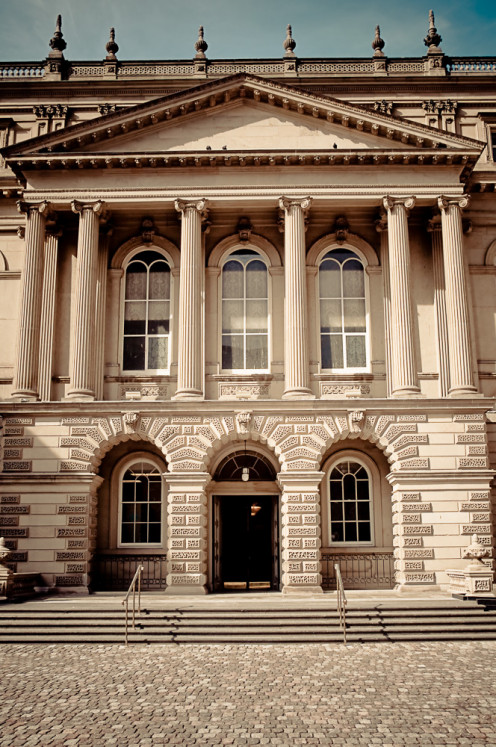
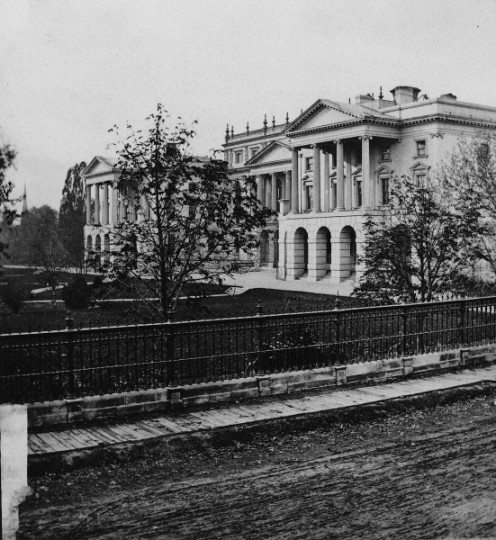
This National Historic Site of Canada is the splendid, Neo-Classical and Palladian home of the Law Society of Upper Canada. The building at its east wing dates from 1829-1832; its first architects were John Ewart (1788-1856)(1) and William Warren Baldwin (1775-1844)(2).
The building's more prominent features are its three classical porticos which are set on rusticated arches (3). The frontage of the building is executed in sandstone. The centre and west wings were constructed between 1844 and 1846. The central elevation by Cumberland and Storm, dating from 1856-1859, was at first topped by a dome, but this was replaced by a portico to match the existing two porticos at the east and west wings.
The complex also houses the Ontario Court of Appeal and the Divisional Court of the Superior Court of Justice, and is jointly owned by the Law Society and the Government of Ontario.
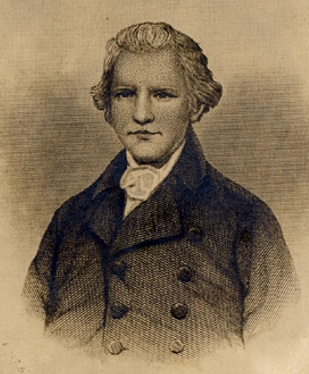
The building is named for William Osgoode (1754-1824), who served as Upper Canada's first Chief Justice (3).
Generations of Ontario professionals and figures in Provincial and national public life have thus known Osgoode Hall as their professional base. (I was first shown Osgoode Hall by my wife, who is an Ontario barrister.)
Osgoode Hall is known for its sturdy, cast iron fencing with narrow gates, which encloses quite extensive grounds. Some say that this was intended to prevent grazing cows wandering into the complex; others suggest this is somewhat of a myth, and that the design of the gates and fencing was simply a matter of Victorian fashion. In any case, in the mid-20th century some students actually tried to introduce a cow to the gardens of Osgood Hall, but attempts to force the poor animal through one of the narrow gates proved to be fruitless. So there is a sense in which the myth — if it was a myth — in some sense became a reality a century later!
Osgoode Hall is located at 130 Queen Street West, Toronto.
February 3, 2015
Notes
(1) Architect Ewart was also responsible for the Middlesex County Courthouse, London, Ontario and other significant buildings. His family is prominent in Ontario history; his daughter Jane Ewart Mowat was married to long-serving Ontario Premier Sir Oliver Mowat; his grandson John Skirving Ewart was a barrister and writer on legal subjects noted for his arguments in favor of the judicial independence of Canada.
(2) William Warren Baldwin also worked on the Bank of Upper Canada building, Toronto. He was very active in Provincial public life and, together with his son Robert Baldwin is credited with introducing the notion of 'responsible government' to Canadian public affairs. He lived at Spadina House, the successor of which still stands and is a museum.
(3) See also: http://www.thecanadianencyclopedia.ca/en/article/osgoode-hall/ For a timeline, issued by the Law Society of Upper Canada, which describes the development of the building, see also: http://www.lsuc.on.ca/with.aspx?id=1053
(4) William Osgoode was designated Chief Justice over a province at first called Upper Canada; later it was called Canada West, as part of the United Province of Canada; after Confederation it was called Ontario; but the Law Society still retains the original title of the Province in its name. The Law Society of Upper Canada was founded in 1797.
Also worth seeing
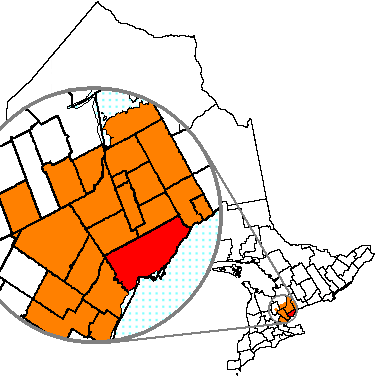
In Downtown Toronto itself, its many visitor attractions include: Old City Hall, Fort York, Campbell House, the CN Tower, Casa Loma; the Ontario Legislative Assembly Building at Queen's Park, Union Station, and many others.
...
How to get there: Porter Airlines, flies to Billy Bishop Toronto City Airport, and has wide North American connections. Car rental is available at Union Station; Air Canada flies to Toronto Pearson Airport, with wide North American and other connections, from where car rental is available, but visitors to Downtown Toronto will find many sights to be easily walkable from Union Station. For up to date information, you are advised to check with the airline or your travel agent. For any special border crossing arrangements which may apply to citizens of certain nationalities, you are advised to refer to appropriate consular sources.
MJFenn is an independent travel writer based in Ontario, Canada.
Other of my hubpages may also be of interest
- Visiting Campbell House, Toronto, Ontario: remembering an Upper Canada Chief Justice in a house dati
Provincial flag of Ontario FlagPictures.org Campbell House, Queen Street West, Toronto 'Robert Scarth', 'Flickr', Creative Commons A-SA 2.0, wikimedia.org This gracious house In Toronto, dating from 1822, provides an engaging cameo into... - Visiting Old City Hall, Toronto, Ontario: imposing Romanesque Revival building by E. J. Lennox
Situated at Queen Street West and Bay Street, the Old City Hall, Toronto, Ontario, was completed in 1899 to an 1887 design by architect E. J. Lennox (1854-1933) (1). The building served as Toronto's municipal headquarters until 1965; hence the... - Visiting Moss Park, Toronto, Ontario, adjacent to Moss Park Armoury: recalling some historical assoc
Moss Park is somewhat of an oasis of greenery close to Toronto's Downtown, lying adjacent to Moss Park Armoury at 130 Queen Street East. The proximity of Moss Park to Toronto's Downtown — particularly the Financial District — mean - Visiting the Parliament of Ontario: Toronto's monumental Legislative Building at Queen's Park
This imposing — indeed, monumental — building mainly dates from 1886 to 1893. This Provincial Parliament building houses the Legislative Assembly of Ontario (French: Assemblée législative de l'Ontario ), from - Visiting the Cathedral Church of St James, Toronto, Ontario: re-inventing the skyscaper, with Mediev
Provincial flag of Ontario FlagPictures.org Spire of the Cathedral Church of St James, Toronto, Ontario MJFenn Dating from 1853, one of the salient features of the Cathedral Church of St James, Toronto, Ontario, is its enormous spire. At 92.9...

Related

Ripley's Aquarium of Canada in Toronto
Visiting the Campbell Block, The Junction, Toronto, Ontario: Ornate Building Formerly Housing a Hotel, Dating From 1888
Coupons for Attractions in Toronto

Visiting Glanmore House, Belleville, Ontario: Recalling the Curious Historiography of Prime Minister Bowell of Canada

Top 10 Fun Things to Do in Prince Edward County, Ontario