- HubPages»
- Travel and Places»
- Visiting Europe»
- United Kingdom
Visiting Wigtown, Scotland, and the Stake and Graves of the Martyrs: women executed in 1685 by a bullying government
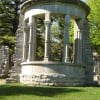
The Government executing women who happened to be the 'wrong sort of Protestant'
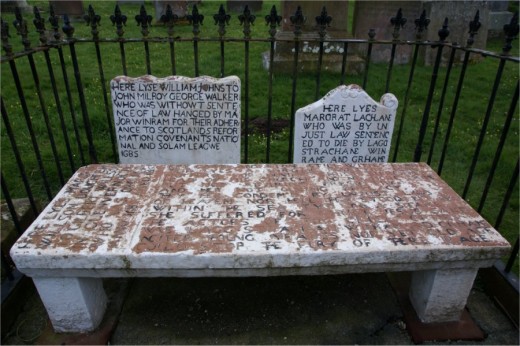
The Parish Church cemetery in Wigtown, Scotland, has the graves of some remarkable women who, in 1685, courageously refused to be intimidated by soldiers and clergy wishing to impose their version of faith upon them, and were thus executed by drowning in the Solway Firth.
So, are the disturbing events commemorated at Wigtown part of the regrettable history of violent conflict between Roman Catholic and Protestant adherents?
Well, actually, no.
Margaret Wilson and Margaret McLauchlan were killed by other Protestants, because they were deemed to be 'the wrong sort of Protestant'.
These courageous women of faith, arrogantly murdered by a brutish government which saw fit to try to violate their consciences, are known variously as the 'Wigtown martyrs' or the 'Scottish martyrs'; this latter designation is because their despicable treatment was supposedly for the benefit of the Episcopalianism being imposed by the King of England, to which there was widespread disaffection among Scottish people, many of whom were of Presbyterian persuasion (1). During this period, especially in the South-West of Scotland, many preachers were driven from their church buildings and they and their congregations hunted down by troops.
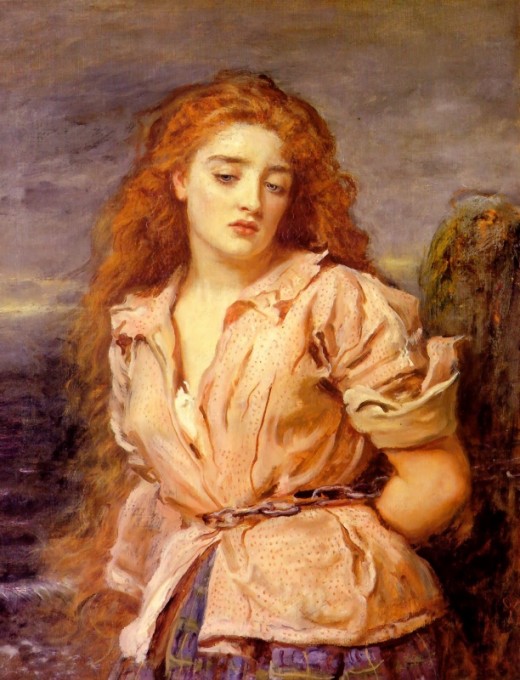
The painter Sir John Everett Millais (1829-1896) depicted one of the Solway martyr women, Margaret Wilson, in his work The Martyr of the Solway, completed circa 1871. This depicted a demure young woman, tied to a stake, shortly before her death. It is a highly evocative work. Much later it was discovered that the central figure in this painting, in the Walker Gallery, Liverpool, had originally been unclothed, but the painter had clearly had second thoughts about leaving her thus depicted.
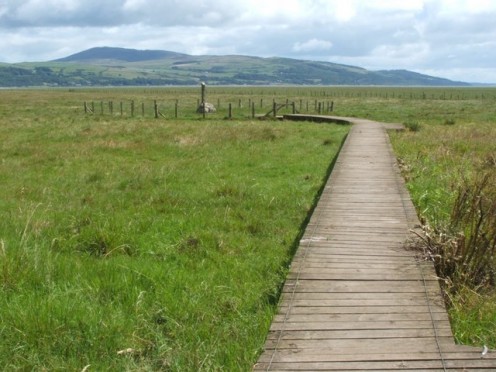
The stake in the Solway Firth, at Wigtown, where Margaret Wilson died, may still be visited. I must confess that I still experienced a wave of revulsion at the arrogant, brutish men who put her there, and at the disgusting clergy who thought they stood to benefit from the intimidation and death of this plucky young woman of faith, and others.
May 25, 2012
Note
(1) There was no monopoly of victimhood or brutality in 16th and 17th Scotland: in 1546, when Protestantism was being enforced, 'pious' men entered St Andrews Castle and partook of communion, the body of Cardinal Beaton lying outside the building, having sustained a broken neck when thrown from a window by the 'devout' celebrants. In turn, Cardinal Beaton himself had previously executed Protestant Reformer George Wishart. Other. similar incidents abounded.
Also worth seeing
In Wigtown itself, as well as the many bookstores there are various noted structures, including the Mercat Cross and the County Buildings.
At Newton Stewart (distance: 11 kilometres) an old bridge crosses the Cree River; the local Machermore Castle (not open to the public) is a senior home.
Lockerbie (distance: 107 kilometres) the Jacobean-style town hall has a distinctive tower.
...
How to get there: United Airlines flies from New York Newark to Glasgow Airport, where car rental is available. Please note that facilities mentioned may be withdrawn without notice. You are advised to check with the airline or your travel agent for up to date information.
MJFenn is an independent travel writer based in Ontario, Canada.
Other of my hubpages may also be of interest
- Visiting Wigtown, Scotland: the National Book Town, with much history also
- Visiting Lockerbie, Scotland, with its magnificent Town Hall: towered Scottish Baronial style archit
- Visiting The Mound, Edinburgh: splendid views of the Castle, and Neo-Classical buildings
- Visiting Crimond Parish Church, Scotland: remembering the famous Psalm 23 tune
- Visiting Bishop Bridge, Norwich, Norfolk, England: sedate structure, dating from 1345, with sober me