Visiting the Rinaldi Palace, Montevideo, Uruguay: triumphant Art Deco verticality
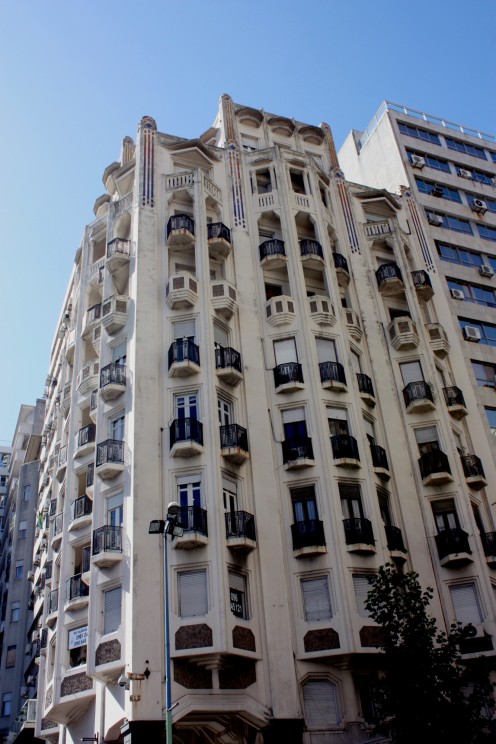
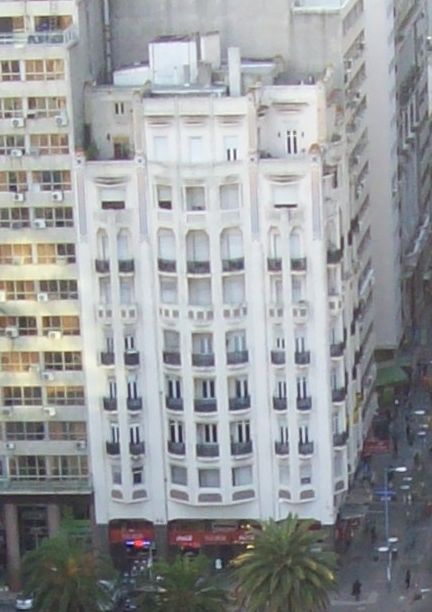
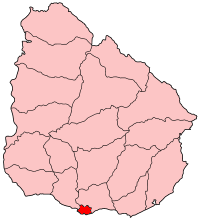
Geometric patterns complemented by an impressive elevation, built in 1929
In the 1920s, Art Deco exploded into the built environment around Independence Square (Spanish: Plaza Independencia ), in Uruguay's capital, Montevideo. More well known than, and slightly older than, the Rinaldi Palace (Spanish: Palacio Rinaldi )(1) is its neighbour across Avenida 18 de julio at that avenue's intersection with this central Square: the Salvo Palace (Spanish: Palacio Salvo).
However, in its own right, the Rinaldi Palace is an excellent example of innovative Art Deco architecture. Amidst the intricate complexity of its abstract geometric patterns (2), the almost labyrinthine lines of this 8-storey edifice are yet informed by a very strong element of verticality.
Some would say, then, that the Rinaldi Palace is dwarfed by its Salvo Palace neighbour; but really, because of the success of the ordered, vertical surge of this apartment and commercial complex, my preference would be to say that it complements it: two juxtaposed integers of successful Art Deco urban development.
I have supplied two photographs of the Rinaldi Palace, one of which gives prominence both to its complex balcony lines suggestive of abstract patterns, but also of its verticality. The other photograph shows its proximity to the herbaceous Plaza Independencia ; this picture also gives a glimpse of the arcading which is integrated into the ground floor.
In fact, as a pedestrian, when resident in Montevideo, I would walk through the Rinaldi Palace arcading without habitually even looking up at the other features of the building, above; such is the architectural blending which has been carried out. A similar lay out pertains on the opposite side of the Avenida 18 de julio , under the Salvo Palace and adjacent buildings.
The architects for the Rinaldi Palace were Alberto Isola and Guillermo Armas.The building was completed in 1929.
July 6, 2012
Notes
(1) It is not unusual in some Spanish-speaking countries for any large, prominent building to be called Palacio — Palace.
(2) These abstract patterns include elements of colour decoration in the upper levels of the building.
Also worth seeing
In Montevideo itself, visitor attractions include: the Salvo Palace; the Independence Building facing Plaza Independencia ; the Artigas Mausoleum; the Gateway (Spanish: Ciudadela ) to the Old City (Spanish: Ciudad Vieja ) the Legislative Palace; the main building of the University of the Republic (UdelaR); the Obelisk; the Cerro Fortresss; the Cerrito; and many others.
...
How to get there: LanChile flies to Montevideo , Uruguay from North American destinations including New York and Toronto . The Uruguayan airline PLUNA, which codeshares with VARIG, flies to a number of Latin American regional destinations. Car rental is available at Montevideo Carrasco International airport. Some facilities may be withdrawn, without notice. Please check with the airline or your travel agent for up to date information.
MJFenn is an independent travel writer based in Ontario, Canada.
For your visit, these items may be of interest
- Visiting the Salvo Palace, Montevideo, Uruguay: among the most significant landmarks of the country
- Visiting the Artigas Mausoleum, Montevideo, Uruguay: complex remembrance of a leader in exile
- Visiting the Independence Building, Montevideo, Uruguay: historic, neo-Classical Presidential palace
- Visiting the Gateway of the Citadel, Montevideo, Uruguay: recalling the Colonial-to-Independence-Era
- Visiting Montevideo, Uruguay and its Metropolitan Cathedral: Neo-Classical building commenced in 179

Related
Visiting San Antonio, Texas: What to Enjoy While in The Alamo City
Visiting: Fatehpur Sikri Palace of the Mughal Emperor Jalaluddin Akbar
Visiting the Fatehpur Sikri Palace of the Mughal Emperor Jalaludin Akbar
Visiting the House of Dr. Luis Alberto de Herrera, Montevideo, Uruguay: Remembering Issues of Historic Sovereignty
Recommendations for Visiting Mesa Verde National Park