Krishna in the Morning
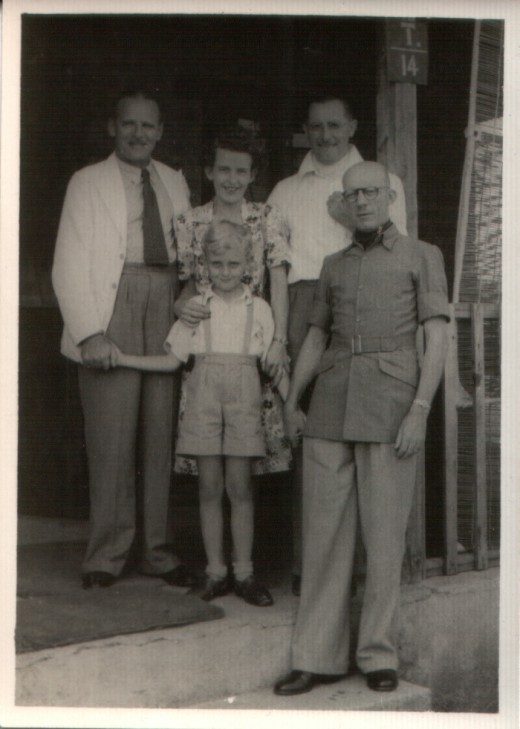
Two of the Low-down-types at the back. Mummy, Daddy and me
Lunch time was always a bridge in time. The morning was over, but nothing had happened.
I had woken when Krishna came into the room and had brought me out of light sleep as his dry feet moved over the dry floor. Krishna always walked so quietly, so as not to wake the Chota Sahib. He walked so quietly, but when he saw that I was awake, he spoke, almost intoned, as if it were his little mantra, the words: “Sahib! Sahib! Chota Sahib!” and I knew that the day had begun, and that Krishna, my Krishna, was there to start it with me.
I heard the soft, dry sound of Krishna’s bare feet on the dry floor, and the fluttering sound that his feet made on the coir matting. There were bare floor boards just near the door, and around the wall, but the centre of the room was covered in a coir mat… coir matting. And in the middle of the coir matting stood my bed.
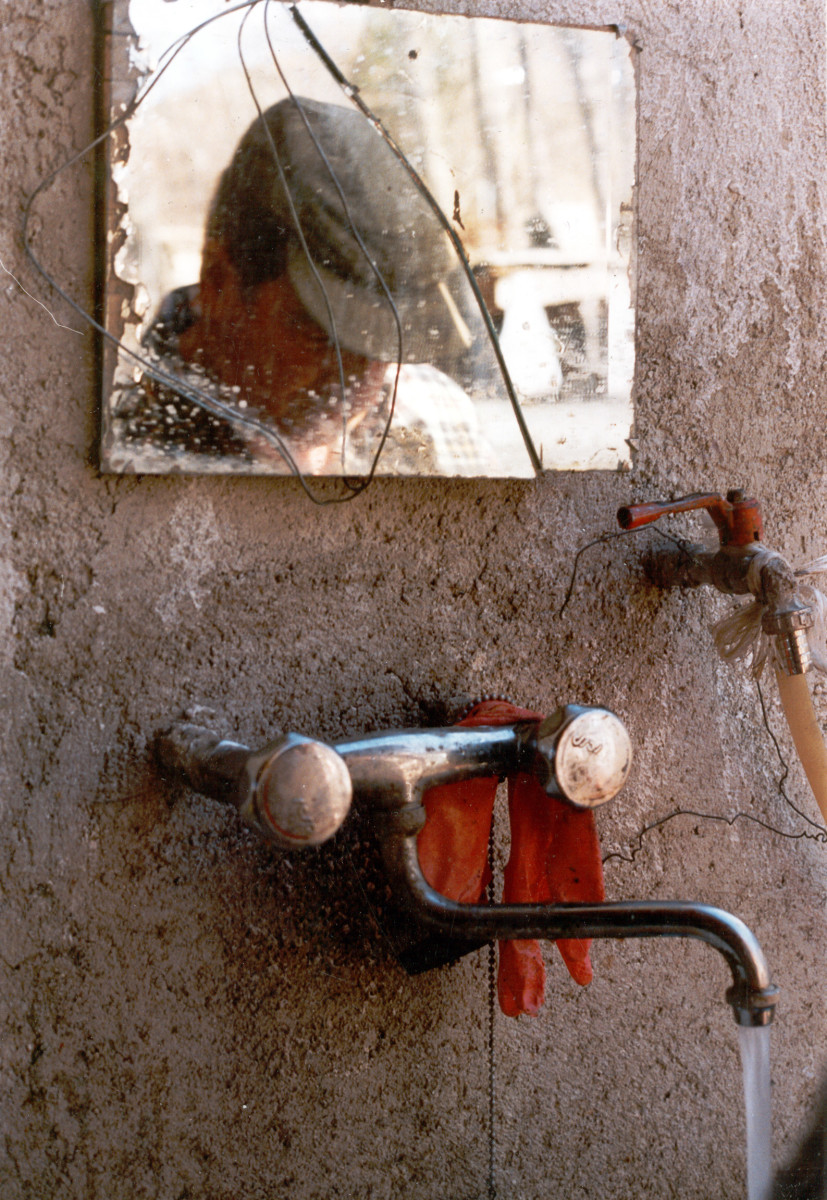
The bed stood in the middle of the room; draped in white mosquito netting. If I pressed my face closely against the netting I could see Krishna as he moved around the room, first with the big water jug out of which he poured a tumbler of water for me, and then I would watch while he poured water into a large bowl for me to wash my face. Beside the bowl, on the table top, stood an open tin of tooth powder. Krishna had already dipped my toothbrush into the water… shaken it so that it was just damp… and then dipped the bristles of the brush into the tooth powder. I hated that tooth powder. It was pink and it tasted of… tasted of nothing, really. It just tasted nasty, and when I had brushed my teeth, there was always some of the tooth powder left in the part of my mouth between my bottom teeth and my bottom lip. And if I put my tongue into that place and tried to remove that gritty powder, it just wouldn’t come until I had washed my mouth with water.
There was a toothpowder that tasted of bananas. I knew there was, and I asked Mummy if I could change to that one. Mummy said, “No! That’s for children and it isn’t very good”. I was a child…Why couldn’t I have the tooth powder? But no.
I wasn’t allowed to get out of bed until Krishna had prepared my tumbler of water or my tooth brush or my bowl. I had to wait until Krishna brought my chapals.
He always gave the one word warning, “Scorpion!” and then added, “Chota Sahib”. Then he would reach under the bed and bring out my chapals, walk towards the open window which looked out onto the veranda and reaching out as far as he could, would bang the chapals together. Holding each leather chapal by the heel and he would bang them together. Not once. Not twice. But three times. Always three times.
Everybody knew that scorpions would climb into chapals while people slept. And then they would bite you on the toes when you put them on in the morning, then you would most probably die. But Krishna always walked with bare feet. Maybe scorpions don’s bite people like Krishna.
Scorpions weren’t very nice. They would wait until you weren’t expecting them to do something nasty; and then they would do it. Mummy said that one night she came into my room to say “Good night” and when she put her hand near the light switch, a scorpion was waiting there to bite her… sting her, really; because a scorpion has a sting on his tail and he stings you with it. I think scorpions just wait around to be nasty. They wait in chapals. And they wait on walls. Mummy said that that’s all they do… just wait around to be nasty. And then they sting you and you die. Just like that.
Scorpions and snakes. Snakes never cross coir matting because the coir tickles their tummies or it hurts their tummies. That’s why there are coir mats in bedrooms… to stop the snakes.
“Snakes never cross coir matting,” Mrs Taylor had told my mother when we first went to live in the Cantonment. Mrs Taylor was Binkie Taylor’s mother. Everybody said that Binkie Taylor was my girlfriend. I didn’t know that, and I don’t think Binkie Taylor knew it either. Mrs Taylor and Colonel Taylor lived at the other end of the Cantonment.
We went there some days to visit them. It was always on a Sunday that we went, but not a lot; and sometimes there were some of the Low-down-types there. Mummy and Daddy called them the Low-down-types, but they were my friends.
One of the Low-down-types was called Chalky White and there was Nobby Clark and there were some others and there was a man who could draw such lovely pictures and I went to the Depot once and he showed me.
The Low-down-types came for lunch in out bungalow on Sundays, and that was the best time… well, almost the best time. The Low-down-types were officers too, like Daddy. Only Daddy was more important, I think. They called him Sir and laughed when he told jokes and silly stories.
When we went to visit people; important people like Colonel Taylor and Mrs Taylor, or sometimes not so important people, we would walk right up, almost to the veranda of the house from our tanga, or whatever had brought us there, and then Daddy would call out: “Koi hai?”. We didn’t knock on the door, Daddy called out “Koi hai?” in a big voice.
That meant, “Is there anyone there?”
Then their bearer would come running down the steps and come and say to Daddy, “Colonel Taylor Sahib is at home, Sahib”. And if he knew Daddy he would call him, “Major Sahib,” or perhaps he could read it on Daddy’s shoulders because Daddy would be in uniform and he had gold stars on his shoulders… “and the Star of India falling from a Sky of Blood into a Sea of Blue Ink”. My Daddy told me that so I would remember.
Very grand people went to Mrs Taylor and Colonel Taylor’s bungalow. There was a Very Important Lady once who was there when I went with Mummy and Daddy. She sat in the big chair Colonel Taylor usually sat in and when she said something, everybody laughed. Some of the things she said were very silly, but everybody laughed anyway.
All the men were standing, and they laughed a lot. When the Very Important Lady saw me, she told me to come and talk to her. She was very old, but she looked very pretty. I thought she was much nicer than Mrs Taylor.
She pointed to the floor in front of her chair, and said,
“Come and talk to me, little man”. So I did. She smelt just like the frangipani that our Mali had growing at the front of our bungalow. I liked that smell. Frangipani smelt so lovely, but when you touched the branches it started to bleed white stuff like sort of blood for trees, and then your hands got sticky and Mali would look sad and say, “Chota Sahib, don’t touch… very dirty, Chota Sahib”. And I would look at my hands and the white stuff from the branches would have turned black and dirty and Mummy would have to scrub my fingers with a wet flannel and be a little bit cross.
Or sometimes Krishna would say, “I’ll do it Memsahib,” and he would say to me, “Come along Chota Sahib, bad, bad fingers” and he would wipe my fingers with the wet flannel, but it didn’t hurt at all; I really loved Krishna.
And the Very Important Lady looked at me very hard and she said,
“My, but you have such blue eyes”, and she touched my cheek with the back of hand, “Where did you get those lovely blue eyes?”
“From the blue, blue Mediterranean Sea,” I said, because my Mummy used to laugh when I said it. And my Mummy told lots of people that I said it all by myself; and she didn’t know where I got it from.
Then everybody laughed again, but the Very Important Lady looked at her hands and then I saw that she was crying a little bit and after that everybody looked like grownups look when somebody has said something that they shouldn’t…
I liked that Lady. I didn’t see her again, but I liked her because she smelt so nice and because she cried a little bit. Sometimes, years later when I would be walking by myself, I would smell that lovely smell and it would make me go all the way back to Dehu Road and to the Cantonment and I would remember that day, and I would remember.
I would remember the Lady who smelt like the frangipani; how she cried just a little bit; and I would remember Krishna and the chapals and the toothpaste, and I would find that I wanted to cry also.
I still do.
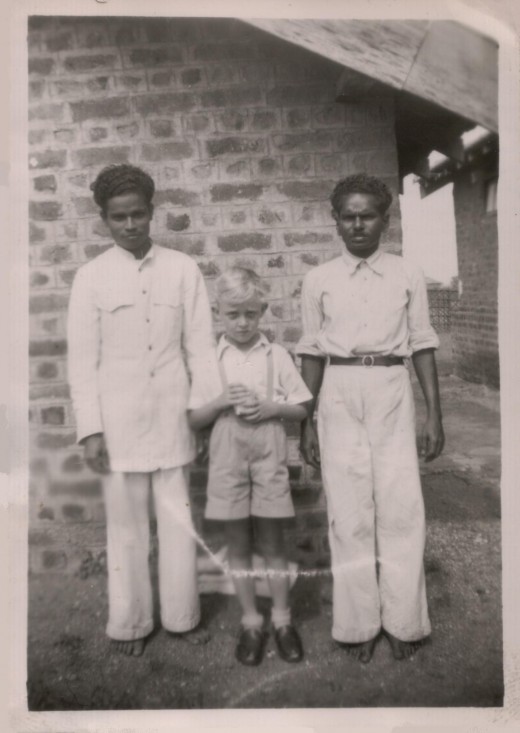
Krishna (on the left) Khansama and me
This is a hub relating to me and where I come from; both geographically and emotionally. If you liked it, perhaps you would like the others here included.
- Jeanette MacDonald goes to Broadstairs
My parents met in about 1937, when my mother was a nanny to a rather rich Polish family living in Ivor, Buckinghamshire. As part of her duties, she would travel to a local private school to collect the little girl in her charge, Anne Zinzinanix I'm - Does Anyone Know What I Am
This is an attempt to explain why I have no loyalty to any particular country or geographical area over any other, as I come from, or lived in, and loved, many. So when I read any nationalistic, or emotionally heart-warming poetry to do with Homeland - Chrome
Chrome When I was just a child in India How many times has that prefaced a tale? Our Mali fashioned for me with two sticks and net, a toy. A net for butterflies. And I went out and gathered Scooped the air and brought within our bungalow Plucked fro - Good Bye - A Poem Concerning departure
"Good Bye" by "Anonymous" This Poem was printed in: The Indian Army Ordnance Corps Gazette Vol. 25 December 1947 No. 12 The Author ("Anonymous") expresses her sorrow at leaving India and the wonderful India People; the country and people whom she had