Mamdani's State-run Grocery Store Plan
What is his plan?
State-run grocery stores for the poor have failed every time (???) they have been tried.
The most recent closure (Kansas City) was announced in December — almost the same news cycle that announced NYC's grocery store plan.
What can Mayor Mamdani do differently to make his efforts work?
GAAs for how far he can take the idea of state run grocery stores, will the idea fall on its face, can the idea be modified in some fashion. I am more than content to let the voters have the final verdict as to whether his ideas can actually work or not. Even if it turns out that it is too far and the oligarchy hollers, he is pushing things in my preferred direction and i give credit for that.
Stick to the question; whether he's 'your guy' isn't relevant. And beating up on Momdani is secondary to the point.
The voters won't have a say in whether his idea works or in the costs to come. History, reality, and the specifics of NYC's plan show that the stores won't work.
The question was serious: what can he do differently to make 'his' plan work?
One proponent says they just haven't been done right; they (the state-run stores) need to be established at a Costco-type distribution-center level. That '... it just hasn't been done right, yet' rationalization doesn't sound right to me.
The idea has proven to be unsuccessful. What can Momdani do differently?
GAGiven the truly massive subsidies he will have to provide I don't see anything he can do outside of germinate a whole orchard of money trees.
The problem isn't just that he wants to cut costs, he must also either provide free groceries to everyone OR somehow protect his stock in trade from disappearing. Both take huge infusions of money.
Of course, if he could just convince the people he is trying to service that crime does not pay, that it is immoral, then the protection isn't a problem. How to produce that miracle, though, I haven't a clue.Your "massive subsidies" point was the OP's point.
The Momdani plan appears so obviously unworkable that just asking how to support it will discredit Momdani more than attacking him directly.
The headlines: 30% discount, ID cards for discounts, ID cards to stop arbitrage, no profit motive, etc, are already trashing the concept. It's not a realistic idea.
There is a reason for food deserts. The Missouri efforts, and their failure, highlight the starkest ones: crime-ridden neighborhoods, retail theft, and no management incentive (aka profit) to 'do better.'
GAThat's why I mentioned the orchard. I have no other suggestions, for I do not believe he can raise taxes enough to do the job. He might raise the percentages, but get them high enough to do what he wants and he will find nobody but the poor to pay them, who he has declared will not pay anything.
GA and Wilderness seem to imply that a major reason for food deserts is crime in poor neighborhoods, which of course disproportionately means poor minority neighborhoods. I reach that conclusion from statements such as “There is a reason for food deserts. The Missouri efforts, and their failure, highlight the starkest ones: crime-ridden neighborhoods, retail theft, and no management incentive (aka profit) to ‘do better,’” or the argument that Mamdani will have to either “provide free food OR pay for a great deal of security. That's why other stores have left, after all.”
There is a problem with those explanations: the evidence doesn't establish that retail theft is the primary reason food deserts exist. - that is just a conservative talking point Theft certainly can contribute to a store's failure, particularly in a business with grocery-store margins. But supermarkets also disappear—or never open—because of rents, labor costs, transportation and distribution costs, population and purchasing power, competition, financing, store size, parking, simply the expected return on investment, or sometimes racist attitudes.
Instead of immediately looking to one of conservatives' favorite whipping boys—crime among the urban poor—consider the scale of economic losses occurring elsewhere in American society.
Estimates of annual shoplifting losses are in the tens of billions of dollars. There isn't a good national government statistic giving us an exact number. We also need to be careful not to confuse shoplifting with “shrink,” which also includes employee theft, vendor fraud and inventory errors. Something on the order of $40–$50 billion annually is a reasonable ballpark for external retail theft, but it shouldn't be presented as a precise audited figure.
Now compare that with other ways Americans lose money. The IRS estimates that $696 billion in legally owed federal taxes were not paid on time in 2022 alone. Wage theft—employers illegally failing to pay workers what they are owed—has been estimated at as much as $50 billion annually. Price fixing, anticompetitive practices and monopoly power can extract still more from consumers, although putting one defensible annual number on those losses is much harder. Why are these not part of the conservative narrative?
And there is something else interesting about shoplifting itself. The evidence doesn't support a simple poor neighborhood = shoplifting equation. A Council on Criminal Justice study found shoplifting was extraordinarily concentrated at particular retail locations: just 5% of addresses accounted for 68.5% of reported shoplifting in Chicago and 62.8% in Los Angeles. In Chicago, one of the largest concentrations was downtown, with another around Old Town/River North/Lincoln Park—hardly evidence that shoplifting is uniquely a problem of impoverished neighborhoods as conservatives want you to believe.
None of this means retail theft isn't real. It is. Nor does it prove Mamdani's grocery-store experiment will succeed. It may fail spectacularly. But if we're going to explain food deserts, let's actually find out why the stores in those particular neighborhoods left rather than assume we already know the answer.
That brings us back to what I think is the real question about Mamdani's proposal: Are there neighborhoods in New York with enough people and enough grocery spending to support a full-service store, but which private companies nevertheless decline to serve because the expected return isn't attractive enough?
If the answer is no—if there simply isn't sufficient demand to sustain a grocery store—then Mamdani may be proposing a very expensive permanent subsidy.
But if the answer is yes, then we have something economists have been dealing with forever: a socially desirable service that the private market isn't providing adequately because the private return isn't sufficient. Government routinely intervenes in precisely those situations. Rural transportation, utilities, hospitals, agriculture, public transit and even rural grocery initiatives receive public assistance for that reason.
And Mamdani isn't proposing that bureaucrats stock shelves and run cash registers. The stores would be city-owned and publicly supported, while experienced private grocery operators would manage their day-to-day operations under city requirements. That doesn't guarantee success, but it is considerably different from the caricature of City Hall trying to run a supermarket.
While Kansas City's failure is relevant evidence, it isn't the entire body of evidence. There are also American grocery cooperatives and publicly assisted community grocery projects that have survived for years. They aren't identical to Mamdani's model either, which is precisely why the sensible question isn't “Has anything vaguely resembling this ever failed?” Of course it has.
The sensible question is: Why did particular projects fail, why did others succeed, and has Mamdani designed his program around those lessons?
That's the discussion worth having. Blaming food deserts on poor people stealing groceries before we've even established why the grocery stores disappeared isn't an economic analysis is simple scapegoating. It's starting with a preferred explanation and working backward.Eso, you can close your eyes to the obvious facts, you can pretend it doesn't happen, you can blame conservatives till the sun dies, but the FACT remains that the inner cities are dying because stores are suffering too much loss from "shoplifting".
There are just too many reports from businesses folding because of this kind of loss to reasonably pretend it isn't happening. In the case of groceries, the feds make sure the money is there - it's just that it isn't being used. When idiots decide that a $1,000 loss is OK, and not to be prosecuted, there is a massive problem, and we can no longer pretend it isn't there.
It IS there, and it IS the root cause of food deserts. Crime is closing down our city centers even as we defund police and change the rules so they can no longer catch and restrain criminals. The food desert is just one result of the soft on crime actions, from parental teachings to legislators and judges refusing to give consequences for poor behavior.After a page of blather, you get to "a discussion worth having;"
"... has Mamdani designed his program around those lessons?"
You are late to the game; that was the OP's question:
"What can Mayor Mamdani do differently to make his efforts work?"
Whadaya think?
But, on 'the other hand,' you're killing me, it's all I can do not to cut-n-paste an AI response to your denial of crime and theft issues. AI's first paragraph supplies the 'official' (from the closing entity) list of three primary reasons for the Sunfresh closure.
The three listed as primary were; extreme financial and security burdens, due to related security costs, theft, and employee safety concerns. (it was noted the store paid $5000 - $6000 per week for security due to employee and customer concerns, with some employees carrying personal tasers.
But that is just one anecdote. Maybe it's not enough to form an impression? Or maybe the Chatbot got it wrong by offering it first?
You put so much effort into rationalizing a denial of easily found 'facts' when the same tool probably gave you the same answer it gave me first.
GAOn second thought, that was a bit snarky, and you're on vacation. My bad, sorry. ;-)
GACan you explain why the following is "blather"?
- the evidence doesn't establish that retail theft is the primary reason food deserts exist. -
- Showing that white collar crime by the wealthy is an order of magnitude bigger (yet ignored by conservatives) problem than retain theft.
- The evidence doesn't support a simple poor neighborhood = shoplifting equation.
- In Chicago, one of the largest concentrations was downtown, with another around Old Town/River North/Lincoln Park—hardly evidence that shoplifting is uniquely a problem of impoverished neighborhoods as conservatives want you to believe.
- While Kansas City's failure is relevant evidence, it isn't the entire body of evidence.
Also, your OP implies (well actually says) Mamdami's approach is a failure from the get go - something that is not supported by facts or logic. So why do something differently?
By the way - where did I "deny" there were crime and theft problems? What I pushed back on is that crime and theft is the end all, be all you imply it is.
Using Sunfresh and ONLY Sunfresh is misleading at best. Prove Sunfresh just isn't the outlier it appears to be.
“Instead of immediately looking to one of conservatives' favorite whipping boys—crime among the urban poor—consider the scale of economic losses occurring elsewhere in American society.”
Thank you
Conservatives as always are rife with double standards and hypocrisy. They don’t care if this is even given a chance as it conflicts with their fundamental value system, people are poor as being their fault. Is that really true?
Why would Mamdami have to provide "massive" subsidies?
I didn't see where his plan was to provide free food; can you point that out to me?
Try convincing Trump that crime doesn't pay or is immoral first.If you think Mamdani can cut the price of groceries 30% you aren't nearly as smart as I thought you were.
The comment was that he either provides free food OR pays for a great deal of security. That's why other stores have left, after all.
Trump isn't stealing from the grocery stores in NYC.I'll return the insult - if you think that is what I thought, you aren't nearly as smart as I thought you were.
You provided NOTHING to support your claims that Mamdami is lowering prices on all grocery items by 30% (he is not)
You provided NOTHING to support your implication that crime is the reason the private sector won't provide service to those areas.
And you are right, Trump is not stealing from NYC grocery stores, that is too small a scale for him. Instead, he steals from all Americans everywhere.
Why do you conclude that from one example? The Kansas City example shows that one particular grocery model failed. It does not prove that every attempt to address food deserts through public support is unsuccessful. There are many American examples where communities, often with government assistance, successfully created or preserved grocery access.
What about these?
1. Wheatsville Food Co-op — Austin, Texas
Founded in 1976.
Grew from a small community cooperative into a successful multi-location grocery operation.
Lesson: Alternative grocery models can survive and thrive when they have strong local support and professional management. (Similar to Mamdami's plan)
2. Saranac Lake Community Store — New York
A rural community created a cooperative grocery after losing traditional grocery access.
Residents invested directly to preserve food access.
Lesson: When the market does not provide a service that a community considers essential, community-supported models can fill the gap.
3. North Dakota and rural Midwest grocery cooperatives
Many rural communities have used:
- cooperative ownership,
- USDA technical assistance,
- community development grants,
- local investment,
to keep grocery stores operating where national chains would not enter.
Lesson: Government support often works best as a catalyst, not as the operator.Mamdani's planned NYC grocery stores will not be co-ops, they will be state-owned and managed—with on-site daily management contracted out to a private enterprise, and prices set by the government. This makes it different from your listed co-op examples and closer to the Kansas City Sunfresh store comparison.
Your "lesson" isn't what Mamdani is planning.
Consider the current details: the 'market' (each targeted NYC borough site) was too negative to support private business. The details that drove them out will be the same for a state-run store. As I see it, subsidies will be the only way to keep the stores open.
Back to the OP's question: What can Mamdani do differently to make his plan work?
GALet's work on one question at a time then - "Why do you conclude from a single anecdote that ALL such attempts will fail?
First, relative to "all such attempts," the 'such attempts' I am speaking of are the ones of Mamdani's details: a low-income, high-crime market location; a government-owned and controlled property; government price controls; and government management of operations policies.
Those are the details of both the Kansas City and NYC examples. They are not the details of the co-op comparisons you offered.
Secondly, the thought didn't derive from a single anecdote; other examples can be found. The Sunfresh example was the most appropriate match to make the point (current timeframe relative to NYC and near-identical operations details). In short: 'same-same.'
As noted in another response, ask your chatbot which countries have government-run grocery stores or have tried them. You won't want to be on that list, and you won't find any successes within the parameters of "such attempts" as Mamdani's proposal.
As previously noted, the reason all such attempts will fail in America is our capitalist foundation in market economics and human nature.
GA
Note - the examples were cases where the gov't, city or state or federal, successfully were involved in the creation of or sustainment of non-private enterprises to provide food in underserved area
Yes they were, but they are not comparable to Mamdani's efforts—beyond the macro goal of helping poor folks eat.
GAI believe that helping poor people eat should be a preeminent goal, are conservatives truly opposed to this while offering fairy tales about America’s unlimited opportunity for all?
What about this thread's focus implies that "conservatives" are opposed to helping poor people eat?
The criticism is about a method, not a goal. Is that taboo because it's a liberal method being criticized? Don't prospects of success or failure matter in this consideration?
GAProspects DO matter, I don’t simply believe that certain failure is guaranteed from Momdami’s attempts in this direction. There is a great deal of variables and uncertainty between the proposed program and the outcome. The voters of New York will determine whether this Mamdami plan is a successful initiative or not. Is this not a reasonable way to let the issue run its course?
So, no, I can’t speak for how it will work and what tweaking will take place if it can be made to work, but neither can you….I don't know what you mean by "the voters will decide ..."
Their only deciding input will be Mamdani's reelection. And then only if the stores fail. If they succeed, Mamdani will already have taken credit and made expansion a platform plank. If he loses because the stores failed, the failure will already have closed them, and the voters had/have no input on the matter.
As previously mentioned, I'm simply predicting.
I don't think you know enough about the issue to be so staunchly defending it, even to the point of insulting folks that criticize it.
You should take the "check-it-out challenge' I put to MyEsoteric. In 10 minutes you can find enough info to make an educated bet on this 'grocery store' issue.
With currently known (and easily found) details, would you 'bet your farm' on the plan's success?
GAVoters decide, isn’t that how it is all done? I am not staunchly defending it as i see the same shortcomings you do within this rigid capitalist system. Yet, i am not staunchly defending its certainty to fail either. The voters had input by electing him in the first place knowing full well what his plans were regarding this matter. And they can also vote him out if this planned approaches on this an other topics fail.
So, ok, i have nothing to hide, i will take the “check out challenge” while checking the source as to what or who is behind it.
I did check and the odds are not good for many of the reasons you mentioned, so let him pivot for an adjustment to his plan. Who is addressing the issue of “affordability”? Holding to the status quo simply is not a satisfactory answer.That was a pleasant morning surprise — a rational response. ;-)
The only point of the OP was that the grocery store idea was not a good plan. It seems obvious there is very little chance for success.
On this issue, I don't give Mamdani 'credit for trying' (or the 'benefit of the doubt') because I think he's smart enough to see the same problems I did, which makes his effort less than honest.
GA
It is time to explain what Mamdami's goal really is - and it isn't "city-owned and managed (in the normal sense) grocery retail operation that sets all the prices in the story. To be clear, the city will:
1. Step in where the private sector has FAILED to provide adequate service to large population groups.
2. Provide the physical assets to operate the stores.
3. Let a competitive contract to a professional private company to operationally manage the stores.
This includes merchandising, sourcing, supply chains, staffing, inventory management, food safety, security, customer service, and other day-to-day operations to include setting prices for the majority of items for sale
4. The city would provide contract management functions. This would include owning/supporting the stores and covering major overhead such as rent/property taxes; selects the operator; establishes the mission and standards; establishes affordability, labor, transparency and performance requirements; monitors contractual compliance; and subsidizing a "core set" of discounted products.
The goal is NOT to provide FREE food as Wilderness falsely claims, but to provide access to groceries, SOME of which would be subsidized, to large swaths of people that the private sector ignores for financial reasons.Nah, it's not time to explain his goals. A thread/tangent about Mamdani's "goals" would be different than this one, which is about a specific proposal. The OP was not critical of Mamdani's goals or political agenda; it was noted as criticism of a specific proposal—a government-run grocery store.
You are defending him for ideological reasons, when his ideology wasn't being challenged. It's off-topic and unnecessary.
I think I can, and have shown his plan to be a pending failure, can you show any support that it is more likely a pending success?
If you had to 'bet your farm,' which bet are you taking? ;-)
GAJust for the record, I think Democratic Socialism sucks and is as dangerous as the far-right.
My main concern, as a liberal, is to help people who are suffering through no fault of their own.
As to "showing" his plan is a likely failure is still based on a single anecdote as best as I can tell. In my opinion is that single anecdote proves that particular store failed.
Capitalism has clearly failed in food deserts. The conservative solution appears to do nothing and maintain the status quo. The liberal solution is to try to do something, which conservatives say will obviously fail, to help people become less food insecure.
Properly executed and with a sufficient population base, there is no reason it should fail, nor have you provided one.
As to the bet, I wouldn't take either side - too many variables.Just to make it clear, I am Social Democrat, accommodating capitalism, but keeping its abuses and oversights in the crosshairs. Elizabeth Warren is my model, Bernie Sanders is Democrat socialist and is step beyond for me right now.
Also "just for the record" ... The OP, and my comments are focused — for now — on the grocery store plan. Not as criticism of Mamdani's ideology.
Also, my criticism is about reality, facts-of-life stuff we have all lived and experienced. It's not partisan or ideologically driven. As a 'statistics' guy, the reality of this situation should be obvious to you. You shouldn't let your liberal side blind you to the facts of this specific proposal.
As for 'food deserts': capitalism did not fail; it simply adjusted to the market. The market could not sustain a type of free private stores, so they left. The market adjusted to what it could sustain. Comparatively speaking, it went from having discount cigarette stores to having a guy on the corner selling 'singles' out of his pack. That's not a failure. That's adjustment.
As to relying on one anecdote ... I do have a bit of life experience to go along with it. As do you. Enough to know that the 'facts' that drove out the free market — which had a strong motivation to make it work and make some money, will destroy a government-run market whose only motivation to 'make some money' (aka government money') is to keep the doors open.
Look for yourself. A few clicks will get you the documented Sunfresh story; a few more will get you the details and demographics of the 5 listed areas Mamdani plans for 'government' stores; and you already have the details of Mamdani's announced operations. Add in a few AI questions about the global experience with government-run grocery stores, and you have a data set to base your "bet" on.
The expression 'Same, same.' will probably come to mind. (or maybe the one about walking and quacking like a duck?)
Argue the details, not the ideology.
So, about that bet ...
GA
Which of these took over the market that had failed because of theft and crime? With prices, of course, 30% under other localities NOT plagued with theft rates high enough to close stores?
A British Take on GA’s Thread About New York’s State‑Run Grocery Store Idea
GA’s thread about New York Mayor Zohran Mamdani proposing state‑run grocery stores caught my attention — not because I know the details of the Kansas City example mentioned, but because it’s rare to see Americans discussing public ownership in anything. From over here, the idea of a state‑run supermarket in the USA stands out immediately.
Speaking as a Brit (and a socialist), the contrast is striking. In America, public ownership tends to be seen through a very ideological lens. In Britain, it’s simply part of how the country works.
We currently have quite a few state‑owned industries and services:
• BBC (public broadcaster)
• Channel 4 (publicly owned)
• NHS (state‑run healthcare)
• Great British Rail (passenger rail brought back into public ownership)
• National Grid ESO (renationalised in 2024)
• Great British Energy (created in 2024)
• British Steel (nationalised in 2026)
And there’s talk of more: water companies, bus services, energy distribution, and possibly Royal Mail.
So public ownership isn’t unusual to us.
But even with all that, we don’t have state‑run grocery stores, and we don’t have a need for them anyway, because we have The Co‑Op.
The Co‑operative Group has been around since 1844, built on democratic ownership and the old Rochdale Principles. Today it runs over 3,160 food stores across the UK. It’s not owned by the government — it’s owned by its members. In practice, it gives us a “people‑owned” alternative to corporate retail without needing the state to run shops directly.
Here’s the advert that captures how the Co‑op sees itself:
Owned by you. Right by you: https://youtu.be/pva5UfbfZ9o
Because of that long history, the idea of a government‑run supermarket feels a bit redundant here. If someone in Britain suggested nationalising Tesco or Sainsbury’s, most people would say: “Why? We already have the Co‑op.”
That’s why GA’s thread stood out to me.
Not because I think Mamdani’s idea can’t work — if he can make it succeed, good luck to him — but because the whole concept is so unusual in an American context, yet oddly familiar in a British one. We’re used to public ownership, just not in retail, because our co‑operative movement filled that space long ago.
Thanks to GA for raising an interesting topic — it’s always enlightening to see how differently these things land across the pond.You are right that most Americans don't share your enthusiasm for government-run 'businesses.' But co-ops are a different mechanism and are supported by most Americans.
Mayor Mamdani's plan is not a co-op plan; it is a small-scale equivalent to your 'nationalizations': government-owned and operated. MyEsoteric's co-op comparison was misdirected.
The details make the difference: In a competitive market, successful grocers operate on a 1% - 3% net profit margin. (I bet food co-ops operate on a similar margin—symbolically)
A very simplistic illustration of retail sales in America uses a '3x' cost-pricing formula. If it costs $1 wholesale, it's priced at $3 retail. $1 product cost + $1 labor costs +$1 operations costs (rent, etc.) = $3 price. (*dollar figures represent percentages, 33% + 33% + 33% = 100% (it's new math LOL)) Profit comes from (mostly) managing labor and operations costs. For most profitable American grocery stores, price competition results in a 1- to 3-cent profit per dollar of sales.
So if it costs a dollar to buy, it will cost a grocer $1.97 to sell to the customer. Still simplistically speaking: Each item of retail theft costs the grocer the profit from 33 other sales
That is just the starting point for problems with Mamdani's state-run grocery stores. The 30% price cuts (especially on meats) won't come from cost savings; they will come from subsidized operations.
Etc. etc. etc., his plan is emotionally enticing (help feed the poor) but doomed by the details of the reality of capitalism* and human nature.
*to illustrate that "capitalism" is a detail of the problem—not a cause of it, ask your chatbot of choice which countries have or had state-run grocery stores. It's not a list you want to be on.
The problem of urban food deserts is real; Mamdani's solution is not. Criticism of the plan is not political or ideological; it's structural.
GAA British Look at the Structural Differences Behind Mamdani’s Grocery Store Idea
GA — I really appreciated your reply, especially the way you framed the issue as structural rather than ideological. That’s exactly the right lens. What struck me, reading your post, is how differently the structure of food retail works over here. The margins may be similar, but almost everything else diverges.
We don’t have urban food deserts in Britain
When you mentioned food deserts in your reply, GA, I actually had to Google the term — it’s not something we really have over here. In the UK, supermarkets are built inside communities rather than miles away from them. Most people live within a short walk of a supermarket, and virtually everyone has a corner shop nearby for everyday basics like milk, bread, and eggs. Public transport fills the gaps, and online delivery is widespread.
So the access problem Mamdani is trying to solve simply isn’t part of our structure.
Competition works differently too
You mentioned the 1–3% net margin — and yes, that’s identical here. But the competitive landscape is not. Britain has seventeen major supermarket chains, all fighting for market share. Aldi and Lidl keep relentless pressure on prices, and Tesco and Sainsbury’s respond with price‑matching.
The result is a continual price war on staples. Fresh food is kept cheap, margins are kept tiny, and supermarkets compete on price rather than convenience.
That’s the opposite of the American model
Your “3× formula” is a neat way of illustrating the American cost structure, but the retail behaviour behind it is where the big difference lies. In the USA, fresh food carries high markups — often 40–100% — because supermarkets need that margin to offset the very low markups (sometimes zero or negative) on junk food. Ultra‑processed foods are subsidised, mass‑produced, and used as loss‑leaders.
So US supermarkets end up with expensive fresh food, cheap junk food, and razor‑thin margins once labour, insurance, rent, and healthcare costs are added in.
In Britain, it’s the reverse.
Fresh food is priced aggressively because of competition, junk food isn’t subsidised, and supermarkets don’t rely on loyalty‑card discounting to the same extent. So even though our underlying costs aren’t dramatically different, the retail prices diverge sharply.
The social side looks different as well
Even with all that competition, the cost‑of‑living crisis has made food banks more important here in recent years. But supermarkets play a major role in supporting them.
Across the UK, supermarkets donate roughly 180–200 million meals’ worth of surplus food each year. Tesco alone donated 88 million meals last year. In Bristol, where I live, local supermarkets contributed to around five million redistributed meals through FareShare South West.
If anyone wants a sense of what that looks like on the ground, FareShare South West recently put out a short video showing how surplus food from farmers, supermarkets, and producers becomes a lifeline for food banks, community groups, breakfast clubs, and schools across the region. It’s a good snapshot of how the system works in practice — volunteers driving vans, picking and packing orders, and keeping thousands of families supplied with good‑quality food for several days at a time.
https://youtu.be/UvqaTi2NJac
It’s a large, organised system — and it means that “feeding the poor” isn’t something that requires municipal grocery stores here.
Which brings me back to Mamdani’s plan
From a British perspective, the idea of a state‑run grocery store feels unusual mainly because our structure doesn’t create the problem he’s trying to solve. We don’t have food deserts, we don’t have long‑distance access barriers, and we don’t have a supermarket culture built around high markups on fresh food.
So the UK doesn’t need municipal grocery stores — not because of ideology, but because the structure already covers the gaps.
Your point that the criticism of Mamdani’s plan is structural rather than political is exactly right. The American retail environment — high operating costs, high shrinkage, high markups, subsidised junk food, and food‑desert geography — makes a 30% discount model inherently dependent on subsidies and vulnerable to the problems Kansas City ran into.
It’s fascinating how two countries with similar supermarket margins end up with such different retail realities once geography, competition, and culture are factored in.
GA — thanks again for the thoughtful exchange. It’s always interesting to compare how these things land on opposite sides of the pond.It does seem fair to say Americans have a problem with ultraprocessed and junk food. Our obesity numbers (and the public acceptance/normalization of them) are both telling and embarrassing.
Regarding food deserts ... the most common scenario is that of a low-income/high crime urban area. That is the problem Mamdani has. Rural 'food deserts' are real, but their primary cause is typically low population density.
GAGA — I think you’ve put your finger on the key distinction. The American issue with ultra‑processed food is real, and the way it’s normalised in everyday retail behaviour is something we simply don’t see to the same extent over here. The obesity numbers speak for themselves.
On food deserts, the structural contrast is stark. In Britain, supermarkets and corner shops are built inside communities — usually within walking distance, and almost always reachable by public transport. Even small villages have a local shop, and online delivery fills any remaining gaps. So the access barrier Mamdani is trying to solve simply doesn’t exist in our system. In the USA, by contrast, supermarkets often withdraw from low‑income urban areas, and rural counties are so large that a “desert” can form naturally. In the USA, people frequently have to drive long distances for basic grocery shopping, which makes car‑dependency part of the structure. It’s a very different geography.
Rural food deserts are another area where the two countries diverge. In the USA, they’re a recognised problem because of sheer scale — vast counties, low population density, and long travel distances. In Britain, the settlement pattern is much denser. Villages of even 500–1,000 people almost always sustain a shop — often alongside a pub and a post office — and even the smallest hamlets (literally just a few houses — often 3–5 homes, a dozen people at most) are only a couple of miles from one. Public transport and delivery cover the gaps. So while rural food deserts make sense in the American context, they simply don’t emerge here.
A small side note that illustrates the difference: UK supermarkets almost always have large car parks, and many now include EV charging points. Some offer slow chargers that are free while you shop, and the bigger chains increasingly provide paid fast chargers as well — enough that by the time you’ve finished your shop, your car is fully topped up. It’s a small detail, but it shows how embedded supermarkets are in everyday local infrastructure here.
That’s why Mamdani’s plan feels unusual from a British perspective. The structural gaps he’s trying to fill simply aren’t present here, whereas they clearly are in parts of the USA. Same supermarket margins, but very different retail realities once geography, transport, crime, and food culture are factored in.
Thanks again for the thoughtful exchange — it’s been interesting to compare how differently the same problem manifests on opposite sides of the pond.I believe that a part of the difference is that this side of the pond shops differently, and maintains differently.
I grocery shop once a month, with perhaps another visit for milk of other perishable items. But the vast majority of the shopping is done in one trip. This may have started when I did live in a very small community without a large grocery market, but for whatever reason it continues to this day. I also have the resources to keep those groceries; a large refrigerator, a freezer and a dedicated pantry with additional storage in the garage. This are things that I don't think are seen in your neck of the woods; my refrigerator is probably twice the size of the normal one there and I get the impression that my freezer (the size of most refrigerators) is uncommon as well.
Secondly, Mamdani doesn't have the problem of rural deserts, or of lack of transportation. His only real problem is crime - even the cost of food is virtually nonexistent as most of the people participating in his "problem" are on government subsidies, getting their basic needs met by government.You do an excellent job of regurgitating conservative propaganda. Unfortunately, without data being presented, or logic for that matter, it is simply a case presenting your prejudices.
To restate the obvious:
“Crime may be one operating cost, but it is plainly not Mamdani’s ‘only real problem.’ New York’s food-access problem also involves rent, store location, neighborhood purchasing power, transportation within the city, supermarket density, labor costs, financing, and the simple fact that low-income residents often pay more for food because they rely on smaller stores with less purchasing power and fewer choices. USDA’s own food-access framework is built around income and access, not crime. It measures things like distance to a supermarket, vehicle access and transportation barriers. Crime is not what defines a food desert.
And the claim that food cost is ‘virtually nonexistent’ because poor residents receive government assistance badly misunderstands how those programs work. SNAP does not make groceries free. Benefits are limited, vary by household, and frequently do not cover a full month’s food needs. USDA’s own research has repeatedly found that many SNAP households exhaust a large share of their benefits well before the end of the month. A family can receive food assistance and still face very real affordability problems.
Nor does New York’s density eliminate access problems. A person may technically live within a mile of a supermarket and still face a meaningful barrier if the nearest affordable full-service store requires multiple bus transfers, carrying groceries several blocks, navigating stairs, or shopping in a neighborhood where smaller stores charge substantially more. ‘There is public transportation’ is not the same thing as ‘there is convenient, affordable grocery access.’
The Kansas City case does show that crime and security can become severe enough to damage one particular store. Spending $5,000–$6,000 a week on security is extraordinary and should not be dismissed. But that proves crime mattered at that store, not that crime is generally the reason urban food deserts exist. To make that larger claim, you would need evidence showing that supermarket closures in New York’s underserved neighborhoods were primarily caused by theft and security costs rather than rent, margins, sales volume, competition, logistics and other operating pressures.
So the real question is not ‘Can Mamdani defeat crime?’ It is: Are there neighborhoods with enough demand to sustain a grocery store if the city reduces some of the costs or risks that keep private operators away? If the answer is yes, then a subsidy may bridge a market gap. If the answer is no, the stores may become permanent money-losers. That is the economic test.”Absolutely — Brits generally shop weekly, and then nip down to the local corner shop during the week to top up with milk, bread, and other perishables. Monthly shopping isn’t really practical here for the reasons you mention: British homes are smaller, so we don’t have the storage space for a month’s supply, nor for the large fridges and freezers that are common in America.
But that’s only part of the picture. A few other structural differences shape how we shop:
• Supermarket proximity. Most people live close to several supermarkets, so weekly shopping is easy. And if you don’t want to drive, every major chain offers home delivery for a nominal fee — sometimes free if you spend over a certain amount.
• Fresh food doesn’t last as long. Under European food‑safety law, many artificial preservatives used in American food are illegal here. As a result, fresh bread lasts about three days, fruit a week or two, vegetables only a few days, and milk just a few days. In the USA, the same items often last weeks or even months. Apples are a good example: American growers use 1‑methylcyclopropene to keep them “fresh” for months, but that chemical is banned in Europe.
• Eggs are handled differently. In the EU and UK, washing eggs is illegal, so they retain their natural protective coating and can be safely stored at normal kitchen room temperature for up to six weeks. In America, eggs are washed, which removes that coating, so they must be refrigerated.
You’re right that British fridges and freezers are smaller — a typical fridge‑freezer is about six feet tall and only around 2 feet wide, whereas American refrigerators are commonly 3 to 4 feet wide, typically about 50% wider than ours.
As for us personally, we’re not a typical British household in that respect. In addition to the fridge‑freezer in the kitchen, we have a 10‑cubic‑foot freezer, and a second small chest freezer roughly the size of a dishwasher. Both freezers sit inside a dedicated food‑storage building at the end of our garden — a solid concrete breeze‑block structure I built decades ago specifically as a food store for my wife. We’ve fitted it out just like a kitchen, with proper shelving, cabinets, worktops, and organised storage (photo below). Because we buy in bulk when food is on offer, that building doubles as a long‑term storage space that saves us around 10% or more on our annual food bill.
We also keep the small chest freezer because it’s where we store the fresh vegetables from our back‑garden plot at harvest time — blanching and freezing them means we can use our home‑grown produce throughout the year.
So yes, the shopping pattern is different on this side of the pond — partly because of home size, partly because of food‑safety laws, and partly because supermarkets are simply much closer to where people live.
Photo below:
The inside of the purpose‑built food‑storage building at the end of our garden, fitted out like a kitchen with shelving, cabinets, worktops, and our freezers.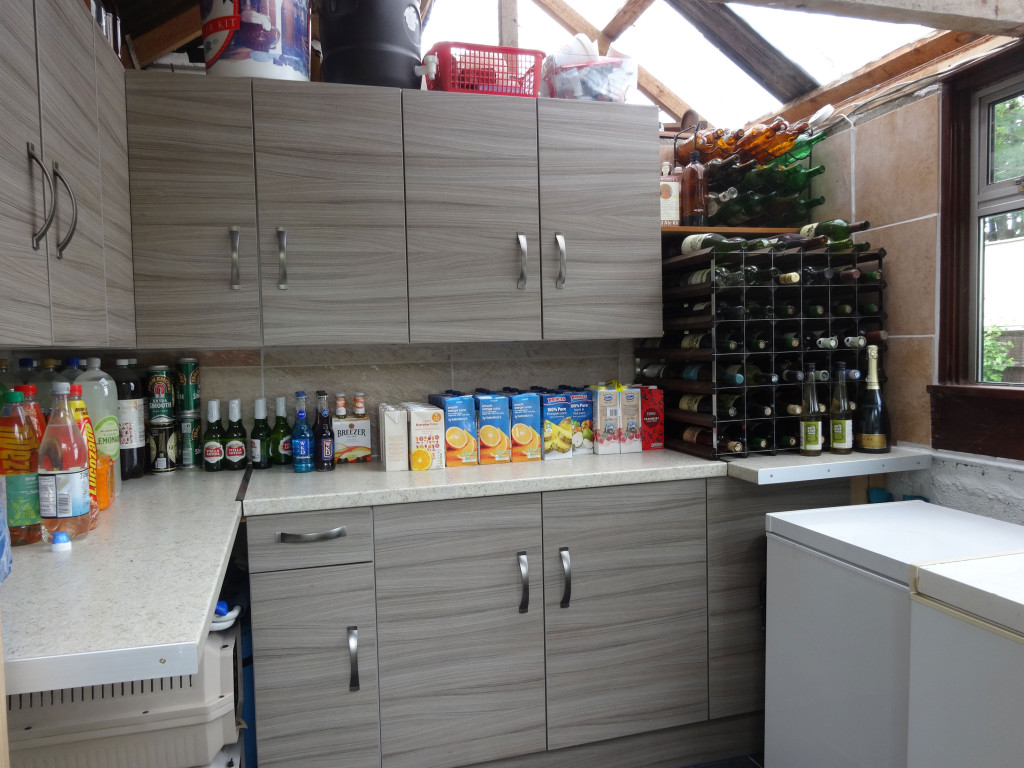
It looks like the "desert" part of 'food desert' needs some tweaking. In general, both in language usage and in physical locations, the 'desert' part refers to a lack of large grocery stores (also with large parking lots) with larger selections and discounted prices (lower than those at convenience stores or bodegas) for fresh food, not a desert with no food selection.
Convenience stores with ultra-processed foods, and bodegas with pantry staples and convenience foods pop up everywhere—even in Mamdani's targeted neighborhoods.
What the 'desert' part really means is no place to buy household groceries. Which our obesity stats prove is a big deal.
Another point to add is the reality of the ugliness of most
urban ('all' wouldn't be too wrong) low-income areas. They are not the small communities or villages in your commentary.
Their portrayal (urban 'communities') as 'places you don't walk after dark' is more reality than Hollywood licence (or bleeding hearts want to admit). There may be a lot of good folks in such a community, but they don't 'walk to the store' after dark either.
That was pretty dark, but with the dilution of degrees in further conversations, it's a more truthful picture of the areas being discussed for Momdani's planned stores. Add in the good folks you might see in daylight and an understanding of the multiplier effect of a few bad apples (more charitable than listing the gangs), and you can see neighborhoods worth saving. But not with this state-run grocery store idea.
GAGA — I think we’re actually using the term “food desert” in the same way. In the American context, the “desert” part refers to neighbourhoods that lack large supermarkets with full selections and discounted fresh food. That’s exactly how I’ve been using the term — but always in reference to the USA, not Britain.
The confusion may simply come from the structural differences between the two countries. In Britain, even small towns and villages have supermarkets or well‑stocked local shops, so the access gap Mamdani is trying to address just doesn’t arise here. Our corner shops and village shops aren’t equivalent to American convenience stores or bodegas; they function more like mini supermarkets, selling fresh milk, eggs, bread, fruit, vegetables, and household groceries. They don’t cook food or specialise in ultra‑processed snacks.
They are, as you say, more expensive than the big chains, but the difference is best described as moderately higher but still affordable — not prohibitive. They simply lack the economies of scale of the national supermarkets.
I did a quick comparison, and the closest UK equivalents seem to be:
• Bodega → deli counter (prepared food)
• American convenience store → petrol‑station shop (junk food and snacks)
So yes, I understand your point that a food desert means “no place to buy household groceries.” In that sense, British corner shops and village shops do fill the gap with a solid range of fresh groceries at moderately higher, but still accessible, prices. That’s why the phenomenon Mamdani is trying to solve doesn’t really appear here — the retail geography is simply different.
Size Differences Between American and British Supermarkets
British supermarkets are genuinely small compared with American ones. Even our “full‑size” stores — Tesco, Sainsbury’s, Asda, Morrisons — are modest by American standards. And then we have formats like Tesco Express and the Co‑op, which are often no bigger than a barbers shop or a small café. They carry a surprisingly wide range of fresh groceries, but the physical footprint is tiny.
The advantage of this model is structural. British supermarket chains operate with national economies of scale — centralised buying, national distribution hubs, and their own transport fleets — which keeps prices low. But by making many of their stores small, they also keep labour costs and overheads down at the individual‑store level. That allows them to open large numbers of local shops directly inside communities, so people never have far to walk or drive to reach a supermarket. Even villages have them.
In contrast, American supermarkets are mega‑stores: huge buildings, huge parking lots, and huge catchment areas. Because each store is so large, there are fewer of them, and they tend to be located far from where people live. That’s one of the reasons food deserts develop in the USA — the big stores are simply too far away for many residents, especially those without cars.
Tesco vs Tesco Express (for American readers)
Tesco is Britain’s largest supermarket chain. A standard Tesco store is a full supermarket with a broad range of fresh food, household goods, and general merchandise. Tesco Express, however, is a completely different format: a very small, localised shop designed for quick top‑up shopping. It sells fresh milk, bread, fruit, vegetables, eggs, tinned goods, and household basics — but in a compact space.
Tesco Express stores are deliberately placed inside neighbourhoods, often on residential streets, so people can walk to them. They are part of the British strategy of keeping grocery access local and convenient.
This difference matters because it leads directly into the Bristol example — when Tesco tried to open a Tesco Express in Stokes Croft, the community reaction escalated into riots. I’ll cover that next.
Stokes Croft: Why the Community Opposed Tesco
Stokes Croft is one of Bristol’s most distinctive neighbourhoods — known for its independent culture, street art, and long‑standing support for local sole‑trader businesses. The area is lined with small food shops, cafés, bakeries, and family‑run stores, and residents take real pride in keeping the neighbourhood independent rather than dominated by national chains.
Because of that, Tesco’s plan to open a Tesco Express on Cheltenham/Gloucester Road was seen as a direct threat. Many locals felt that a national supermarket, with its buying power and lower prices, would undermine the independent food shops that already served the community. There was a strong sense that Tesco was “muscling in” without regard for the area’s character or the wishes of the people who lived there.
The opposition wasn’t just about groceries — it was about protecting the identity of Stokes Croft. Residents argued that the neighbourhood had repeatedly expressed its objections, yet the development went ahead anyway. For many, it symbolised the displacement of local culture by corporate interests.
This tension eventually escalated into protests, and then into the well‑known Stokes Croft riots. Several videos of the clashes were uploaded to YouTube at the time, and they show how quickly the situation intensified once the police moved in to secure the newly opened store.
Here’s a short video showing the Stokes Croft Tesco Express protests and the clashes that followed:
Bristol – Stokes Croft Riots (2011): https://youtu.be/W7xx-3g8ONg
That particular supermarket finally closed in 2025. Tesco stuck it out for 14 years in the hope that local residents would accept them, but too many continued to boycott the store, so it wasn’t profitable. As per this local newspaper article:
Tesco announces unexpected closure: https://www.bristol247.com/news-and-fea … stol-shop/
In Bristol we have around 30 large supermarkets (large by British standards) and over 100 small supermarkets similar to Tesco Express, serving a population of around half a million people in a 44‑square‑mile area — just 8 miles in diameter. We are well served for supermarkets, and therefore have no “urban food store desert” in Bristol. That’s typical of Britain as a whole, urban and rural.
On the Urban Safety Point
I understand the picture you’re describing. The American urban environment can be very different from ours, and the issues you mention about safety, long walking distances, and the influence of a few bad actors are real factors in many low‑income neighbourhoods in the USA.
In Britain, the pattern has changed over time. We certainly had rough urban areas in the 1970s and 1980s where people genuinely avoided walking after dark. But over the last few decades the landscape has shifted: regeneration, denser settlement, better lighting, CCTV, and more mixed‑use neighbourhoods mean that most people now walk to local shops in the evenings without feeling unsafe. So the idea of residents being unable to reach a nearby store because of safety concerns isn’t really part of our present‑day structure.
That’s why my comparisons have focused more on geography, transport, and retail layout than on crime. The American context you’re describing — large urban districts, long walking distances, poor lighting, and pockets of gang activity — simply doesn’t map onto how British towns and cities are built today. It’s a very different urban reality.I get your point about shifting patterns since the 70s & 80s. Shifting was a good word choice.
Co-Pilot says that Pittsburgh, PA, or Baltimore, MD, have similar socioeconomic demographics as Bristol. Both are less densely populated than the "food desert" areas of NYC, but all (including Bristol) appear to have low-income, high-crime areas. Your "urban reality" does seem to be different than my perception of ours, so I can't say Bristol's poor areas fit my 'walking' description. But ...
On this point I have the advantage of not really knowing what I'm talking about. ;-)
GAGA — I appreciate your reply, and I think we’re actually converging rather than diverging here. One of the things I value about our conversations is that we each speak from lived experience: you know the American urban reality first‑hand, and I know the British one. That makes the exchange far more educational than anything either of us could pick up from the internet or an AI.
On the point you raised — whether Bristol has “low‑income, high‑crime areas” comparable to Pittsburgh or Baltimore — I can see why your Co‑Pilot framed it that way. At a very broad level, all cities have pockets where lower income and higher crime overlap. But once I looked more closely, the comparison didn’t align with how Bristolians actually understand the city, nor with the structural patterns on the ground.
How Bristolians Think About These Areas
In Bristol, people don’t talk about “low‑income areas.”
We talk about low house‑price areas versus high house‑price areas.
That’s because many higher‑income households deliberately buy in cheaper districts — NHS staff, teachers, tradespeople, tech workers, civil servants. Even when I was a civil servant on a good salary, we bought our second home in a low house‑price area simply because it made economic sense. So the American idea of a uniformly low‑income neighbourhood doesn’t map neatly onto Bristol. Income mixing is normal here.
Where Crime and Deprivation Actually Sit Today
Bristol does have some deprived pockets — Hartcliffe, Withywood, Knowle West, Lawrence Hill, and specific streets in Easton and St Paul’s — but they’re very small, tiny neighbourhoods of about 1,500 people each, scattered within otherwise mixed areas.
Crime in these pockets is mostly antisocial behaviour (ASB), vehicle crime, domestic incidents, and some drug‑related activity. Violent crime is far lower than in US cities. And because these pockets are so small, they don’t form large districts or “no‑go zones” — they’re just scattered areas within wider, stable neighbourhoods.
The Historical Shift Since the 1970s–80s
Bristol did have rougher areas decades ago. Southmead, Hartcliffe, and St Paul’s all had reputations in the 70s and 80s. I walked those streets often — you just needed to be street‑wise: walk confidently, don’t stare at the lads on the corners, and they ignored you. It wasn’t threatening, just a matter of being aware of your surroundings. And although young women walking alone at night might have felt a bit wary, many I knew lived in those areas and frequently walked those streets on their own; they were street‑smart and it generally didn’t bother them.
From the 1980s onward, several political and social changes transformed these neighbourhoods — and although I’m a socialist and no admirer of Margaret Thatcher, I do think it’s important to give credit where it’s due, because some of her policies had unexpectedly positive long‑term effects.
• Right to Buy (Thatcher’s policy)
Council houses — local‑government‑owned social housing for low‑income and unemployed residents — could be bought by their tenants at generous discounts. Over time, about half the homes on old council estates became privately owned. This mixed ownership helped stabilise neighbourhoods and reduced the concentration of deprivation.
• The rise of the Yuppie (Young Upwardly‑Mobile Professional)
Another Thatcher‑era phenomenon. Yuppies weren’t snobs — they were savvy. They bought cheap houses in run‑down areas because it made economic sense, and doing the places up themselves helped them climb the economic ladder. As more of them moved in, neighbourhoods naturally became more respectable, and house prices rose as a result.
• Local government learned from this
They stopped building huge mono‑class council estates, which had sometimes become trouble spots. Modern developments deliberately mix private and social housing on the same streets. That blend of rich and poor living side‑by‑side works remarkably well and keeps most British neighbourhoods safe day and night.
• St Paul’s as an example of change (for different reasons)
Its transformation wasn’t directly caused by Right to Buy or mixed‑housing policy. St Paul’s had a unique history: wartime damage, post‑war decline, Windrush‑generation settlement, and clashes with police in the 1980s. Over time, regeneration, community leadership, cultural pride, and events like the St Paul’s Carnival reshaped the area. Today it’s peaceful, diverse, and nothing like its 1980s reputation.
Why the American Comparison Doesn’t Hold
Pittsburgh has multiple neighbourhood clusters with simultaneously high poverty and high violent crime.
Baltimore has some of the highest violent‑crime rates in the US, with large, historically segregated districts shaped by redlining and deep structural poverty.
Bristol simply doesn’t have anything on that scale. Our deprived pockets are small, mixed, walkable, and improving. Crime is moderate and localised, not city‑defining. The American “unsafe walking corridor” model — long distances, poor lighting, gang‑controlled blocks — doesn’t map onto Bristol’s urban form.
Madison as the Closest American Analogue
Of the American cities I looked at, Madison seems to be the closest match to Bristol. The similarities line up on several fronts:
• University influence — both cities have major universities that shape culture, employment, and regeneration.
• Mixed‑income neighbourhoods — small, walkable areas with a blend of incomes rather than large segregated districts.
• Moderate, localised crime — pockets rather than large zones, and far lower violent‑crime levels than in many US cities.
• Regeneration rather than abandonment — steady investment and improvement, not Rust Belt‑style decline.
• Compact, walkable urban form — shops, services, and housing close together, making everyday walking normal and safe.
This gives a much clearer picture of why Bristol’s “poorer areas” don’t resemble the American examples your Co‑Pilot suggested.
On Your Density Point
You mentioned that Pittsburgh and Baltimore are less densely populated than the “food‑desert” areas of NYC. Bristol is also far denser than those American cities, and that makes a big difference to walkability. Even in our lower house‑price areas, shops and services are close together, streets are well‑lit, and people walk everywhere. So the “long unsafe walking corridor” pattern you see in some American cities doesn’t really exist here — even in the pockets that had rough reputations decades ago.
Where This Leaves the Mamdani Discussion
I can’t claim any deep knowledge of American cities or grocery‑store economics, and I know you’ve said the same about NYC. But from what I’ve read, the picture doesn’t seem as clear‑cut as treating Sun Fresh as a straightforward precedent. That store had several issues at once — falling customer numbers, security costs, and a change in operator — so it’s hard to draw a simple lesson from it.
New York hasn’t chosen its five locations yet, and the success or failure of Mamdani’s idea will probably depend on very local factors: population density, demand, the operator they select, and how the city manages the costs. It might fail, as you predict — or it might work in some places and not in others. I don’t know enough about the American context to say either way.
My only point is that the “known facts” don’t seem quite as settled as they first appear. Time will tell.Your Bristol description is also what Co-Pilot offered. I was looking for big city-type slum areas to match my impression of our inner city low-income communities. As you noted—I didn't find them. I found pictures that matched your descriptions. Live & learn.
As a 'cute' side note relative to your housing descriptions, when I asked Co-Pilot about inner city slum areas in Bristol, it informed me that Britons find the term too derogatory and use the term 'low housing cost areas.' ... and then you come along, and your comment confirms it in practice. As I said, 'Live & learn."
The Mamdani issue: There is a strong capitalist bias pushing those "known facts." For example, the known East Harlem location isn't as bad as the demographics at Sun Fresh. It isn't even designated as a food desert. Most descriptions note that the area is anchored by an established food-vendor market. But it does have similar low-income, high-crime demographics.
My perception is that in addition to the stereotypical 'low-income, high-crime area' problems, the government store will also be resented by the other businesses. It's not a statistically proven perception; it's a lived perception of human nature.
The other known location is The Peninsula in the Bronx. It is a closer match to Sun Fresh than La Maraqueta (East Harlem), but it is not noted as a food desert either.
The push behind my bias is both the concept and the details. The declared intent is to make food cheaper for one group of people at the expense of others (it turns out not to be a "food desert" fix). The declared method of doing this defies the reality of the capitalism of our human nature.
Your (generic) heart might scream to hell with capitalism, but your head knows you have to change human nature first.
GAYour reference to slums raises an interesting point.
You won’t find any slums in Britain these days for two very good reasons:
1. They’re illegal — local governments (councils) are legally required to prevent unsafe or unfit housing.
2. Councils have a statutory duty to house the homeless, so people aren’t left to form slum districts.
For clarity:
• “Council” is simply the British word for local government.
• A “Council House” is a home built and owned by local government for ordinary working families — long‑term, stable, affordable housing.
Also, all new‑build homes in Britain must meet very strict building standards — some of the strictest in the world.
That’s not to say Britain never had slums. In fact, slums were a major social and political issue from 1883 (after The Bitter Cry of Outcast London) right up to the Second World War. Successive governments struggled with the sheer scale of the problem: clearing and replacing up to a million slum houses was prohibitively expensive, and in practice almost no progress was made — Britain entered 1939 with roughly the same number of slum houses it had in the 1880s.
In a dark twist of history, the Blitz accomplished what decades of governments couldn’t: it wiped out Britain’s slums. Not by design — Hitler was aiming at factories and docks — but the slum districts clustered around them were destroyed all the same. Post‑war Britain was nearly bankrupt, but at least it no longer had to fund the demolition of a million unfit homes.
For the first decade after the war, councils built large numbers of new homes. Then, from the mid‑1950s through the 1970s, policy took a wrong turn: councils shifted from building traditional brick‑built houses to constructing high‑rise flats (apartments) for social housing. It seemed modern at the time, but it proved to be a failed experiment — the tower blocks quickly became low‑income, high‑crime environments, and high‑rise living was totally unsuitable for families, with well‑documented psychological and social‑isolation problems.
From the mid‑1980s onward, most of those tower blocks were demolished. Roughly 3,000 high‑rise blocks, housing about half a million people, were replaced with proper two‑storey brick‑built Council Houses (state/government‑owned social housing) built to modern standards.
To give you an idea of the standards modern social housing is built to, this short video is a good example:
5 bedroom new brick‑built Council House (local government built and owned social housing) tour https://youtu.be/-g0Fnn1P-Z8]5
2. The Mamdani Plan — Context, Caution, and Human‑Nature Dynamics
Your points about the Mamdani plan raise several interesting distinctions. One of the first is the question of what the scheme is actually designed to fix. Although the early press framed it as a “food desert” solution, the two proposed locations — East Harlem and The Peninsula in the Bronx — aren’t classified as food deserts. So I can see why you say the plan isn’t really about food‑desert remediation in the strict USDA sense.
Where the scheme does seem to be focused is affordability rather than access. The stated aim is to make a core basket of groceries about 30% cheaper for low‑income households. Whether that’s wise or workable is another matter, but it does mean the intent isn’t quite the same as the Sun Fresh situation you’ve been comparing it to.
On the question of resentment from other businesses, I understand the point you’re making. Even here in Britain, when a large chain moves into a neighbourhood with a strong independent identity, it can provoke pushback from local residents who feel their existing traders are being undermined. Stokes Croft in Bristol was a good example of that dynamic. So I can appreciate why you see a similar reaction forming around the Mamdani proposal.
As for the broader issue of “capitalism versus human nature,” I can’t speak to the American context, but from the outside it looks less like an attempt to challenge capitalism itself and more like a small‑scale affordability experiment — a pilot scheme to see whether a city‑owned store, run by a professional operator, can deliver lower prices in a couple of specific neighbourhoods. Whether it succeeds or fails will probably depend on practical factors rather than ideology: shrinkage, security costs, operator competence, and whether the subsidy is sustainable. Those seem to be the same issues that determined the fate of Sun Fresh.
3. Socialism, Capitalism, and the “Human Nature” Question
On your point about “heart versus head,” I think this is one of those places where British and American political language use the same words but mean quite different things. In Britain, socialism doesn’t mean rejecting capitalism; it means running a mixed economy where the state owns and manages key public services — health, education, transport, energy, water, sewage — while private industry operates normally in commerce, retail, and manufacturing. The two systems run side by side.
Where the British model differs from the American one is in the level of regulation. Private industry here is expected to operate within a framework of consumer protection and employment rights: a legal one‑year warranty on all goods, a statutory minimum wage, six weeks paid leave from the first day of employment, strong health‑and‑safety rules, tenancy protections, and high standards for food quality and product safety. None of that is ideological; it’s simply the way Britain balances market freedom with public welfare.
Because of that, the British idea of “human nature” tends to be different too. It isn’t framed as purely competitive or profit‑driven. There’s an assumption that people want stability, fairness, and reliable public services, and that government has a role in providing those things. So when we talk about socialism here, it’s usually in the context of practical administration rather than a philosophical challenge to capitalism.
Burnham’s model fits squarely into that tradition. It isn’t ideological socialism; it’s a pragmatic, mixed‑economy approach aimed at reducing the cost of living and improving public services. His focus is on putting more disposable income into the pockets of ordinary working people, not on changing human nature or overturning the economic system. In that sense, the British debate is operating on a different set of assumptions from the American one.
I hope that helps explain the distinction a little more clearly, and why the same terms can carry such different meanings on opposite sides of the pond.
This photo below appeared in the Bristol Evening Post in 1954. It shows my parents being handed the keys to their new Council House, with my brother in my mother’s arms. The reason it made the newspaper is that this particular home was the 1,000th new council house built in Bristol after the Second World War — part of the huge post‑war programme to replace the slum housing destroyed during the Blitz and to give ordinary working families proper, long‑term homes.
Yep, we do expect different things from our governments.
My perception is that "socialism" (in America) is more of a political 'Boogie man' than an actual societal fear. Most of us accept the necessary reality of a mixed economy. (as we accept the reality of the need for a progressive tax system). Differences are almost always just an argument of degrees rather than opposites.
My negativity towards Mamdani's plan isn't because they are tenets of socialism or 'liberal thinking,' it's because I believe they've been tried before (in concept, if not details) and shown to be failures.
On another note, your Council house commentary has had me pondering the concept all morning. It's been more interesting considering the questions without Google. They're everywhere.
Where does 'Council' get the money to build the houses: 'government money' or private market participation? I'm thinking about our FHA initiatives of the 1950s & 60s ...
Was "1000th" a great benchmark met for Bristol, or just a step on the path of one Council?
Was the construction industry a participant, or was it a service bought? The private-versus-public-money question pops up again.
Those are rhetorical questions. They don't need answers; they're illustrations of where the thought wandered. I think if I dug deeper, there would probably be a lot of similarities between your Councils' efforts to provide housing and our Federal housing assistance programs of the same era.
I did peek at the 'eviction process' and intentional homeless solutions, but they weren't obvious comparisons (too many cultural differences). So that's where my pondering ended.
Now I'm off to thinking about your description of Brits' view of human nature. I think you're right, and I think it's due to our nations' age difference. ;-)
GAGA, I think you’ve put your finger on it when you say that, in both our countries, the differences are usually a matter of degree rather than opposites — whether we’re talking about mixed economies or progressive taxation. That’s a very helpful way of framing it.
On Mamdani’s plan, I understand your point about similar ideas having failed before. True — though past failures don’t always predict future ones, and every now and then a pilot does surprise us.
COUNCIL HOUSES (GOVERNMENT‑OWNED SOCIAL HOUSING)
The simple answer to your question about funding is: central government money.
But the landscape changed so dramatically in the 1980s that it’s easier to explain with a bit of history.
Britain began building council houses in 1919, just after the First World War, under the slogan “Homes Fit for Heroes.” These were publicly funded, publicly owned homes built by local government for ordinary working families.
During the 1920s and 1930s, councils built about 1.1 million council homes, housing roughly 10% of the population.
After the Second World War came the ‘Golden Age of Council Housing’: from 1946 to 1979, councils built another 4.4 million homes. By the late 1970s, about one‑third of British households lived in council housing.
The Thatcherism Effect
Everything changed in the 1980s. The “Right to Buy” policy allowed tenants to purchase their council homes at market value, minus all the rent they had paid as a discount. Over the following decades, this dramatically reduced the council‑housing stock.
Then, from 2010 to 2024, under Conservative governments, central‑government funding for new council housing was minimal. Councils could only build small numbers of new homes using rental income from the stock they still owned.
Today, roughly:
• 65% of people own their homes
• 19% rent privately
• 8% live in Housing Association homes (non‑profit social housing)
• 8% live in council housing
Rent Levels
For context, the rent levels across those groups differ sharply. Private renting is by far the most expensive and often the least secure. Housing Association rents are significantly cheaper because the organisations are non‑profit and exist to provide affordable social housing. Council‑house rents are the lowest of all — set to cover long‑term maintenance rather than profit — which is why council housing has historically been the most affordable option for working‑class families.
The Andy Burnham Effect
That picture is about to change again. The new Labour government Prime Minister (Andy Burnham) has just restored large‑scale funding for council‑house construction — something Britain hasn’t seen since the 1970s.
As for the “1000th house” in Bristol: it was a milestone for the city, but only the beginning of a much larger national programme. Every local authority (local government) was building new council houses at scale during that period.
FHA Initiatives vs Council Housing
I enjoyed reading up on the FHA era — thank you for pointing me in that direction. But if I’ve understood correctly, the FHA initiatives of the 1950s–60s were fundamentally different from UK council housing.
The FHA insured mortgages for private suburban homes, giving banks confidence to lend to middle‑class families. It was a homeownership‑expansion policy.
Council housing was the opposite model:
• publicly funded
• publicly owned
• publicly managed
• built for working‑class families at controlled rents
So although both involved government intervention, they were philosophically and practically different systems.
Construction Industry
On your question about who actually built the homes:
Councils own the land, hire the architects, choose the contractor, and manage the project — but the physical construction is always done by private‑sector building firms. Councils don’t maintain their own construction workforce. They run the procurement process and oversee the build to ensure it meets national standards.
Evictions
Yes, I agree — the cultural differences make direct comparison difficult. But one takeaway is that eviction from social housing for rent arrears is extremely rare here. People on low incomes or who are unemployed have their rent paid for them by the central government as part of the welfare system, so straightforward non‑payment is unusual. When eviction does happen, it’s usually due to severe anti‑social behaviour or complex personal circumstances rather than simple financial hardship.
Human Nature
I liked your point about our nations’ age difference. It may well play a part. Britain’s assumptions about “human nature” tend to emphasise stability, fairness, and reliable public services, and that shapes how we think about the role of government. It’s one of those areas where the same words carry different meanings on opposite sides of the pond.
As always, I appreciate the thoughtful exchange.
ArthurWe have to keep in mind that only one "past failure" has been offered and that one does not fit the current proposal.
That photo is classic, Arthur, thanks for sharing it. It sort of makes you a celebrity….
Capitalism does not necessarily have to result as outcrop of human nature, your society seems to do well without such a designation.Credence - glad you liked the photo — it’s a lovely bit of family history, and it still strikes me as slightly surreal that my parents ended up in the local paper simply for being handed the keys to a new council house. If that makes me a “celebrity”, it’s only in the most modest, Bristol sort of way.
On your point about capitalism and human nature, I agree. Capitalism isn’t an inevitable outgrowth of human nature — it’s just one way of organising a society. Ours has always leaned more towards the idea that government should step in where markets don’t deliver fairness or stability, and that shapes how we think about things like housing, healthcare, and welfare. Different assumptions, different outcomes.
Always appreciate your perspective.
Arthur
Reception of Mamdami grocery store plan has been mostly negative. Offering free rent and no property taxes may well not be enough beyond tax payer subsidy to make this work.The threat to traditional retail outlets will be there even though Mamdami is talking about basic staples. Could it work for a smaller segment of store inventory? Basic staples? I will do whatever i can to kick the oligarchy in the head, but this upon close examination may not be the way
Maybe if access to the stores requires membership that is based on a member income “not to exceed”principles?Yep, his plan is such a bad idea that it doesn't need any political spin to highlight its problems. Plus, his staff and spokesfolks' statements made things worse.
This is one example: a reporter asked about concerns that someone might try to use the 30% discount for arbitrage instead of food. A staffer replied with something about a "library card-esque' store card or ID card, which led to social media comments and extrapolations about government ID cards, which led to more news-cycle confusion and clarifications about whether the plan was a program with government ID cards for government food from a government store, and ... you can imagine how that went over.
Your 'membership idea ... yep, it went over like a lead balloon. LOL
GA“The country needs and, unless I mistake its temper, the country demands bold, persistent experimentation It is common sense to take a method and try it: If it fails, admit it frankly and try another. But above all, try something. The millions who are in want will not stand by silently forever while the things to satisfy their needs are within easy reach.”
FDR, 1932
There is the challenge against the same pedantic, hidebound attitude associated with conservative thinking. So, let Mamdami attempt, through moderation and adjustment he may well make some headway, the capitalists and aristocrats will resist on principle. But, I don’t care what they think, they are more than happy to retain their advantages in a system whose fairness I have always questioned. So, if Mamdami fails dismally, you are vindicated. But, I am willing to wait and see what he can do.
Conservatives never have problems with Government ID cards as long as they can use them to intimidate voters. So, what is the problem here? I have to have a card to use either Costco or Sams stores. The idea of “means testing” is not a novel one, it is used everyday. I can’t use VA medical facilities because of it. The objections, if any, are primarily superficial.
I say to Mamdami to ignore rightwing chattering and PRESS ON…..
So, is it really all “doom and gloom”, GA?
https://inequality.org/article/how-city … nsecurity/It's all doom and gloom now. After all my effort to focus on one particular non-political point, it still failed. You still have nothing but political mantra garbage as an answer.
It's damn disappointing, Cred. Look at your words. None of them apply to the point of this thread. There was nothing political or ideological about the topic (you said as much yourself in previously describing the plan as 'possibly a bad idea').
Now all you have to offer is: "pedantic, hidebound attitude associated with conservative thinking." —there was none of that in the OP, or afterwards.
... and "the capitalists and aristocrats will resist on principle" — where were they in this conversation before you interjected them?
... and "they are more than happy to retain their advantages in a system" what advantages do "they" have in Mamdani's low-income target areas?
... and "Conservatives never have problems with Government ID cards as long as they can use them to intimidate voters." Oops, the story that related the reporter's question about ID cards wasn't from a conservative source or mouthpiece. You've made an assumption. You should have checked the story.
... and on and on you drone. Not about the topic, but about the mantra of your returned audience.
Yep bud, your reply did bring me a doom and gloom mood. I had other expectations.
GAIt is non political, what is your objection to the attempt? As usual, you listen only to what you want to hear. There is no certain outcome of failure that you seem to be alluding to….
The people in New York voted this man in for a reason, is that to be ignored because you think that you know better?I'm not "alluding"; I'm predicting. Get it right.
I'm predicting that the currently known facts indicate a strong likelihood of failure.
I'm predicting that that failure will have nothing to do with politics or ideologies. It will fail for the same reasons Sun Fresh did.
By "fail," I mean the costs to the city will become too high to keep the store open. Just like the Sun Fresh example.
I don't think I know better. Why do you feel the need to throw that barb/insult into the mix? What's next, I know you are but what am I? Or, 'You're an ugly dodo head.'? Surely your faith isn't so weak that you feel threatened simply because it's challenged?
GAThat’s simple enough, predict, there are many others that are predicting otherwise. As for whether your “prediction” is correct, only time will tell. Your prediction is your opinion as there are other opinions expressed across the internet.
There is no “barb”intended.What I have issues with is the "known facts" part of "I'm predicting that the currently known facts indicate a strong likelihood of failure."
Besides Sun Fresh, I'll ask again, what facts are known that says that the state providing facilities and hiring professional operators to run it = failure? Also, was that the paradigm used at Sun Fresh?
I then asked ChatGPT the following question:
Is Sun Fresh even a legitimate data point? The differences between that and what Mamdani is proposing are vast.
The response brought to light the weakness in using Sun Fresh as your only data point.
Sun Fresh is certainly worth studying, but treating its failure as evidence that Mamdani's model is likely to fail ignores most of what actually happened in Kansas City.
First, Sun Fresh had a demand problem in addition to a crime problem. The surrounding area had been losing population, other grocery options existed nearby, and customer traffic reportedly collapsed from roughly 14,000 shoppers per week to about 4,000. Crime and security expenses were unquestionably serious—the reported $5,000–$6,000 weekly security bill is extraordinary—but you cannot attribute the failure of a store that lost roughly 70% of its customers entirely to shoplifting and security.
Second, the later operating arrangement wasn't the one Mamdani is proposing. After the original private operator wanted out, Community Builders of Kansas City, a nonprofit community-development organization, took over the grocery operation through a subsidiary. Mamdani proposes competitively contracting the grocery operation to experienced professional grocery operators while the city provides the facility and establishes the public-policy requirements.
But here is what I find most interesting: Kansas City's reaction to the Sun Fresh failure was not to conclude that the public-facility/private-operator concept doesn't work. It did essentially the opposite.
Kansas City kept the publicly owned grocery facility and sought a new private operator. In January 2026, after a competitive selection process, the city chose United Market KC, affiliated with Associated Wholesale Grocers, emphasizing grocery experience and financial sustainability. The city explicitly described the replacement as a privately operated grocery store in the city-owned facility. The replacement store opened in May 2026.
Think about what that means for using Sun Fresh against Mamdani. The lesson Kansas City itself appears to have drawn from its failed experiment was:
Publicly provide the facility, but put the grocery business in the hands of an experienced professional grocery operator.
That is considerably closer to Mamdani's proposed model than the arrangement that ultimately failed at Sun Fresh.
There is another enormous difference. New York has not yet selected the five locations. The relevant question should be whether each proposed location has sufficient population and grocery demand to sustain a store. If NYC selects dense neighborhoods with demonstrable unmet grocery demand, those economics could bear very little resemblance to a Kansas City store whose weekly customer count had fallen from 14,000 to 4,000.
None of this proves Mamdani's experiment will succeed. It might fail. Crime might become a problem at one or more locations. The subsidy might prove too expensive. The city might choose bad locations or bad operators.
But that's precisely the point. Where is the evidence that the particular model Mamdani is proposing has a “high likelihood” of failure? One repeatedly cited failed store in Kansas City doesn't establish it—especially when that store suffered collapsing customer traffic and severe site-specific security problems, wasn't ultimately operating under the same paradigm, and Kansas City's response to its failure was to adopt a model more like Mamdani's, not abandon the idea.
In fact, if Sun Fresh is going to be our principal case study, perhaps we ought to wait and see how its replacement performs under the new professional-operator model. That would be a considerably more relevant data point.
Food Deserts explained:
USDA's actual framework is revealing. What used to be commonly called a “food desert” is now measured as a low-income, low-access (LILA) area. The factors USDA uses include income, distance from supermarkets, vehicle availability, transportation, and other measures of accessibility. Crime is not part of the definition.Here is a good article about the subject of this forum and it hits the nail on the head defining the difference between GA's thoughts and mine, Credence's, and Nathanville's thoughts.
"The obsession with ‘Mamdani marts’ isn’t about groceries"
I think the defining paragraphs are these:
"The response to Mamdani’s plan reflects something much deeper than the brand of ketchup public stores will sell or the price of eggs. It comes down to a fundamental disagreement about the responsibility of government.
Where supporters see government intervening to solve problems of everyday people struggling to afford groceries, others see a socialist mayor overreaching to take aim at a powerful symbol of America’s riches.
“The debate is not really about the specific mechanics of the model,” said Nevin Cohen, an associate professor at the CUNY School of Public Health. It’s a “test of competing ideas about what we expect government to provide.”
That is followed by a counter to the Sun Fresh example:
"Never mind that the public stores aren’t a radical new idea and the city is bringing in private operators to manage them and source the food. Or that 99% of New Yorkers will never shop at one of them. They will not destroy John Castimatidis’ Gristedes supermarket empire."
Followed by:
"He is following in the footsteps of his political idol, Mayor Fiorello LaGuardia, a champion of government intervention during the New Deal who built public parks, housing and the airport that bears his name. Overcoming opposition from private industry, LaGuardia opened a network of city-run indoor markets during the 1930s to move pushcart vendors off streets and reduce the cost of groceries. Several of the markets are open today."
https://edition.cnn.com/2026/08/15/busi … s-new-yorkYour LaGuardia mention caused me to look. I'm impressed. Visualizing the streets of NYC and its described pushcart problem makes his 'market' idea seem like a smart move. Considering what the ones that still exist morphed into—it's clear it was a city-altering idea.
But, it is not a similar effort, and it does not relate to the framing of "GA's thoughts" at all.
Your 'framing' paragraphs are off-base relative to my thoughts.
Specifically to the point of my OP, and contrary to the summation of your first paragraph, the OP is not ... a fundamental disagreement about the responsibility of government."
It is very specifically about the chosen mechanism: a government-run discount grocery store.
My thoughts aren't criticisms of Mamdani's ideology or his "overreach"; they are about the specific tool chosen for the job. Again, contrary to your next paragraph's summation, my criticisms are very much about the "mechanics of the model."
It is those mechanics, and not the legitimacy of the ideology, that the OP criticizes. Also, the criticism isn't about the effect on other 'private' stores.
One other point: Much is made about the idea of "professional" operators being able to make the plan work. Sun Fresh was run by professional private operators, and all but one of the successful co-ops I looked at were run by private professional operators. I don't think "professional operators" is the fix the proponents emphasizing it claim it to be.
Your final LaGuardia paragraph offered a good start to my morning. I was familiar with him as a historical NYC mayor, but I didn't know about his markets. It was a good idea that worked. Mamdani's discounted grocery store is not in the same vein as the LaGuardia markets.
GAI have to question this, in that the quote indicates that these millions and millions of dollars will benefit less than 1% of NY residents.
Is that really what government is all about? Spending millions/billions of dollars to "help" a tiny minority of the people that COULD be helping themselves?What exactly does the fact that the city is spending millions and millions of dollars prove? The whole point is to help people who face problems they cannot reasonably solve for themselves. The question is whether that expenditure solves a real problem and whether the benefits justify the cost.
And I still don’t understand your statement that these people “could be helping themselves.” Exactly how are they supposed to do that? If affordable private grocery stores are no longer available in their neighborhoods, what did these residents supposedly do to cause that? What realistic option are you saying is available to them that they are simply refusing to use?
The fact that fewer than 1% of New Yorkers may shop at these particular stores doesn’t by itself tell us whether the expenditure is justified. Government spends money all the time on programs that directly serve relatively small portions of the population. The relevant questions are whether there is a legitimate need, whether the program works, and whether there is a more effective way to address the problem.
Wilderness' claims of millions in subsidies might be seen in the city's Operator bid request. It asks that bids include anticipated subsidies.
Prompted by a good article, Zohran Mamdani's Promise and the Reality of Supermarket Prices, I spent a whole cup of coffee visualizing the arbitrage possibilities.
Before you sneer, it goes like this. To set the stage, it starts with hamburger hustlers. In the article, in a discussion about how the 30% will be determined, an example of different market pricing noted that while hamburger might be $7.99 lb. in a 'regular' grocery store, it could also be $14.99 lb. in smaller shops and bodegas.
The point was about the 30% discount—the $7.99 ($2.10) or the $14.99 ($4.20)? You know the hamburger hustlers will be waiting to empty the shelves for their new bodega customers.
... and it went further. Now, to combat the arbitrage of the hamburger market, someone manages the meat shelves, limiting purchases to two per shopper. And that stresses out a poor old white-haired grandmother who needs 5 lbs. to make a meatloaf for a big family dinner on Sunday.
She explains it's a special reunion dinner. She begs, she pleads. Finally, she asks for the manager—only to be told the manager got off at 3:30.
The grandmother was so distraught that the police had to be called. Then, some of the folks loitering around the entrance took offense at how she was being treated.
And that's how her picture and "City Store Denies Hamburger to Poor Grandmother!" splashed across the front page headlines. By the time I got a hot refill, the thought was gone. ;-)
GAThis is the sensible bottom line of that article - "If Mayor Mamdani is going to build these stores, he should be clearer about the limitations of the experiment. And he should do what the Pentagon never managed to do: publish the affordability payment. Publish how the basket is priced and against what benchmark. Then let someone independent verify what shoppers actually save. Start before the day the doors open."
I understand and agree with much of what the author wrote. I don't think anybody disagrees that what Mamdani is proposing is a subsidy, The author compares them to the city (and others) paying for public school and roads. To argue against that is to say that making sure a population has quality produce, meat, and farm products at affordable (to them) prices is not anywhere near has important as public schools and roads.
Of course, i suppose one could argue that those to items don't deserve public support either.
Simply put, what Mamdani wants to do is subsidize food and put it where needy populations can get to it. I see nothing wrong with that if NYC taxpayers are willing to foot the bill.
And if they aren't willing, vote him out at the next opportunity.Keep in mind that my criticisms are of the method, not the goal. This 'idea' gets worse as more details emerge.
I thought Mamdani was going to repurpose city property; now I understand they're building a new store. An article about a tour of prospective "operators" described it as a vacant lot about a block+ (1 1/2) away from the La Marqueta location. It also noted it was surrounded by 'meat shops, produce shops, grocers, and bodegas'. That was what prompted the hamburger hustlers thought. It sounds silly, but it is a real probability. *shrug*
I agree with your quoted blurb. And I agree with your description of what he's trying to do. But, agreeing with the goal doesn't require ignoring reality. It's not a new idea. It has been tried before. Many variations of it have been tried before. The problem isn't 'that it just hasn't been done right', it's a flawed model.
Instead of wagging a finger when they vote him out (as I mentioned to Cred, it would be too late then), I'd rather see him succeed in some way. As described by another, 'it's the appearance of doing good vs actually doing good.' Words vs. action
GAI have to argue that Mamdani's model has not failed before, because it has never been tried before. Each example failure is materially different from what he is proposing.
GA, i would like to see Mamdani succeed in someway as well. I simply dont see with the evidence presented by you and ESO, that Mamdani ideas have to be a total abject failure without hope of success at any level.
I like the ID card idea as one that means tests and make certain that not everyone lives off from taxpayer subsidies to these programs. What is the problem with “means testing” and ID issuance for those eligible to attain basic staple food materials at reduced prices? I dont see such an outlet as really designed to be competitive in the supply and demand sense with other retailers.
I dont write off Mandami’s programs and i admire him for making the attempt to challenge the status quo. If he fails, it wont be too late to revert back to the original system. Those that support the current status quo will correct his error fast enough.I see many objections to this plan:
1. The same problems with voter ID cards exists here: for some people they are nearly impossible to get. Disabled, too poor to pay the cost whether travel or money. While I disagree with them, I have to give consideration to the millions that insist they are impossible for some, and food is far more important to them than voting is.
2. At the root, this is nothing but another socialist program to take from one and give to another. Wealth cannot be created this way, no matter how hard we pretend it is. How about the only people that can buy cheap food work the store and, at a minimum, reduce the subsidy required of taxpayers that do not benefit?
3. Judging from past history, and watching 50+ years of it, the "limit" for means testing will forever climb, and not because of inflation, Instead, the non-producers will forever be given more and more and more of what the producers have built.
4. So let Mamdani find a way to sell cheap food...without taxpayer subsidies. He will have actually created wealth, and produced a competitive model that can be copied by business everywhere. We can all benefit from it that way instead of a select handful living off the efforts of others. If that is unacceptable, simply double, triple or quadruple the food stamp program. Whatever is necessary. This is cheaper to the taxpayer that building a store and using government employees to staff it.Wilderness, I think you are being confused by the term "ID Card". The proposed grocery card isn't an ID card in the voter-ID sense at all. Nobody has to prove who they are, prove their income, or even prove they live in New York City to shop at Mamdani's stores. The city has discussed a voluntary, library-card-like customer card primarily to keep people from buying subsidized food in bulk for resale. Comparing the difficulty of obtaining government identification to obtaining that card is comparing two completely different things that happen to have been called cards.
2. Then with all the subsidies conservatives insist the rich get, can I call you socialist as well? Should we put laws in place to stop the wealthy from siphoning off money from the poor?
3. What "means-testing" are you referring to?
4. Please get your facts correct then try again.1. You have cleared one thing up for me. Why it is the GOP is insistent on these IDs, as those that would have the most difficulty obtaining them would generally not support Trump nor the GOP. This difficulty has not stopped conservatives from pursuing the ID’s why should it stop progressive folks?
2. Everything is socialist, wilderness, from the mill levy taxes I pay to support public schools when neither I nor any charges of mine attend. No one is talking about creating wealth, but preventing people from falling to be able to feed themselves and their family. Conservatives consistently support the idea that the poor are poor as their own fault. Well, that is not always true, with the current wage structure, it is seen that hard work does not always lead to success or economic sufficiency. Most of those warm fuzzy beliefs belong in an elementary school’s student primer.
3. I dont agree that the limit would necessarily rise for any reason beyond inflation. Social Security COLAs has not risen any where near the extent of inflation over the last 50 years. So, it is for you that people who work hard without being able to survive are “non-producers”? From where does that attitude derive?
4. Heaven knows that I subsidize everything else, from Trump’s wrecking ball in Washington, to a bloated military budget. I just as soon subsidize those that through no fault of their own are not able to survive at a subsistence level.
The ID card aspect needs some clarity. As proposed, the stores are to serve low-income New Yorkers, but not only them. There is no means test in the plan. Otherwise, customers could use their SNAP card for ID and payment.
Consider the existing details: The goal is stated as reducing prices for the three most sought-after (and valuable) foods: meat, seafood, and fresh produce, in designated areas (the five boroughs).
It is admitted that the store will require city subsidies, but no one is saying how much—but it seems the number is in the millions (10s, 100s, billions???). Nobody knows yet.
The specific location of the East Harlem store is surrounded by "... meat shops, produce shops, grocers and bodegas," independent businesses serving the same market. Two class action lawsuits have already been filed against the city. One argument compares what happens when a Walmart comes to town.
The optics: the city will subsidize a store that will put New Yorkers out of business. Consider the irony; they keep Amazon and Walmart out only to put their store in.
I think my 'hamburger hustlers' thought has a high probability of being a 'real thing,' as well as some of the original demographic issues also being applicable.*
*The stories of how people shoplift steaks from real grocery stores will surprise you. From cargo pants pockets to down the pants' crotch and legs, to stuffed in purses and bras. It's a real issue.
... and then there are the operational facts and issues. There are good sources that explain why the 30% discount will not come from reduced wholesale costs. The only source will be operational savings and subsidies.
GAI agree with some of what you said, but certainly not all of it. As to cost, I put on my cost analyst hat, pulled some figures from AI and very roughly estimated that the top line for the subsidy portion shouldn't exceed $108 million a year or about point 08 percent of the City's budget.
Unlike what conservatives appear to want to do, I just can't bring myself to assume that because a few people do something bad, everybody like them will do the same thing. Sure, somebody may stuff a steak in her bra. People shoplift. They do it at grocery stores all over America. Yet somehow those stores manage to stay in business. So why is shoplifting suddenly supposed to make Mamdani's stores unworkable? Is the assumption that poor and minority people are uniquely likely to steal? Because otherwise I don't understand the argument.Of course, you can't agree with all I say. It's blasphemous to even consider the possibility. ;-)
Relative to the subsidy cost, even if your estimate is close, it's still a hundred million that the city does not have. Ironically, Mamdani has been praised for presenting a transparent budget that exposes the deceit of previous administrations (hiding deficits as off-budget items, etc.). It shows a structural gap —year after year—of billions.
The shoplifting point was only a demographic note. Relative to the developing specifics of the East Harlem location, it's almost becoming a secondary argument.
Originally, the argument for the idea spoke of inner-city 'food deserts' and poor, low-income New Yorkers. Now, the argument is focused on affordability (subsidies and the 30% discounts).
Relative to shoplifting, my perception, both recall and anecdotal, is that poor neighborhoods do shoplift more than middle-class ones. Maybe your life experience is different, but in mine, I have watched the 'good' stores leave the poorer areas of town. I've heard about, and seen, shoplifting and 'shrinkage' (employee theft) being noted as primary reasons for retail failure.
Have you seen or noted this issue differently? Do you think it's only spoken of as a 'character slam' rather than a fact of life?
GA
As for your paragraph, true GA, the SNAP cards should help. Mamdami says that the SNAP program has been inadequate to addressing rising food costs. Rising costs of food means that the subsidy does not go as far as it once did. This is restricted to New York City and its 5 boroughs, and that may very well be true.
I am not Mamdami, but i would restrict the food access to basic food stuff items, it can’t be a matter of what is sought after by beneficiaries when this program involves the public dime. Vegetables and meat items, not lobster or even steak with nutritional value.
I wanted to see a narrow constituency for the program, without the overwhelming threat to grocers in the area.
Ok, shoplifting is a problem in poor neighborhoods, that is not new. But i would not blanket poor people in general as subject to criminal activity. If the scope of the program is limited, i will work within the operational savings and subsidies.Mamdani has insisted, from the start, that there will be no means-testing restrictions. An out-of-stater can buy from the stores.
He has also stressed that the 30% discount will be applied to meat and seafood. My Hamburger Hustlers' story covered the original thought about that choice, and recently the bodega owners (1000-member coalition) said the same thing. It is doubtful the selection will be restricted to hamburger and fish patties.
The concept presented by the mayor is detailed as a full grocery store. Not a restricted item/choice food bank. So you don't get your "narrow constituency" or limited menu.
Ironically, most recent articles, both for and against, are using photos of the neighborhood that show blocks full of independent shops; well-stocked, well-organized, and clean, with real owners/operators in the picture. Bad optics for the mayor's plan.
GAAfter researching specifically the La Marqueta area, I am leaning toward your point of view, but only for that location.
According to what AI found roughly 14,500 people near La Marqueta experience food insecurity, representing something on the order of 6,000–6,500 meals per day that households cannot currently afford. And that is after the conservative driven disappearing SNAP and other benefits from the federal gov't.
That is the problem Mamdani is trying to solve - those people can't afford to pay the high prices charged by local businesses in the area, so they go hungry sometimes. But it seems to me that in the La Marqueta area an inflation-adjusted purchasing card for qualifying households that can only be used at qualifying local businesses might be a better solution. Of course, checks would need to be put in place to prevent price gouging because these people are now getting more money.Why is the solution always to give away what one has built/earned to another? To a stranger that has not been responsible for supporting themselves?
Why is that the only solution liberals ever come up with?It is called being a responsible human being.
My perspective also changed as more details about the La Marqueta store came to light.
The issue isn't about food insecurity; it's about affordability. That doesn't get the same sympathy as food desert or food insecurity do. He's lost the initial rush of support.
And now his $30 million price tag is being challenged. Critics are popping up with estimates as low as $10 million for the speculated specs of the La Marqueta building. *shrug*
GATo me, when people regularly miss meals, as the data shows, that is by definition food insecurity.
News of lawsuits against Mayor Mamdani's La Marqueta location has raised a new question: Is the reward worth the risk?
The coalition suing the city represents independent immigrant shop owners (1000s???). In following this issue, the lawsuit articles prompted a thought; the accompanying images were of produce shops, grocers, delis, and bodegas. Well-stocked produce and grocery shops.
Even the pro-plan articles included views of the shops in their articles about the potential operator's 'vacant lot' tour.
These are, in some cases, generationally-owned shops. Their arguments are demonstrably true. A state store will be a Walmart to them. Is the cost worth the reward?
... and then, there are the administration's replies: They are talking about finding regulations and red tape to cut, tax abatement possibilities, and even ..... grants, to help the small shops stay afloat.
Plus, Mamdani says there are 8,500 grocery stores in the city; he's only talking about 5 more. Sheesh.
One of the articles described one of those 8,500 — almost right across the street from the state store: "On the other side of Park Ave along east 116th street is City Fresh Market, a clean, well-stocked, 24/7 grocery store that's been feeding the neighborhood for decades. They fear their cash registers would sit empty if a taxpayer funded store opens within walking distance and cuts into their already slim profit margins."
ABC Eyewitness News Ch. 7
As more details come to light, the state-run grocery store idea is looking less like a good plan.
GA






Related Discussions
- 6

Planning For Chicago-owned Grocery Stores
by ga anderson 2 years ago
This idea is so ripe that there is something for everyone. The meme makers are drooling over those old pictures of empty shelves in Soviet Union(?) grocery stores.Mayor Johnson Announces The Exploration Of A Municipally Owned Grocery StoreExploring a municipally owned grocery store is part of...
- 3

Do you buy mint or dandelion greens in a grocery store? Why?
by toomuchmint 14 years ago
Do you buy mint or dandelion greens in a grocery store? Why?
- 9

If you smell something really bad in line at the grocery store, do you comment o
by rutley 14 years ago
If you smell something really bad in line at the grocery store, do you comment or just ignore it?
- 8

Is there any solution to long lines in the grocery store.
by Annie 13 years ago
Is there any solution to long lines in the grocery store.
- 7

Suspicious Behaviour at the Grocery Store; being watchful.
by SandCastles 12 years ago
Another grocery store tale: At the grocery store (in the evening) there was a man and a woman shopping together and I immediately got a bad feeling when they passed me. They walked around the store and didn't seem to be buying anything. Then when I went to the till, they were suddenly behind me....
- 11

Waiting at an amusement park vs. a grocery store.
by Barbara Sloan 14 years ago
Waiting at an amusement park vs. a grocery store.Why are people willing to wait an hour at an amusement park to ride an attraction, but get irritated waiting in line at the grocery store?