The Politics of EV
Britain is gearing up for a big transition: in just four years — by 2030 — the sale of new fossil fuel cars will be banned. Here in the UK, people are largely supportive and embracing the change. But across the Atlantic, the real battle is playing out — with strong resistance from politicians and oil companies in America. How’s the EV shift coming along where you live?
We recently made the switch ourselves. After retiring our two faithful 20‑year‑old Daihatsu Terios, my wife picked up a 2025 Citroën e‑Berlingo MPV EV, and my son went for a 2025 Renault Kangoo small van EV. With a home charger installed, the running costs are astonishing — only about $0.03 per mile, roughly one‑tenth of what we used to spend on petrol (gasoline). In Britain we fill up with petrol, while in the USA you call it gas — either way, the savings are huge. We couldn’t be happier.
Have you already gone electric, or are you planning to make the leap soon?
Below - Our Two New EVs: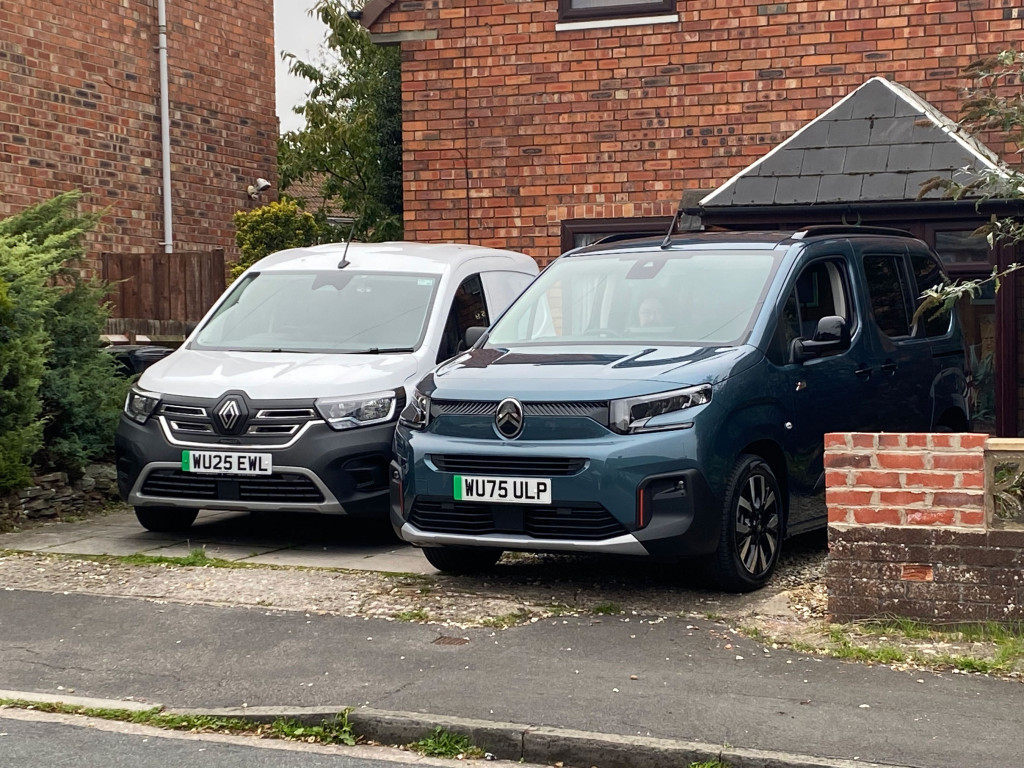
I think at this point, just offering info, instead of my view. This will give the best of current trends, vertical sales, and what is being manufactured. I do have friends who own EVs and are very pleased with their vehicles.
Overall U.S. New Vehicle Sales by Type (2025 Estimates) 1. Trucks and SUVs (Majority of sales)
Trucks + SUVs combined: ~82 % of all new vehicles sold in the U.S. — this includes full‑size pickups, midsize pickups, and all SUV sizes.
J.D. Power
This trend continues the long‑term shift away from passenger cars toward larger vehicles.
Breakdown (approximate):
SUVs: ~50 %+ of new vehicle sales (many analyses place compact & midsize SUVs largest overall segment).
Visual Capitalist
Pickup Trucks: ~30 %+ of new vehicle sales (counts all pickup sizes).
Visual Capitalist
Taken together this means trucks + SUVs dominate well over 80 % of the market.
2. Passenger Cars (Sedans, Hatchbacks, Smaller Cars)
Sedans & traditional cars: ~15 % or less of new sales in 2025.
Visual Capitalist
This segment has shrunk dramatically over the last decade as buyers prefer SUVs and trucks.
3. Electric & Hybrid Vehicles (EVs + HEVs + PHEVs)
Electric and hybrid vehicles cross traditional body‑type lines (EV SUVs, EV cars, hybrid trucks), so their share overlaps with the categories above. But looking at the powertrain market share:
Battery Electric Vehicles (BEVs/Electric‑only): ~7.9 % of new vehicle sales (February 2025 data).
Edmunds
Plug‑In Hybrids (PHEVs): ~1.8 % of new vehicle sales.
Edmunds
Hybrid Electric Vehicles (HEVs): ~~12 % of new sales (2025 forecast).
J.D. Power
All electric + hybrid combined: ~20 % of new vehicle sales.
J.D. Power
EVs alone are still a small piece of the total sales picture compared with SUVs and trucks, though hybrids add significantly to the electrified total.
U.S. Automakers Are Scaling Back EV Production Plans
Major traditional automakers like Ford are publicly reducing their EV commitments:
Ford has retrenched on EVs, taking a large financial charge (about $19.5 billion) and shifting investment away from large, all‑electric models toward hybrids and extended‑range models that combine battery and combustion power.
Reuters
Ford canceled its EV battery supply deal and halted production of some planned EVs, signaling a pullback in pure EV manufacturing capacity.
Reuters
VW — a global automaker still with significant U.S. ambitions — is closing a plant that built EVs.
New York Post
Taken together, these moves clearly show U.S. companies reallocating capital and production capacity away from EVs and back toward hybrids or ICE variants.
Market Demand & Policy Shifts Are a Big Reason
Three major forces are reshaping the EV production landscape:
A. Expiration of Federal EV Incentives
Federal tax credits worth up to $7,500 per EV were a key driver of early EV adoption. Their expiration in 2025 has reduced consumer demand and weakened the business case for large EV production.
Economy
Weak Near‑Term Consumer Demand
With federal incentives gone and charging infrastructure still limited in some areas, demand for EV purchases has slowed. Some automakers are reporting unsold EV inventory and discounting to move existing stock.
CBT News
This shift in economics pushes firms to delay or reduce EV production capacity until they can make it profitable without heavy subsidies.Wow – very comprehensive, informative, and enlightening. Thanks for sharing.
From your data, it’s clear that the situation in the USA is radically different to the UK:
- In the UK, large vehicles such as small vans, SUVs, and MPVs (Multi‑Purpose Vehicles) now account for about 60% of all new car sales, while smaller cars like hatchbacks and saloons make up around 40%.
- My wife’s new EV is an MPV. For clarity, an MPV is essentially a small van (roughly the size of an SUV) converted into a car by adding windows and foldable rear seats. Unlike SUVs, they’re boxier in shape, which gives them far more storage space when the seats are folded down. Unsurprisingly, MPVs are gaining popularity here.
It doesn’t surprise me that EVs and hybrids together only account for ~20% of sales in the USA. That’s in stark contrast to the UK, where this year EVs and hybrids combined have exceeded 50% of sales (roughly split 25% EVs and 25% hybrids).
I’m disappointed to hear that USA automakers are scaling back EV production. Again, that’s another sharp contrast with the UK, where manufacturers are scaling up rapidly. Just five years ago, EVs were less than 2% of sales; now they’re over 50%, and by 2030 they’ll be 100%.
Three Major Forces Reshaping the EV Landscape – USA vs UK
1. Policy & Incentives
- In the USA, the expiration of federal tax credits worth up to $7,500 per EV in 2025 has weakened demand.
- In the UK, we’ve never had such “carrot” incentives. Instead, the government has used the “stick” — but the stick is aimed squarely at car manufacturers, not the public:
• In 2020, the Conservative government set in stone the 2030 deadline banning new ICE car sales. That forced manufacturers to plan a rapid transition.
• Annual EV sales targets were introduced, rising each year until 100% in 2030. This year’s target is 28%; next year it rises to 33%.
• Failure to meet quotas results in a £15,000 ($20,000) fine per car under target — a penalty imposed on the manufacturer by the UK government, not on consumers. Ouch.
2. Consumer Demand
- In the USA, demand is weak, as you explained.
- In the UK, demand is strong and growing, thanks to the rapid rollout of public charging infrastructure. Drivers now feel confident they can travel long distances and recharge when needed. Seeing more EVs on the road also reinforces popularity.
3. Charging Infrastructure
- In the USA, infrastructure remains patchy.
- In the UK, the 2030 ban created a guaranteed market, which attracted heavy investment. Investors saw a clear opportunity for strong returns by funding public charging networks. With everyone needing EVs by 2030, the demand for chargers is locked in.
Conclusion:
In the UK, these three forces – government policy, consumer demand, and infrastructure investment – are feeding into each other, creating a rapid upward spiral. The result is accelerating EV production, rising EV sales, and expanding charging networks, all reinforcing one another.I think it’s a worthwhile move for the UK, but the U.S. faces different obstacles. Our weather varies drastically, people tend to drive long distances, and the charging infrastructure simply hasn’t kept pace. Yes, Americans were pushed to buy EVs, but there was no parallel push to build the infrastructure that would make EV ownership practical. And the reality is, U.S. consumers still overwhelmingly prefer larger vehicles.
Infrastructure really is the key. Over here in the UK, the 2030 ban on new ICE cars created a guaranteed market, which in turn encouraged private investors to roll out charging networks quickly. Without that parallel push in the USA, I can see why EV ownership feels less practical — the infrastructure has to grow alongside adoption, otherwise drivers won’t feel confident making the switch.
As a sideline, though, I’d just add that distance itself isn’t necessarily an insurmountable obstacle. These days, plenty of people drive across Europe on holiday in EVs — for example, the direct trip from Britain down to Spain is around 1,500 miles, and with detours through France or other countries en‑route the mileage can be much higher. With the right charging network in place, even journeys of that scale are perfectly manageable. It all comes back to infrastructure: once the chargers are there, the miles take care of themselves.
And on the point about weather, Scotland is a good example. Winters there can be cold and brutal, yet EVs are proving practical. Drivers do see reduced range in freezing conditions, but with pre‑heating, smart charging, and a strong public network, even long trips across the Highlands are manageable. Norway is an even stronger case — despite harsher winters than Scotland, it has Europe’s highest EV adoption rate. That shows climate isn’t the real barrier; once infrastructure and driver habits adapt, EVs cope just fine.
Both politically and based on infrastructure, America remains a long distance from the example provided by the UK. Here in central Florida, I can count on one hand the amount of electric charging stations that I have actually seen.
Electric vehicles are an extension of an answer to climate change, that which conservatives still deny is taking place. The administration has relaxed emission standards and moved forward deadlines for transition to electric, they are not pulling in the same direction that we need to shoot for.
Conservatives are basically oligarchs, whose concern is more about keeping the spigot open and protecting their sources of wealth than to deal with the broader public issue.
I am not a physicist, but I have heard that batteries are less efficient in cold weather, it would be interesting to learn how the Norwegians overcome this basic impediment.
The idea is still mostly science fiction here is more in a prototype stage, practical application to the extent that we need it may be years away.You make some very good points, and I completely agree with your overall assessment of why the USA is lagging behind the UK and Europe on this. The political headwinds, the influence of the oil lobby, and the lack of consistent federal direction all play a huge part. In countries where government, industry, and infrastructure all move in the same direction, the transition tends to accelerate very quickly — and that simply hasn’t happened in America yet.
On your point about cold weather and battery efficiency, that’s a really interesting question. Norway is the best real‑world example we have of EVs thriving in extreme winter conditions. Their winters are far harsher than most of the USA — long periods of sub‑zero temperatures, deep snow, and mountain roads that stay frozen for months. Yet EVs dominate the market there, with well over 80% of new cars sold in 2025 being fully electric or plug‑in hybrids.
Of course, parts of the USA — places like Minnesota, North Dakota, Montana, and Alaska — get winters every bit as severe as Norway, sometimes even colder. But the key difference is infrastructure. Norway has reliable home charging, widespread public chargers, pre‑heating systems built into the vehicles, and a network designed specifically for sub‑zero climates. Once that support structure is in place, the cold becomes far less of an impediment.
You might find this video interesting — it shows an EV being taken to the extreme in freezing temperatures in Norway:
Taking the electric car to the EXTREME with Freezing Temperature
https://youtu.be/2bAI2ebSIFs
And as an afterthought, here’s another one you might enjoy. It’s a test drive of the new electric Scania truck in the Norwegian snow, filmed by a female truck driver from my part of the world. I actually know her from the annual Somerset Guy Fawkes carnivals — she drives one of the floats — and she’s the same woman who made that behind‑the‑scenes carnival video I emailed you recently. So I thought you might like to see her putting an electric truck through its paces in proper winter conditions:
Test driving the new electric Scania in Norway snow
https://youtu.be/bNiPFtKiibc
As for your final paragraph, I know exactly what you meant. In much of America, the perception — not your view, but the general sentiment — is that EVs are still “science fiction” or something for the distant future, and that the practical need for them is years away. That’s largely because the infrastructure simply isn’t there yet. When people rarely see charging stations, and when the political messaging is inconsistent or openly hostile, it’s no surprise that many Americans think the whole idea is still at the prototype stage. But as we’ve seen in Europe, once the infrastructure arrives, attitudes shift very quickly.
So yes — politically and practically, the USA has a long road ahead. But the technology is already here, and working brilliantly in places with the right support. Once the charging network expands and the political winds change, I suspect the transition will accelerate far faster than many people expect.There is another problem the US faces that is minimized in Europe, and that is population density. Where I live towns (not cities, but towns and villages of 500 people) can be hundreds of kilometers apart. This makes it very difficult create the infrastructure, for the resources just aren't there to build them with! There isn't the electrical capacity, for hundreds of kilometers, to provide for even a handful of charging stations!
That means it isn't a matter of erecting a small building or even a few charging pedestals and tying them to the power grid that's overhead; we need a whole new set of high voltage feeders coming long, long distances.Well, I'm glad they have a wonderful EV program going...
I'll take America...
They (UK) just sentenced a guy for 20 months in jail for making a derogatory comment about immigrants online, saying he didn't want government money going to them...even after he publicly apologized for making it. The judge said he could have sentenced him to 7 years.
Thanks... I'll take America and its gas guzzling SUVs and Trucks... but where I can speak my mind and not be sentenced to years in jail for it.Ken, that’s a completely separate issue from what I’m talking about. You’re raising a broader political argument about freedom and speech, and that’s a debate you and I have gone around many times over the years. I’m not reopening that here. We clearly have very different views on what genuine freedom looks like, and I happen to think the approach we take in the UK is a more balanced and civilised one — but that’s a much wider discussion than this thread.
My point here has simply been about EV infrastructure and how different countries have approached the transition. On that front, the contrast between the USA and places like Norway, China, and much of Europe is pretty clear.
You’re absolutely right that population density plays a huge part in how easy it is to build out infrastructure. When you take Europe as a whole, the population density is roughly double that of the USA — about 746 million people across a landmass similar in size to the USA’s 332 million. That naturally makes things easier in many regions.
But there are also parts of Europe that are every bit as sparsely populated as the areas you’re describing. Norway and Scotland are good examples. In fact, the population density of the USA is almost double that of Norway: around 96 people per square mile in the USA versus just under 40 in Norway. Norway is vast, mountainous, and thinly populated — yet more than 80% of new cars sold there are EVs, and they even have public chargers at the tops of mountain passes (scenic viewpoints).
Scotland is similar. The most remote public charger in the Highlands is in the village of Durness — population 347 — which is 120 miles from the nearest town. And in England, the most remote charger is in Kielder, a tiny village of just 218 people, 35 miles from the nearest town. So even in very remote areas, the infrastructure has been pushed out to where people actually live.
Where you say that the USA would need “a whole new set of high‑voltage feeders coming long, long distances,” that’s exactly the challenge the UK (and the rest of Europe) faced back in 2012. At that time, 98% of our electricity in the UK came from fossil fuels, wind power was in its infancy, and EVs were virtually unheard of. Our ageing National Grid simply couldn’t handle the power demands of the future, and upgrading the entire system in the traditional way would have been prohibitively expensive.
So instead, Europe went down the Smart Grid route — keeping the existing networks, but making them far more intelligent and flexible, and then expanding only where necessary. A big part of that for the UK was connecting the hundreds of offshore wind farms to the grid, which typically involves up to 40 miles of seabed cable to shore and another 20–30 miles of buried cable inland to the nearest grid connection point.
The other major step was cooperation. Rather than each country trying to build spare capacity on its own — which is slow and expensive — Europe agreed on a single set of standards and regulations and built the system collectively. In contrast, the USA has 50 different regulatory environments, which makes nationwide coordination far more difficult. Europe’s ability to work as a unified bloc on energy policy is one of the reasons the EV transition has moved so quickly here.
Working together, Europe interconnected their national grids into one large, continent‑wide system. That approach has been far cheaper and far quicker than going it alone. The UK alone now has around 1,650 miles of high‑power seabed cables linking us to the rest of Europe, with more under construction.
And it works. Looking at National Grid Live right now, the UK’s electricity mix is roughly 31.5% fossil fuels, 57.4% renewables, and 11.1% imports. At this moment we’re exporting electricity to Ireland and Belgium, and importing from France, Denmark, Norway (hydropower), and the Netherlands. The whole system balances itself in real time.
If you’re interested, this video gives an excellent visual overview of how the UK and Europe built their undersea interconnectors and why they matter for a modern, flexible grid. https://youtu.be/2Ry38iWLJr0
So yes — the USA absolutely faces challenges because of its geography and population spread. But Europe had many of the same problems, and the solution wasn’t to rebuild everything from scratch, but to make the grid smarter, more interconnected, and more flexible. That’s what ultimately made widespread EV adoption possible, even in very remote areas.
I appreciate the links, the first two were much like a travelogue, a splendid trip around Norway. The snow and ice being quite familiar. Too often I have fixed myself on the old lead-acid batteries and their capabilities. Of course, all of that has changed. I am delighted to have that myth of inefficient batteries in cold climates debunked. The “science fiction” is not my view, but the perception of where our nation finds itself today in regard to this issue.
There is a whole mountain range that have to be moved before we can even consider catching up. With sufficient and plentiful charging stations, and with vehicle technology beyond what I was familiar with 20 years ago, I can visualize the transition from internal combustion vehicles.Glad you enjoyed the videos, Credence — Norway really is something else in winter, and it’s a great reminder of how far the technology has come. It’s easy to get stuck with the old assumptions about batteries, so I’m pleased the examples helped show what modern EVs can actually do in real‑world conditions.
And yes, you’re absolutely right: the perception in America is shaped far more by the lack of infrastructure than by the capability of the vehicles themselves. Once the charging network becomes widespread and reliable, the rest tends to follow quite naturally. It’s a big shift, but it’s certainly not science fiction anymore — the pieces are already there, it’s just a matter of building the foundations.
Always appreciate your thoughtful take on these things.
Hmm... what about the proposed pay-per-mile charge to bring EVs in line with ICE vehicles?
Also, I recommend you watch this: https://youtu.be/SNag4j0nmKU?si=d_fPn1ma8cdEZ4w9 to see how clean EVs are.Duh, what do you expect? Petrol tax is a massive revenue stream for the government — around £25 billion a year — and as EVs don’t pay fuel duty, that hole has to be filled. Of course mileage on EVs will be taxed, just like mileage on petrol cars.
But here’s the kicker: from April 2028, EVs will pay 3p per mile, rising to 6p per mile by 2030. Even with that, the running cost is still far lower. Electricity averages 2.6p per mile, so even with tax added, EVs remain cheaper than petrol, which costs in excess of 20p per mile. The numbers don’t lie — EVs are still the better deal.
And spare me the “foreign dependency” nonsense. That video doesn’t even relate to us. Our EVs and their batteries aren’t from China — they’re made in Europe, under far stricter environmental and worker safety standards. European mining and production are regulated to protect both the environment and the people working in the industry. So dragging in horror stories from China is irrelevant to our cars and our supply chains.
My son’s Kangoo EV van was built in the UK with a French battery, while my wife’s Berlingo MPV was built in France with a UK made battery. That’s cross channel cooperation, not dependency.
Meanwhile, the UK is actively building battery independence:
• Britishvolt’s Northumberland site (under new ownership, being revived)
• Envision AESC’s Sunderland gigafactory, backed by £1bn investment, supplying Nissan
• AMTE Power’s Dundee project, focused on specialist cells
By 2035, these projects aim to make the UK 90% self sufficient in EV battery production, cutting reliance on imports and securing our automotive sector.
And don’t forget Cornwall. Cornish Lithium is scaling up hard rock and geothermal lithium extraction, with funding from the UK’s National Wealth Fund.
By 2030, Cornwall could supply up to 20% of UK lithium needs, and by the mid 2030s enough to cover around two thirds of UK EV batteries.
That’s domestic mining, domestic jobs, and domestic supply chains.
Inside a British lithium mine: A Cornish white gold rush https://youtu.be/ezFg43sjO2c
So the reality is simple: EVs are cheaper to run, the UK is securing its own battery future, and Cornwall is powering the raw materials. The anti green, anti EV rhetoric is just noise — the facts are stacked against it.Oh yea, let's dig up Cornwall. Duh.
Batteries - yum. How much will yours cost to replace? What will happen to the old ones?
'Your' EVs may not come from China but have you seen how many Chinese imports are coming in to the UK? When you talk about the politics of EVs, you need to get away from your own narrow perspective and look at the issue as a whole.
I'm keeping my ICE, which is increasing in value as we speak while yours are depreciating at a rate of knots.
Oh, and don't forget to wrap up warm in this cold weather as you won't be able to keep the heater on if doing any longish journey
No need to dig up Cornwall. The mines and quarries already exist, exhausted of their other valuable minerals after thousands of years of mining. Lithium has been sitting in the slag heaps as waste — only now does it have value. So it’s easy pickings with little environmental impact, and without the need to “dig up Cornwall.”
EV batteries typically last 10 to 15 years. Replacement costs are currently around £7,000, but they’re falling fast, and most manufacturers give an 8 year warranty. By the time a battery needs replacing, most people would be thinking of replacing their car anyway. And the outlook is clear: costs will continue to drop as UK and global gigafactories scale up production.
Old EV batteries don’t get thrown away. They’re repurposed for second life uses like home or grid energy storage, or recycled to recover valuable metals such as lithium, cobalt, nickel, and copper. Recycling rates are improving, with up to 90–98% of materials recoverable.
Yes, I know how many Chinese imports are coming into the UK — in 2025 it was just 10%. But it’s up to the individual whether they buy Chinese or European. We chose European.
That’s your prerogative if you want to keep your old ICE. But eventually, when you do have to buy a new car, after 2030 you’ll have no choice other than an EV — unless you decide to stick with old second hand cars.
And yes, you’re right — old ICE vehicles are increasing in value. When we sold ours they’d just become classified as “Classics.” We had two buyers vying for them, and in the end sold to a dealer who dabbles in classics, at an excellent price for both — even though one was broken and needed repairs worth more than the car itself.
And yes, if you drive an EV in Eco mode, the heater is less effective. But for the odd bitterly cold day we switch to “standard” mode, and then the air conditioning is very effective. We still get good mileage — just not as far as in Eco mode.
Finally, yes — an EV loses half its value in the first year. But if cost is your primary concern, you can pick up second hand EVs one to three years old as cheaply, or even cheaper, than a new ICE car.
My wife’s new EV hasn’t cost her a penny — all she pays for is electricity to keep the battery charged, and on the Motability scheme, in three years’ time it’s replaced with another free EV car.
Last May my wife was finally granted full Motability (PIP). On the Motability scheme she gets a new car every three years, all inclusive: free insurance (for up to three drivers), free servicing, free MOT, free repairs, free breakdown cover, free road tax, plus free tyre and windscreen replacement, and support for EV charging. For the support for EV charging element of the Motability scheme we opted for a free OHME Pro Home Charger installation.
We could have had Motability pay for a fixed ramp or hoist for her disability scooter, but that would have permanently taken up too much storage space. Instead, I built a DIY ramp for under £100 — it does the job perfectly.
Mobility Hacks: Transforming a Family Car for Wheelchair Accessibility: https://youtu.be/bTzP614trrw
As for my son’s new EV van: after his old car died in June, we were going to let him have my wife’s old car. But the following week he spotted a dealer selling a 2025 pre production EV model with just 3 miles on the clock, at half price. It had been a forecourt showpiece for nearly a year, and they wanted it gone to make space for the 2026 model. So he bought a brand new EV van for the same price as a second hand ICE van less than three years old. I’d call that a real bargain.
Ouch! My electricity rate ranges from 7 cents to 12 cents, depending on time of day. At 11 Kwh to drive 40 miles (the SUV isn't nearly as good as the older Chevrolet Volt), that's less than 80 cents, or less than a tenth of what you're paying. And that's before the extra 6 pence tax!
I think something may have been lost in communication, so I just want to check that I’ve understood what you said correctly.
If I’m reading it right, you’re saying that:
1. It costs between $0.07 (£0.05) and $0.12 (£0.09) per kWh to charge your hybrid.
2. That works out to about $0.80 (£0.60) for 40 miles, which is roughly $0.02 (£0.015) per mile.
Have I understood that correctly?
For clarity, in case my earlier explanation was misleading:
In the UK:
1. It costs about $0.09 (£0.07) per kWh to charge our EV, provided we use the cheap overnight tariff between 11:30 pm and 5:30 am.
2. That works out to around $0.035 (3½ cents, or £0.026) per mile.
Of course, once the mileage tax is introduced at the full rate in 2030, the cost per mile will rise from $0.035 to $0.11 (£0.086).
So yes, at 3½ cents per mile, it may currently cost a little more to charge an EV here in the UK than it does for you in the USA, but the difference isn’t huge. And although by 2030 (with the introduction of the millage tax) we’ll be paying about $0.11 per mile—roughly five times your $0.02 per mile—that will still be far cheaper than petrol (gas) in the UK. Car Fuel has always been significantly more expensive in Europe than in the USA, and that’s simply a reality we live with.
I bought a plug in hybrid some years ago, then replaced it with another, this time a SUV. Very, very happy with it - I get about 3,000 miles to a tank of gas. It would be more, but I travel about 250Km (one way) every 2-3 months to visit relatives and that takes most of a tank in and of itself.
Ev's are just not practical yet in most of the US - distances are just too great and charging stations too few. It's getting there, but not yet.I’ve got to say, I’m genuinely impressed with what you’ve managed with your hybrid — 3,000 miles to a tank is no small achievement. You’ve clearly made the most of what’s practical in the USA, and I completely understand the challenges you face with the sheer distances and the limited charging infrastructure. It’s a very different landscape compared to here, and I think you summed it up perfectly with “It’s getting there, but not yet.”
Over here, although Europe is also vast, it’s now possible to travel across the continent in an EV just as easily as driving across the UK, thanks to the huge European wide charging network. Ten years ago it was a different story — batteries weren’t as powerful, charging stations were few and far between, and you had to plan routes carefully to make sure you could recharge en route. But things have changed dramatically: batteries have become stronger, chargers are faster, and the public charging infrastructure has mushroomed.
These days, there are countless mobile phone (cell phone) apps that not only show you nearby charging stations, but also tell you the charging speed, the cost per kWh, and even guide you there with built in GPS and satnav. And here’s a fun fact: there are now more public charging points in the UK than petrol (gas) stations, with new ones being rolled out at a rapid pace… in fact, in 2024 alone more than 20,000 new public charge points were installed across the UK — that’s one every 26 minutes on average. The pace of growth is astonishing.
Octopus Electroverse - Electric Vehicle Charging Made Simple (video is just 1 minute and 20 seconds long) https://youtu.be/wSdzLONg2O0
So while I completely appreciate the hurdles you face in the USA, it’s encouraging to see you say “it’s getting there” — because that’s exactly what happened here too. A decade ago, EV travel was a challenge in the UK, but now it’s seamless. I’m confident the USA will catch up, and when it does, you’ll be in a great position having already embraced the hybrid transition.
America has infrastructure issues, and with the massive deployment of AI Data Centers all over the country, which take up as much power as a small city, this greatly compounds the problem.
The Biden Administration spent a trillion dollars to build the infrastructure like Tesla has built for its own customers nationally... don't ask me where that money went, because no infrastructure for EVs was built.
We own two Tesla's a 3 and a Y... both are great, best technology has to offer vehicles, before that we had a Chevy Bolt and Volt... Tesla is far superior to anything else out there, all around, from safety to security, you name it.
But with the explosion of AI Data Centers being built, power costs are going up everywhere. EVs are still more affordable than gas, no oil changes, no gas costs, etc. but I can see on the horizon the cost for electricity making EVs less of an economic no-brainer in the future... here in America.
Our country is much bigger... our population is much bigger... and the infrastructure to convert all people over to EVs is not there, we would need to stop funding foreign wars and foreign migrants and NGOs whose goals are to destroy the Nation state and invest those trillions into building the new High Voltage power lines and distribution centers... and then there is the crime factor, where charging stations are ruined because crack-heads steal the copper or because some ideological nitwit wants to attack Tesla because of Elon's politics.
These things are easy for well-off European nations with small populations and small geographical areas, much more problematic here.Yep, AI Data Centres are the in‑thing; even on this side of the pond. We don’t have them on the same scale as the USA, but for a small country like the UK the scale is quite impressive — around 250 active data centres across 72 cities, with a pipeline of about 94 new‑build centres planned or under construction.
Back in 2020, when the UK Conservative Government set 2030 as the point at which the sale of new ICE cars would become illegal, the government braced itself for having to fork out huge sums of taxpayers’ money to build the EV charging infrastructure — the classic chicken‑and‑egg scenario.
But as it turned out, they needn’t have worried. With the 2030 cut‑off set in stone, it created a guaranteed captured market. Private investors saw it as a goldmine for a profitable return, and poured money into rolling out public charging networks.
The only company to misjudge things was Tesla. They quickly rolled out 3,115 Tesla charge points, initially exclusive to Tesla cars. But Tesla has never been as popular here as other EVs — only 16% of UK EVs are Tesla. To recoup their investment, Tesla opened up their chargers to all EVs, and even offer discounted rates to non‑Tesla drivers at off‑peak times.
Like in the USA, the rapid expansion of data centres and EVs is putting pressure on the UK’s power grid. But we do have several advantages:
Britain has upgraded to a smart grid, balancing demand and supply to keep costs down.
(a) Utilities offer cheap overnight tariffs when demand is low and offshore wind is plentiful — encouraging EV owners to charge at home when electricity is cheapest.
(b) Offshore windfarms continue to grow, providing more clean, cheap power.
(c) Wave and tidal power projects are in the pipeline.
(d) We’re connected to the European grid, so we can import electricity when needed and export surplus when others need it.
As I write, looking at National Grid Live, the UK’s electricity mix is: 20.8% fossil fuels, 58.5% renewables, and ~20% imports. Imports at 10am (18th Dec) were: France 8.8%, Denmark 3.6%, Norway (hydro) 3.5%, Belgium 2.6%, Netherlands 2.6%. At the same time, we were exporting 1.4% to Ireland.
Yes, your country and population are much bigger than the UK. But Europe is comparable in size to the USA, and its population is larger. Yet EV take‑up across the EU is 32% of new car sales — much higher than the USA’s ~20%. Like the UK, the EU has a well‑developed public charging network, giving drivers confidence to buy EVs. So I don’t think size or population is the key factor in the USA’s slower EV adoption — I think Sharlee put her finger on the real issues in her post above.
Wow — I didn’t realise you had a crime factor in the USA, with charging stations ruined by copper theft or vandalism linked to Elon Musk’s politics. We don’t have that in the UK. And while Tesla isn’t universally popular here either, the fact they’ve opened chargers to all EVs, with off‑peak discounts, probably helps reduce animosity against them.Sharlee is hitting the mark, she usually does, but there are additional factors.
Public sentiment being one, trucks are big here because the country is large and it has been marketed to Americans for decades... muscle cars and trucks.
EVs other than Tesla that were sold here left a BAD taste in people's mouths... again, there is no national infrastructure other than Tesla's, that allows people to take an EV and drive long distances... this also is less of a problem in smaller nations where people are not accustomed to multi-hour commutes by car.
I am not poo-pooing EVs... obviously, as I own them. I was a former Director of Renewable Energy and Green Housing, back when Solar City was the big thing and Elon Musk was a struggling entrepreneur... I remember when those with the means were building sheds in their back yards to house the car batteries needed to store the energy from their solar panels, so they could get thru the night without relying on the grid.
The size of the country does matter... the resistance to this by Big Oil lobbyists matters... a lot of factors go into it... including that we waste trillions of dollars on feckless wars trying to control the world.
Yes it can be done, look at China, a government-backed, tech-driven push making it the world's leading EV market, half the vehicles in that country are EVs.
As with a lot of things in our country, the individualistic, liberty minded citizens are making the EV revolution happen one household at a time.
That was my own dream back in 2009... have Solar Panels, battery storage, and EVs... never needing to rely on the grid or gas.
Probably could have done it, but I live in a part of the world where heavy hurricane traffic is the norm... and investing into something like Solar Panels and then losing them in a storm I felt was too much of a risk at this time.
The UK does some good things that I give them credit for, sounds like the push to renewable energy and EVs is one of those they should be commended for.You’ve clearly got a wealth of experience in renewables, Ken — being involved back in the Solar City days must give you a unique perspective on how far things have come. I can understand why investing in solar in a hurricane‑prone area would feel risky, that’s a challenge we don’t face here.
Culture and infrastructure really do shape the transition. In the USA, trucks and muscle cars are part of the national identity, and I completely take your point on that. Here in Britain, although the percentage of large cars is lower — about 60% of all new sales — we do have them too. In fact, my wife’s new EV is an MPV (essentially a small van converted into a car), and my son’s new EV is a small van, so both are large vehicles. The difference is that in Europe, people tend to drive long distances mainly for pleasure, such as holidays. For commuting, we rely heavily on our sophisticated public transport networks, so daily multi‑hour car journeys are less common.
Distance and geography are factors, but not insurmountable ones. Plenty of families here drive across Europe on holiday in EVs — for example, the direct trip from Britain down to Spain is around 1,500 miles, and with detours through France or other countries en‑route the mileage can be much higher. With the right charging network, even journeys of that scale are perfectly manageable. And when you compare the USA with Europe or China, both of which are similar in size or larger, it’s clear that geography alone isn’t the decisive issue. The real key is infrastructure: once the chargers are there, the miles take care of themselves.
The oil lobby is another big factor. In the USA, the oil companies wield enormous influence, and that resistance slows progress. In the UK, they don’t have the same teeth. Instead, many have taken a different tack — investing some of their profits into the Green Revolution, where the future lies. A prime example is Shell, which is putting money into offshore windfarms and rolling out EV charging points at their petrol (gas) stations across the country. Rather than fighting the change, they’re jumping on the bandwagon.
China’s example is striking — when government, industry, and infrastructure align, adoption can accelerate rapidly. In the UK, the 2030 ban created a guaranteed market, which encouraged private investors to build charging networks quickly. Different approaches, but the same goal.
Finally, I liked your point about individual households driving the revolution. In the UK, individual take‑up certainly mattered in the early years, but what really accelerated the transition was strong government policy — the 2030 ban on new ICE cars and annual EV sales quotas forced manufacturers to adapt quickly. Without that framework, it would have taken far longer. That’s the key difference: here the government set the pace, while in the USA it’s being left largely to individuals, which makes the journey slower and more fragmented.It will come to America, sooner or later, if AI self driving cars doesn't make the whole issue moot in a decade or less.
If we weren't investing a trillion dollars a year into our military and wasting trillions more in overseas conflicts and other non-essential efforts for decades... and had instead redirected that spending into our own infrastructure I am sure we could be leading the world in that transformation today.
These are the choices our leadership made... most of the Renewable Energy efforts going back to the Obama years were grifts to siphon tax dollars off to companies that received billions then went belly up:
President Obama’s Taxpayer-Backed Green Energy Failures
https://www.dailysignal.com/2012/10/18/ … -failures/
Obama’s Folly: Gambling Billions on Green Energy
https://www.rpc.senate.gov/policy-paper … een-energy
Those articles show all the companies that got hundreds of millions, if not billions, that went bankrupt after getting the government payout.
But not before hundreds of millions of that money got funneled back to the DNC/Campaigns.
It was no better during the Biden years, the amount of money stolen was just larger.
When it comes to how the ARRA money was spent, I was there, very close to the people making those decisions... Deputy Director Dep of Energy, Lt. Gov, meetings close.
I saw not only how that money was getting spent in my State at that time, but also what happened to those companies (above) funded by billions of those tax dollars.
Good intentions in America are sold by the Democrats... but they have been schooling the Republicans on corruption and collusion for decades.
Which is why America is behind the EU... China... the UK... on this issue, and others.You make an interesting point about AI and self‑driving possibly changing the landscape entirely. If autonomous vehicles do become mainstream, that could reshape how people think about car ownership, charging patterns, and even how road networks are planned.
On the question of infrastructure investment, I completely agree that long‑term planning and consistent funding make a huge difference. That’s essentially what we’ve seen in regions where government, industry, and the energy sector have moved in the same direction — once the charging network is built out, adoption tends to follow quite naturally.
I had a look at the two links you included. Both come from explicitly partisan publications, and both were published back in 2012, so they’re describing a very early stage of the renewable‑energy sector. A lot of companies failed in those years — which is normal for any emerging industry — but the EV and battery landscape today is completely different. The technology, the scale, and the investment environment have all moved on enormously since then, so those articles don’t really reflect where the sector is now.
Your experience from the Solar City days gives you a unique perspective on how early renewables projects were handled, and it’s always interesting to hear from someone who was close to those decisions on the ground. Whatever the history of specific programmes or companies, what we’re seeing globally is that EV technology, battery costs, and charging networks have advanced rapidly in many regions — particularly Europe and China. In the USA, progress has been far more uneven, with periods of strong momentum followed by periods of slowdown, which has made the overall transition more fragmented.
As for why the USA is currently behind Europe, China and the UK, the clearest pattern internationally is simply the pace and consistency of infrastructure rollout. Once chargers are widely available, reliable, and visible, people start to adopt EVs regardless of distance, climate, or driving habits. That’s been the experience across Europe — once the infrastructure is there, the rest tends to fall into place.
I've never owned an EV and intend on never owning an EV. I live in a place where there are some very serious hills and EVs just don't have the power to deal with them. The batteries are too heavy. They don't work for me. I have had friends who have tried. When the weather gets below zero Fahrenheit for an extended period of time, they are really worthless.
So, they may work for urbanites and city dwellers.
We also regularly travel long distances without any charging stations around. We can carry gas in case we get stuck. Can't do that with an EV. Those of us who have to depend on our vehicles to do some serious hill climbing and dealing with some serious cold temperatures and more can't take the chance to depend on them.I completely understand your concerns. Living in a region with steep hills, long distances, and brutal winters does make you cautious — and it’s fair to say EVs aren’t yet practical everywhere in the USA, especially where charging infrastructure is sparse.
On hills, though, EVs actually tend to perform better than petrol cars. Electric motors deliver instant torque from zero rpm, which makes climbing steep gradients easier, not harder. Regenerative braking also helps on the way down, recovering energy instead of wasting it.
Regenerative Braking on Your EV https://youtu.be/rElHP0uN-dE
On cold weather, you’re right that freezing temperatures reduce range — typically by 15–25% — because batteries work less efficiently and more energy is used for heating. But “worthless” is an exaggeration. Norway, with harsher winters than Scotland or much of the USA, has the highest EV adoption in Europe. Drivers adapt with pre‑heating, smart charging, and using seat heaters instead of blasting cabin heat.
On battery weight, yes, EV batteries are heavy, but that doesn’t stop them performing. In fact, the low centre of gravity improves handling. The extra weight does reduce efficiency slightly, but the torque more than compensates when it comes to power.
On driving modes, EVs typically offer three: Eco, Standard, and Sport. Eco mode deliberately reduces power output to maximise efficiency and extend range — that’s the mode we almost always use. Standard mode balances performance and efficiency, while Sport mode unleashes the full torque and acceleration potential. In fact, many EVs in Sport mode can out‑accelerate petrol sports cars, delivering 0–60 mph in under 5 seconds. We’ve never dared use Sport mode because it would give our EV more power than my wife could comfortably handle. So far from being powerless, EVs actually have more performance available than most drivers ever need — it’s just that Eco mode makes them feel gentler because it’s designed to save energy.
On long distances, this is where your point really hits home in the USA. Rural charging infrastructure there lags far behind urban areas — as of 2025, only about 45% of rural counties had at least one fast charging port, compared to over 75% of metropolitan counties. By contrast, across Europe the rollout has been far more uniform: even rural regions are now well served, with dense networks of public chargers along motorways and in smaller towns. That’s why long holiday drives of 1,500 miles or more — say from Britain down to Spain, sometimes with detours through France or other countries en‑route — are now routine in EVs. The difference isn’t the geography, it’s the infrastructure: once the chargers are there, the miles take care of themselves.
So the reality is this: the technology itself isn’t the barrier — EVs can handle hills and cold weather just fine. The real issue is infrastructure. Until the USA builds a network as comprehensive as Europe’s, rural drivers like yourself will understandably stick with petrol. Infrastructure is the key that unlocks everything else.I appreciate your respectful and well-thought-out response.
I still think an EV would probably be good for cities and suburban environments.
I can tell you, the EV just can't compete with the gas-powered vehicles where I come from. Even the hybrids don't do that well. I'm telling you that regularly driving the hills will drain that battery pretty good. I've experienced it.
From a practical point of view. If given the choice, I'm going with a gas powered vehicle. I suppose around here people would rather buy a vehicle that can do what they need from the start and don't require any adaptations to use it. To me that just makes sense.
Now, many people I know will use their vehicle with a trailer because they have to haul equipment from one sight to another. Again, this is common around here and the EV batteries just drain too quick to be practical. It's been tried.
I suppose the technology will improve in the future. Right now, the gas vehicle just meets our needs better than an EV. I do know a few people who do have an EV. These are people who simply drive to one location for the day for work and that's it. I can see where it would work in that situation.I completely understand why EVs feel impractical where you live — steep hills, long distances, and harsh winters are a challenging combination, and if the local charging network is sparse, that only makes things harder. Everything you’ve described makes perfect sense for the conditions in your area.
A lot of the things you’re seeing — faster battery drain on hills, reduced range in freezing weather, and the difficulty of towing or hauling heavy loads — are all real effects in regions where the infrastructure hasn’t caught up yet. In places with strong charging coverage, drivers usually plan around those factors, and regenerative braking on the downhill stretches helps recover some of the energy. But without that network in place, the limitations are naturally going to feel much more pronounced.
Cold weather definitely reduces range, and that’s true for all EVs. In countries with severe winters, like Norway, drivers adapt with pre‑heating and reliable charging availability, which makes EVs practical even in sub‑zero conditions. But again, that depends entirely on the infrastructure supporting them.
And you’re absolutely right that if you regularly need to haul equipment or travel long distances without guaranteed charging, a petrol vehicle is going to meet your needs more reliably at the moment. Heavy loads do increase energy use — just as they do with petrol vehicles — and in regions with good charging coverage, people who tow or carry equipment tend to choose larger‑battery EV models or hybrids to give themselves more margin. Without that supporting infrastructure, the limitations you’re seeing are naturally going to feel much more pronounced.
So I’m not trying to persuade you otherwise — EVs clearly don’t suit the conditions where you live right now. My only point is that the issues you’re seeing aren’t inherent flaws in EVs themselves; they’re very much tied to local conditions. In regions where the infrastructure is more developed, those same challenges tend to be far less of a factor.I can see how owning an EV would work in a place like the UK. There are probably many of those charging stations and the distances are not as great as some places in the US.
I will admit, if the technology and charging stations catch up to the needs of people where I live I can see where they would probably go with an EV. Removing thinking from using gas will probably increase with each generation.
What do you think of self-driving cars? Went to a place on vacation and you could take a short ride in a self-driving car. It turned out okay, I just was worried because I didn't have confidence in it. Younger people who did it were so very excited about the experience.
I'm sure that technology will increase in popularity with future generations.
Ah, nothing stays the same.In answer to your first point, yes — there are many charging stations in the UK, and the distances between them aren’t that great. For example, there are between 250 and 350 public charging points within 10 miles of where I live. And approximately between 1,200 and 1,600 charge points within an hour’s drive — I can’t get more precise than that without individually counting them on the map, but it does give you a good idea that we’re well covered here in the UK, and across Europe generally.
On your point about future generations, I think you’re right. Once the infrastructure catches up in your area, and as younger people grow up with EVs as the norm rather than the exception, the shift will probably feel much more natural. Every country that has made the transition so far has followed that same pattern — first the infrastructure, then the adoption, then the generational shift in attitudes.
As for self‑driving cars, that’s a good question. It’s not something I’ve really sat down and thought about before, so I can’t give a detailed or technical answer. But thinking about it now, I’m certainly excited by the technology. I imagine that if I rode in a self‑driving car for the first time I’d be a bit apprehensive — probably much like you were — but I suspect confidence would build fairly quickly with experience. We’re already seeing small steps in that direction here in the UK. Self‑parking cars are becoming more common, although ours isn’t one of them and I don’t personally know anyone who has one yet.
What I do love, though, are the built‑in rear cameras and the AI‑assisted parking overlays you get on the dashboard display. They’re brilliant. On a lot of new cars, ours included, you even get a kind of birds‑eye view of the car with a computer‑generated image of the surroundings, parking bay lines, and any major obstacles. How it manages that from a single rear camera still baffles me, but it’s fascinating to watch when my wife is reverse‑parking.
Update....
Your question actually prompted me to look into how that “bird’s‑eye” view works on our own Citroën e‑Berlingo, because I’d always wondered how it manages that trick. Unlike the true 360‑degree surround‑view systems you get on some cars, which rely on four separate cameras, ours only has a single wide‑angle rear camera. What it gives you is a simulated bird’s‑eye view created entirely in software. It takes the wide‑angle rear image, corrects the distortion, overlays a computer‑generated model of the car, adds virtual parking lines and surroundings, and then uses the ultrasonic sensors to place obstacles on the image. So the “overhead” view isn’t a real camera angle at all — it’s a rendered top‑down graphic combined with the corrected rear camera feed. Clever stuff, and fascinating to watch in action.
Ah yes — nothing stays the same.Are you sure about the camera? I get that "birds-eye" view as well, but besides the rear cameras (2 of them - one high up for a rear view display on the mirror and one low down for a back up camera) there is one in the front windshield as well. That one detects road signs, the lines on the tarmac, etc. for the limited auto driving ability in my Toyota Rav4 Prime.
And in addition to that I found that when the view is in use if I pass my hand under the exterior mirrors the view goes away! Turns out that each mirror has a camera mounted underneath it - I had no idea they were there. That's five cameras (that I know about) to knit together to form that overhead view.Actually, we’re both right. Some cars — yours included — do have four or more cameras, plus a whole array of ultrasonic sensors, to give a true 360‑degree surround view and a genuine birds‑eye image. That setup can stitch together real camera feeds from all sides of the vehicle, which is why your Rav4 Prime can produce such an accurate overhead view.
Other cars, like my wife’s e‑Berlingo, only have the one rear‑view camera and four ultrasonic sensors for reversing, so it can only emulate the birds‑eye view rather than generate a true one. The ultrasonic sensors let it “see” obstacles like a bat, and the software fills in the rest. It does also have a second, forward‑facing camera for the ADAS features — things like lane‑departure warnings — but that camera isn’t used for the parking view.
So compared to your setup, our camera and sensor arrangement is very basic, but still impressively effective for everyday parking. We don’t have the rear‑view display on the mirror either; everything shows up on the large central screen on the dashboard.
And I have to say, cameras hidden under the exterior mirrors is ingenious — it’s amazing where manufacturers tuck all this technology away these daysI hadn't thought about the ultrasonic sensors (I guess that's what they are), but it makes perfect sense that the "view" from them be integrated into the camera picture as well. Astronomers have been using such things for a long, long time, and so has the military. (radar, radio telescopes, infrared cameras, etc.). The only thing different is the computer used to put them all together into one composite view.
I absolutely LOVE the rear view camera (as opposed to the back up camera) that is put onto a normal interior rear view mirror. Those mirrors have always loosened up with time because my wife and I are such different sizes and have to adjust it every time we drive. It also lets me fill the back end (it is a SUV with a hatchback) clear to the roof and still have a rear view mirror! Or, if it dies, I can turn it off and the mirror is just a mirror then.You’re right — it’s fascinating how the system blends the ultrasonic sensor data into the camera view. All these different bits of tech working together behind the scenes make the whole thing feel very seamless from the driver’s seat.
And I really like the sound of that rear‑view‑mirror camera setup you have. We don’t have that feature on ours, but it would be incredibly useful. We have an MPV — which is basically a boxier SUV with even more storage space; I think the closest American term would be a minivan — and my wife packs the back full whenever we go on holiday. She always leaves enough space for the rear‑view mirror, but if we had the camera feed displayed directly in the mirror the way yours does, it would let her load it even more without worrying about blocking the view. Very clever design.Bingo! That's the biggest use for me - packing the back end. The camera is mounted on the inside of the rear glass window, just below the top and within the range of the rear window wiper so that the area stays clean. This gives it virtually the same view as a mirror would, depending on the settings (you can enlarge or widen the view).
(Why do wives have to carry the house with them when travelling? )
)Neat — being able to enlarge or widen the view is a really cool feature. I’m genuinely impressed.
And yep, it’s amazing how wives want to pack everything into the car, including the kitchen sink… In our case half the clothes and food never get used. She brings enough coats and shoes for every possible weather and terrain scenario, and most of them never leave the car. Taking some food is handy — mainly tins — because then we only need to buy milk and bread when we’re away, but since we eat out most days on holiday, half the tins, bottles and cartons end up coming home again untouched.
One of the most useful things we pack is our PORTAL XL Deeper Festival Trolley. It folds down to about the size of a camping chair, unfolds just as easily, has big wheels and a pull handle, and it’s strong enough to carry a person — rated up to 120kg (265 lbs). For beach days or open‑air events it’s brilliant: we load it with folding chairs, coats in case the weather turns, packed lunches, drinks, a thermos for hot drinks, our son’s camera gear, and whatever else we need. Then we just pick a spot and settle in to enjoy the day in comfort.
Speaking of thermos flasks — if I don’t get my coffee fix I can get a bit cranky, so we always keep one in the car. We used to have the old glass‑lined ones and had a few disasters where they broke, followed by a mad dash to replace them for the next day. But a couple of years ago a friend bought me a big Stanley metal flask as a Christmas present — completely unbreakable — and it’s brilliant.
Below is the foldable trolley that we love, parked just above the beach on our last holiday to Essex this summer.
LOL We bought a wagon (trolley) a couple of years ago, and it looks much like yours, folds up like yours, and is beloved like yours is. Great for flea markets, beach days, going to the park for a day, etc. We also got a cooler - a small powered refrigerator - that runs on house current (120 volts for us) or 12 volts. We have a 120V plug in the rear of the car, so that works very well and it's great for days at the beach or park, or perhaps fishing. It isn't real powerful and needs plugged in the night before to really perform well, but does a good job of keeping things cool if done right.
Cool — those trolleys (wagons) really are a great asset when you’re out for the day.
And that portable electric cooler of yours is cool. Ours is much more low‑tech — just cooler bags and freezer blocks. When we’re on holiday (or heading out for a day trip), we keep the food and drink chilled in the fridge overnight, and my wife fills the freezer with the blocks. Then in the morning we line the bottom of the cooler bags with the frozen blocks, pack in the pre‑chilled food and drink, and zip everything up.
By early afternoon the freezer blocks have usually melted, so it’s not actively cooling anymore, but it still keeps things fresh and the drinks reasonably cool compared to the outside temperature. And most importantly for me, it stops the milk from turning on a hot day — essential if I’m going to get my coffee fix.
That 12‑volt socket in the rear of your car is cool. Ours is in the front between the driver’s and passenger seats.
one...I cannot afford an electric car. And two...the need to be travel ready for ice and snow. We get bad winters here. In my little area there are no charging stations, so it wont work too well.
Id have to drive about an hour to find one.Absolutely, on your first point, that was exactly the same problem here in the UK just a few years ago. Back in 2018 EVs were 51% more expensive than fossil‑fuel cars – ouch.
But with falling EV prices in the UK, due to economies of scale as production ramps up, more affordable models entering the market, and the continued fall in battery prices (which is the single biggest driver of EV affordability), the price gap has shrunk dramatically. With an 11% fall in EV prices last year, the gap is now only around 18%, and it’s predicted that price parity here will be reached by 2028 — within the next couple of years.
On your second point about winter conditions, that’s a completely fair concern. Cold weather does reduce range, and if you live somewhere with harsh winters you need a vehicle you can rely on. What’s interesting, though, is that the country with the coldest climate in Europe — Norway — also has the highest EV take‑up anywhere in the world. In 2025, well over 80% of all new cars sold in Norway were either fully electric or plug‑in hybrids. Their winters are far harsher than anything we get in the UK, yet EVs work there because the infrastructure supports them: reliable home charging, widespread public chargers, and vehicles designed with cold‑weather performance in mind.
And that brings me to your final point, which is really the key one: infrastructure. If you have to drive an hour just to find a charger, then of course an EV isn’t going to be practical. That’s not a flaw in the car — it’s simply a lack of local charging availability. In regions where the charging network is dense and reliable, people can use EVs in all kinds of weather and terrain. But in areas where the infrastructure hasn’t caught up yet, the limitations are naturally going to feel much more pronounced.
So your situation makes perfect sense. EVs can work brilliantly in the right conditions, but without the charging network in place, they’re never going to be a realistic option for day‑to‑day life where you live right now.
I am against the government mandating people purchase EV vehicles. I think it is something people have to purchase willingly based on the benefit it provides them and not because the government has demanded it.
I'm sure that in a decade the appeal of the EV vehicle will increase.
I was reading where the number of EV purchases is growing steadily each year.
I bet within my lifetime the EV will outpace gas-powered vehicles in sales.
A relative of mine has one and they are much quieter to drive.
I'm also sure the technology will advance in a decade to make it more appealing to people in places like where I live.
We'll see if I'm right.Just to clarify one point — at the moment the UK Government isn’t mandating anyone to buy an EV. It’s entirely up to the individual whether they choose an EV or an ICE vehicle, and unlike some countries there are no government purchase incentives here anymore. Even so, EV sales in the UK are already higher than ICE sales, and that’s been driven by people choosing them for the benefits they get, not because anyone has been forced into it.
Although in the UK EVs have been more expensive than ICE cars up to now, that price gap has been narrowing quickly, and the prediction is that we’ll reach price parity within the next couple of years. So far, people here have been making the switch because it suits their needs, not because the government has required it.
Of course, from 2030 the sale of new ICE cars will end, so at that point new‑car buyers will naturally be choosing from EVs only — but anyone who prefers an ICE vehicle will still be free to buy second‑hand if that’s what works best for them.
Americans often point to the Nevada desert as the ultimate example of “you can’t drive an EV across the middle of nowhere”. But the USA’s empty regions are tiny compared with China’s. The Qinghai–Tibet Plateau alone is larger than Western Europe, with vast stretches where towns are hundreds of miles apart and whole regions have almost no permanent population. In fact, the gaps between towns on the Plateau are often twice as large as the longest gaps on Nevada’s Route 50. Yet China still installs EV chargers across these routes, including in remote service stations, small settlements, and even road‑maintenance bases. If China can build EV infrastructure across regions this empty, the USA can certainly do it across Nevada.
China & Norway: World Leaders in New EV Battery Technology
While the USA is still debating whether EVs can cross Nevada, other countries are already building the next generation of EV technology — not just chargers, but entirely new ways of powering electric cars.
China: Fully Automated Battery‑Swap Stations
China has rolled out robotic battery‑swap stations that can replace an EV battery in around three minutes. No waiting, no charging queue, no range anxiety. The system is standardised, automated, and already operating at scale across cities and long‑distance routes.
Video: Chinese smart‑battery swap stations — https://youtu.be/1kZgG58zz8U
Norway: Wireless EV‑Charging Roads
Norway is developing inductive charging roads that can charge EVs while they drive. This technology removes the need for long charging stops entirely and builds on Norway’s position as the world’s most advanced EV market.
Video: Norway’s wireless EV‑charging roads — https://youtu.be/tN36A16Q_pk
Closing thought:
While the USA debates whether EVs can cross Nevada, China and Norway are already building the future — automated battery swaps, wireless charging roads, and infrastructure designed for the next generation of electric travel.I don't see much motivation to focus on EV sales in the United States.
The United States exports energy. We are energy independent. The United States does not have the problems obtaining sufficient amounts of energy for our economy as Europe does. EVs make sense for Europe and their energy challenges. The United States does not have that issue.I don't think the push for EVs was ever about saving energy. It was always about pollution, and stopping the global warming which will extinguish all life on earth within 5 years (or 10 or 2 or 20 years, take your pick).
Mike, EV adoption has nothing to do with “energy scarcity”, and Europe didn’t switch to EVs because it ran out of oil. Europe has never had an oil shortage. The shift from ICE to EVs has been a deliberate long‑term strategy to cut carbon emissions, modernise transport, and reduce pollution — not a crisis response.
If anything, the best example is Norway. It’s one of the world’s major oil and gas exporters, yet it chose to electrify transport faster than anyone else. Norway generates less than 2% of its electricity from fossil fuels, and over 70% of its new cars are EVs. That’s not because Norway “needed” EVs — it’s because the economics and environmental benefits made sense.
The UK has followed a similar long‑term path. Over the last decade, successive governments have deliberately limited new North Sea oil licences as part of the transition away from fossil fuels. Fracking is illegal in the UK (it remains legal in the USA), and the current government has now banned all new North Sea oil fields entirely. Again, these are policy choices — not the result of any shortage.
The only genuine energy shock Europe faced was natural gas, not oil — and that was due to the Ukraine war. Germany was heavily dependent on Russian gas (55% at the start of the war), and that dropped to 0% almost overnight. Norway wasn’t affected because it’s a major gas exporter, and the UK gets roughly half its gas from the North Sea and most of the rest from Norway.
But here’s the key point:
Despite losing Russian gas almost instantly, Europe didn’t have blackouts, electricity rationing, or grid failures. Instead, it accelerated its transition away from fossil fuels. The crisis sped up a direction Europe was already moving in — it didn’t create it.
A major reason Europe handled the shock so well is its pan‑European integrated electricity grid. Countries balance supply and demand across borders in real time. Norway exports around 20% of its surplus hydropower across Europe, including to the UK when needed. The UK likewise trades electricity with the rest of Europe.
And just to give a snapshot of where things stand right now: at the moment of writing, only about 15% of the UK’s electricity is coming from fossil fuels, over 75% is coming from wind, and the UK is actually exporting more than 12% of its surplus electricity across Europe. This is not a continent “struggling for energy”. The UK and EU are on track to become largely self‑sufficient in renewable energy within the next decade.
Meanwhile, the USA still generates around 58% of its electricity from fossil fuels. Europe is already below 30%, the UK is around 28%, and Norway is effectively at zero. So the idea that EVs “make sense for Europe because it has energy problems” simply doesn’t match reality. Europe is moving away from fossil fuels because it planned to — and because it’s already built the infrastructure to support that transition.
And while the USA debates whether EVs are even necessary, other countries are already building the next generation of EV technology. China has fully automated battery‑swap stations operating at scale. Norway is developing wireless charging roads. Europe and China are setting global standards while American automakers warn they’ll lose export markets if they don’t keep up.
EV adoption isn’t about energy scarcity. It’s about technology, economics, pollution reduction, and global competitiveness. Oil‑rich countries like Norway are leading the transition, not resisting it. The USA isn’t being “forced” into anything — but it is at risk of falling behind.
And just to illustrate the point, here’s the UK grid at the moment I’m writing this — 15% fossil fuels, 75% wind, and the UK exporting electricity to Europe.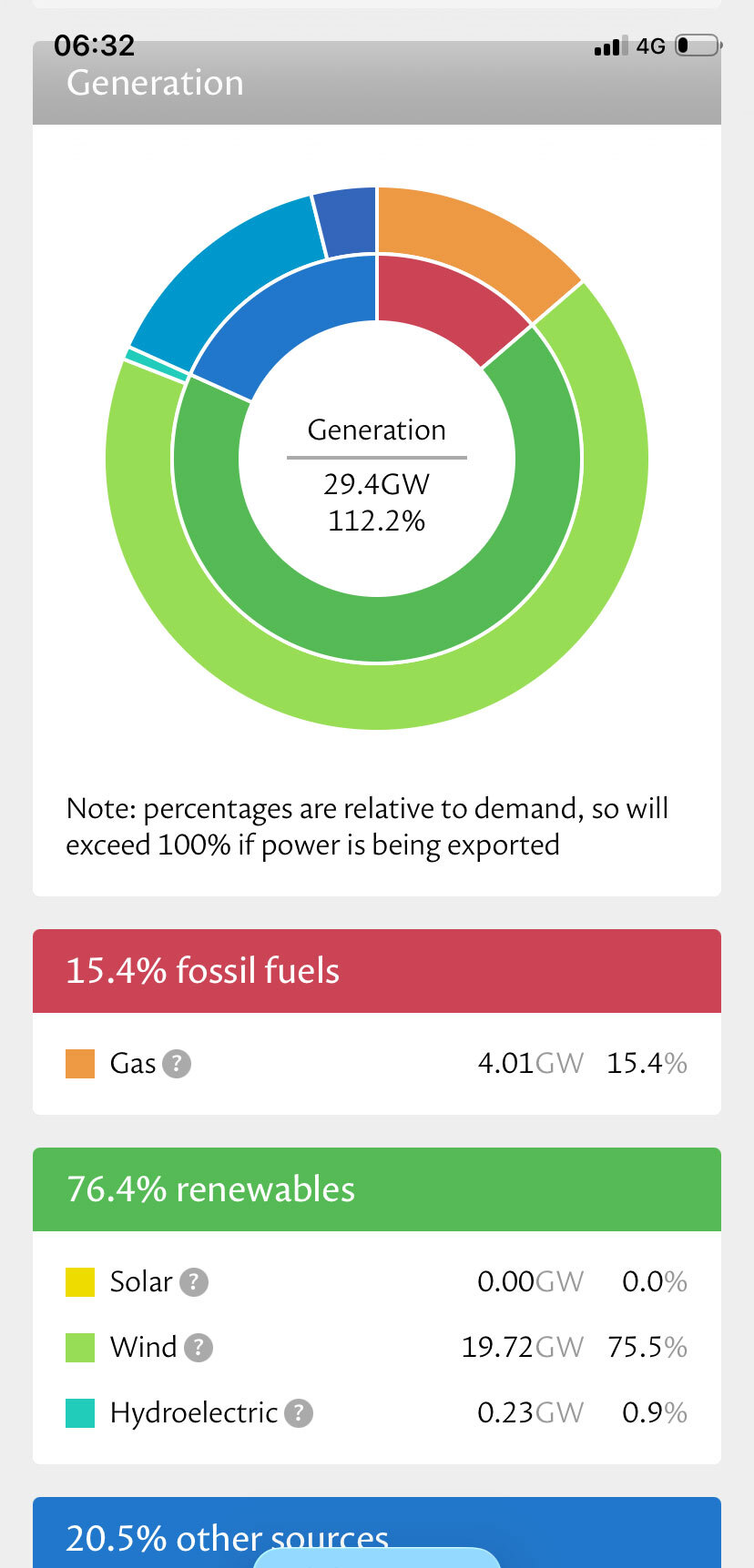
Well, Arthur, happy new year. Your reply to mike left no doubt about the reality of the situation in which we here in US find ourselves. And yes, we are already BEHIND. Such an eloquent and cogent explanation on this issue and the comparisons that you have made can leave little doubt for anyone seeking the truth. I am really impressed concerning progress being made in Norway, taking us well into the future. I have yet to see the video regarding Norway’s answer to the fossil fuel problem. I am anxious to check it out. How is the free transportation and unlimited fuel source for drivers to be paid for? Will it be similar to a collecting a toll for the use of conventional roads, here, for example?
Such an initiative would be terribly expensive here. It will be a long journey, but can we not begin before we become irrelevant and obsolete? The current administration is resisting this trend and actually support policies that hinder the necessary development even as we as a society attempt to take the baby steps.Happy New Year to you as well — and I’m glad the explanation helped.
Regarding Norway’s wireless charging roads, the key point is that the electricity isn’t “free” at all. The charging is wireless, but the billing works exactly the same as any other public EV‑charging system.
Each EV that uses the inductive road has a small receiver fitted underneath. That receiver has a unique ID, rather like a toll tag or fuel card. The coils in the road stay inactive until a registered vehicle is directly above them, and then the system transfers power wirelessly while the car is moving.
The energy transfer is metered automatically — the system knows which vehicle received how many kilowatt‑hours, and for how long. Drivers are then billed in one of two ways:
• Pay‑per‑kWh, just like plugging into a normal public charger
• Subscription model, which is what bus companies and delivery fleets tend to use
So there’s no “unlimited free fuel” and no taxpayer‑funded giveaway. The road operator builds and maintains the infrastructure, and the driver pays for the electricity they actually use, just as they would at a charging station. The only difference is that the charging happens dynamically while driving, instead of during a stop.
It’s a clever system — and very typically Norwegian in how seamlessly it integrates technology into everyday life.You’re absolutely right that the initial investment is substantial. Norway didn’t build this sort of infrastructure overnight, and the early pilot projects were expensive. But that’s true of every major shift in transport history. The first motorways, the first fibre‑optic networks, the first mobile‑phone towers — all of them looked costly at the start, and all of them became cheaper once the technology scaled.
What Norway (and Sweden, and now Italy) have shown is that the technology itself is no longer experimental. Dynamic charging already works in daily service for buses and freight vehicles, and the long‑term economics improve dramatically once you move from pilots to proper rollout. Costs fall, maintenance becomes routine, and the benefits stack up: fewer charging stations needed, smaller batteries in vehicles, and far less downtime.
The real question for the USA isn’t whether it’s expensive — it’s whether the country wants to lead the next generation of transport technology or wait until other nations set the standards and dominate the supply chains. Starting early doesn’t mean building everything at once; it means beginning with corridors, freight routes, and city pilots so the expertise and industry stay at home rather than being imported later at a premium.
Every country that’s ahead today started with “baby steps”. The difference is simply that they took them early.








Related Discussions
- 56

Infrastructure Bill Passed... Finally!
by Ken Burgess 4 years ago
Finally, the House Democrats were able to shove aside a few of their fringe extremists who were determined to hold the Bill hostage until they got every little whim they wanted... and with the help of a few moderate Republicans they pushed it across the finish line.Solar made it into the final cut,...
- 19

The Costs and Benefits of Solar Panels and Wall Battery
by Arthur Russ 4 years ago
Having just had solar panels and a wall battery installed I recently published an article about our experience on HubPages, but with the comments section no longer available, by popular demand I’ve created this forum.In summary:-The system we’ve had installed is 10 x 380w solar panels (5 panels...
- 11

Not A Problem Solver Biden Is A Problem Maker
by Sharlee 3 years ago
"Dealerships had a combined 92,000 unsold EVs sitting on their lots at the end of the second quarter, according to Kelley Blue Book data, more than four times the number a year ago. Moody said automakers are stockpiling EVs as they seek to capture a larger swath of U.S. motorists.Jul 24,...
- 55

Think your little electric car is gonna save the planet? Think again.
by tobey100 15 years ago
I've finally had my fill of people preaching electric vehicles (EVs) as the salvation of the world. It might make a body feel 'green' but it actually does nothing in terms of conservation or 'saving' the planet. But, of course, we all realize that the 'feeling' is everything. ...
- 38

What A Difference A Year Makes
by Sharlee 4 years ago
With prices surging worldwide for heating oil, natural gas, and other fuels, the U.S. government said Wednesday it expects households to see their heating bills jump as much as 54% compared to last winter. https://apnews.com/article/business-pri … e25dff1983Gas prices rising...
- 52

I'm going to be a ditzy teen girl for a moment....
by Shanna 14 years ago
I went out to start my car today and it wouldn't start. After eleven years, the battery finally died, and being the teen girl I am, I know very little about cars. I found a friend with jumper cables who's willing to give me a jump, but beyond that I'm not sure what to do. How long will the battery...